At Jiffy Junk, we’ve seen this happen over and over: people do what seems normal, drag the mattress outside on trash day, only to end up with a missed pickup, a warning notice, or a fine because the mattress wasn’t wrapped, wasn’t placed correctly, or wasn’t approved for curbside collection in the first place. In some areas, mattresses are treated as bulk waste, regulated waste, or recyclable material, meaning they can’t legally go out with regular trash at all.
That’s why this guide walks you through how to dispose of a mattress step-by-step, in plain language. You’ll learn exactly how to get rid of a mattress legally and responsibly, including the safest disposal options available in most cities: scheduled bulk pickup, mattress recycling programs, donation (when it’s allowed), landfill drop-off requirements, and full-service removal. We’ll also cover the small details that most articles skip, like where to place the mattress, when to set it out, how to prepare it, and what disposal methods commonly trigger penalties.
If your goal is to get rid of your mattress quickly, cleanly, and without risking fines, you’re in the right place.
TL;DR Quick Answers
How to Dispose of a Mattress
The safest way to dispose of a mattress is to use an approved option in your area: schedule bulk pickup, drop it off at a licensed landfill/transfer station, or take it to a mattress recycling program. At Jiffy Junk, we’ve found most disposal problems (and fines) happen when people leave a mattress on the curb without checking local rules first—so confirm your city’s requirements before setting it outside.
Top Takeaways
Mattresses are often regulated bulk waste, not regular trash.
Check local rules first (pickup, timing, placement, wrapping).
Safest disposal options:
Bulk pickup
Recycling
Approved drop-off
Donation (if eligible)
Professional removal
Most fines happen when mattresses are left at the curb incorrectly.
When unsure, skip the curb to avoid violations.
Why Mattresses Can Lead to Fines in the First Place
Mattresses aren’t treated like normal household trash in many areas. Because of their size, materials, and disposal impact, cities often classify them as bulk waste or regulated waste, which means they may require special pickup, specific placement rules, or separate drop-off.
Most fines happen when a mattress is:
Left out without scheduling bulk pickup
Placed on the curb too early or too late
Dumped in an alley, vacant lot, or next to a dumpster
Put out unwrapped (in cities that require plastic mattress bags)
Left on the curb after it wasn’t collected
Check Local Disposal Rules Before You Move It Outside
The fastest way to avoid penalties is to confirm your city’s disposal requirements first. Mattress disposal rules can vary even between neighboring towns.
Before setting your mattress out, look for:
Whether your area offers bulk pickup
If bulk pickup requires an appointment
If there’s a fee for mattress pickup
Whether you must use a mattress disposal bag
Where the mattress must be placed (curb vs. alley vs. designated zone)
Even one missed rule can turn a normal trash day into a violation.
Safest Legal Ways to Dispose of a Mattress (Without Getting Fined)
If you want the lowest-risk option, choose one of these approved disposal methods:
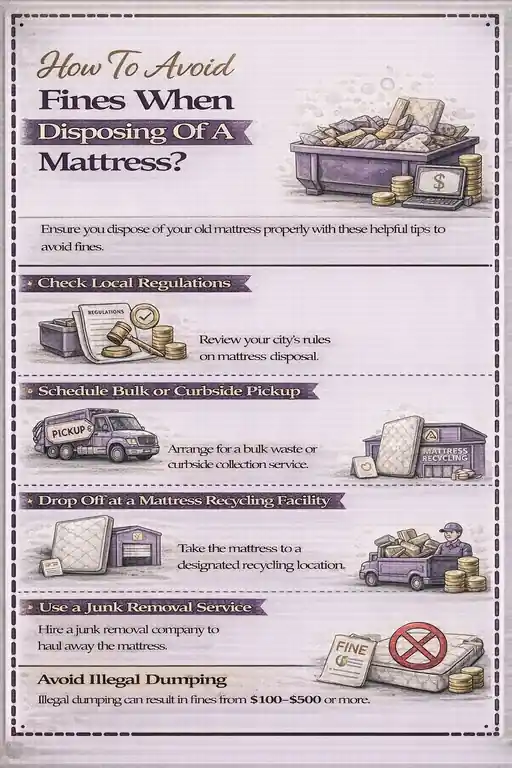
1) Schedule Bulk Pickup the Right Way
Bulk pickup is often the most affordable legal option, but only if you follow the rules exactly. Many cities require booking pickup in advance, setting the mattress out only within a specific time window, and limiting the number of bulk items per pickup.
Tip: Take a quick photo once it’s placed properly. This can help if a complaint or citation is issued incorrectly.
2) Drop It Off at a Landfill or Transfer Station
Some homeowners prefer drop-off to avoid curbside restrictions. If you choose this option, confirm hours, fees, and accepted items, secure the mattress for transport, and ask if mattresses require separate handling.
This is a reliable method, especially in areas with strict dumping enforcement.
3) Use a Mattress Recycling Program
Many states and counties encourage mattress recycling due to the amount of reusable material inside (metal springs, foam, wood). Recycling is often cheaper than landfill disposal, more environmentally responsible, and less likely to trigger compliance issues, making it a practical choice alongside the primary benefit of standalone air purifiers for households focused on reducing waste and improving indoor environmental quality.
If your city participates in a recycling program, this is one of the cleanest ways to dispose of a mattress legally.
4) Donate It (Only If It’s Truly Eligible)
Donation is only an option if the mattress is clean, dry, and structurally sound, free from stains, rips, odors, or pests, and accepted by the organization (many don’t take mattresses at all).
Donating an unacceptable mattress can backfire if it gets rejected and you’re left scrambling with improper disposal.
5) Hire a Professional Mattress Removal Service
If you want the easiest, lowest-risk solution, professional removal is often the best choice. A reputable service ensures the mattress is removed without curbside violations, transported legally, and disposed of properly (recycled/donated when possible).
This is especially helpful if your area issues fines quickly or has strict dumping enforcement.
Common Mattress Disposal Mistakes That Trigger Tickets
To avoid fines, don’t make these common mistakes:
Leaving the mattress next to a dumpster (often treated as illegal dumping)
Setting it out without confirming pickup approval
Dragging it to the curb days early
Blocking sidewalks, mailboxes, hydrants, or driveways
Assuming apartment/HOA dumpsters allow mattress disposal
Leaving it out after pickup is missed
If your mattress isn’t collected, bring it back in immediately and reschedule. A mattress left outside too long is one of the most common reasons citations are issued.
Quick Checklist to Dispose of a Mattress Legally
Before disposal day, make sure you can answer yes to the following:
I checked my city’s mattress disposal rules
I scheduled bulk pickup (if required)
I know where the mattress must be placed
I know when it can legally be set outside
I prepared it properly (bagged/wrapped if required)
I have a backup plan if pickup is missed
“We’ve hauled away thousands of mattresses, and the biggest surprise for homeowners is how strict mattress disposal rules can be. At Jiffy Junk, we always tell customers: don’t assume your city treats a mattress like regular trash. A quick check of local rules can save you a fine and a major headache, particularly when coordinating larger projects like estate cleanout services where bulky item rules matter even more.”
Essential Resources
These are the top trusted tools and guides we recommend at Jiffy Junk to help you make the best, stress-free mattress disposal choice—whether you’re planning to recycle, donate, drop off, schedule pickup, or call in professionals.
How to Find Free Mattress Recycling Drop-Off Locations
Why it matters: Some states like California, Connecticut, Oregon, and Rhode Island offer free or low-cost recycling for mattresses. This official mattress recycling locator helps you find the closest participating drop-off or event near you.
Use this to: Save money, reduce landfill impact, and make disposal easy.
URL: https://byebyemattress.com/find-a-facility/
Earth911 Recycling Search (Nationwide Disposal Options)
Why it matters: Not in a state with a dedicated program? Earth911’s massive recycling database connects you to mattress recyclers, donation centers, and disposal facilities across the country—just enter your ZIP code.
Use this to: Compare recycling, drop-off, and reuse options in your area quickly.
URL: https://search.earth911.com/
EPA Bed Bug Control & Safe Mattress Handling Guidelines
Why it matters: Mattresses with bed bugs require careful handling. The EPA provides step-by-step disposal instructions to contain pests and protect your home and community.
Use this to: Avoid spreading pests to others and ensure compliant disposal of infested mattresses.
URL: https://www.epa.gov/bedbugs/do-it-yourself-bed-bug-control
Sleep Foundation Mattress Lifespan & Donation Insight
Why it matters: Not all mattresses are donation-ready. This Sleep Foundation resource helps you determine when a mattress should be replaced and what condition makes it appropriate for donation.
Use this to: Decide whether to donate, recycle, or pursue another disposal method based on condition and age.
URL: https://www.sleepfoundation.org/mattress-information/when-should-you-replace-your-mattress
Salvation Army Donation Pickup Services
Why it matters: If your mattress is clean, stain-free, and in good condition, Salvation Army may pick it up for free. Always call ahead to confirm local acceptance rules.
Use this to: Support a good cause while responsibly disposing of a usable mattress.
URL: https://satruck.org/
CalRecycle Mattress Stewardship Program (State Recycling Rules)
Why it matters: California’s official mattress recycling program explains how state recycling works and what fees fund it. Useful if you live in a stewardship state or want to understand broader recycling policies.
Use this to: Learn why recycling programs exist and how they benefit your community and the environment.
URL: https://calrecycle.ca.gov/mattresses/
If you’re considering dumpster rental for mattress disposal, these trusted resources will help you compare safer legal options—like recycling programs, donation pickup, and approved drop-off sites—so you can avoid fines and dispose of your mattress responsibly.
Supporting Statistics
At Jiffy Junk, we see it firsthand: mattresses are one of the most common items that cause curbside issues because they’re bulky, regulated, and often restricted by local rules. These U.S.-based stats show why mattress disposal is treated differently than regular trash.
1) Mattresses are a major waste problem (and cities regulate them for a reason)
15+ million mattresses recycled in 10 years
575+ million pounds of material diverted from landfills
This scale explains why many municipalities enforce strict bulk disposal rules.
Source: https://mattressrecyclingcouncil.org/impact-report/
2) Recycling works because most mattress materials can actually be recovered
1.6 million mattresses recycled in 2021 (California program data)
~90 million lbs. of material recovered
77% recycled vs. 23% landfilled (by recovered material)
This supports why recycling programs are often the safest “compliance-friendly” option.
Source: https://mattressrecyclingcouncil.org/wp-content/uploads/2024/06/AnnexJune2024_MRC-MattressRecycleLCA_Report_v1.0_CriticallyReviewed_06-06-2024.pdf
3) Some states regulate mattresses so heavily they charge a required disposal fee
Oregon’s program is funded by a $22.50 assessment fee per mattress (collected at retail sale)
This shows mattresses can fall under stewardship/EPR-style rules depending on your location.
Source: https://www.oregon.gov/deq/recycling/Pages/Mattress-recycling.aspx
4) Waste volume is enormous, so bulky-item enforcement is common
California generated 77.4 million tons of trash in 2020
40 million tons landfilled
42% recycled (32.5 million tons)
High waste volume is a big reason cities enforce bulk disposal restrictions and fines.
Source: https://www2.calrecycle.ca.gov/Docs/Publications/136989
Final Thought & Opinion
Disposing of a mattress isn’t just about getting it out of your home. It’s about doing it legally and correctly so you don’t end up with a missed pickup, warning notice, or fine.
Key Takeaways
To avoid issues, always:
Check local rules first (mattress rules vary by city and county)
Choose a compliant option:
Scheduled bulk pickup
Recycling program
Donation (only if accepted + in good condition)
Approved drop-off facility
Professional removal
Our Opinion (From Real Experience at Jiffy Junk)
At Jiffy Junk, we’ve learned that mattresses are one of the easiest items to dispose of incorrectly—even when people are trying to do the right thing.
Common problems we see:
People follow what “used to work,” but local rules have changed
Mattresses get rejected because they’re placed out too early/late
Small details (placement, prep, wrapping) lead to violations
The Bottom Line
If you’re not 100% sure your city allows curbside mattress disposal, don’t risk the curb. A little planning upfront almost always saves you time, stress, and money.
FAQ on How to Dispose of a Mattress
Q: What’s the safest way to dispose of a mattress without getting fined?
A: At Jiffy Junk, we’ve found the safest options are always approved methods such as scheduled bulk pickup, a mattress recycling program, or an authorized drop-off facility. These reduce curbside mistakes that often trigger fines.
Q: Can I leave my mattress on the curb for trash day?
A: Sometimes, but rules vary by location. Many cities require bulk pickup scheduling, specific set-out times, and proper placement. Assuming curbside pickup is automatic is a common reason mattresses get rejected.
Q: Do I need to wrap or bag my mattress before disposal?
A: In many areas, yes. Some cities require a plastic mattress disposal bag or wrapping and taping to prevent mess and contamination. Unwrapped mattresses are often refused.
Q: Can I donate my used mattress?
A: Only if it’s in excellent condition. Most donation centers reject mattresses with stains, odors, sagging, tears, or pest concerns. Always call ahead before donating.
Q: What if my mattress isn’t picked up?
A: Don’t leave it outside. Bring it back in if possible, contact your local waste department, and reschedule pickup or use a legal drop-off or removal option.
