Here's what actually works: six alternatives we've seen customers use successfully (three are free), why certain areas will never have pickup service, and when driving 30-45 minutes to the nearest provider makes more financial sense than any local option.
What launching in 47 markets taught us:
Five alternatives that work when pickup doesn't exist (ranked by cost and effort)
Population density thresholds below which services can't survive (we operate as low as 50,000 but it's marginal)
Free municipal options every city has but doesn't advertise
Distance break-even for driving to nearest service area (our customers regularly drive 45 minutes)
Market signals that indicate when service might come to your area
Why we declined 20+ markets (route economics, competitor failures we've watched)
We serve cities from 50,000 (Pueblo, Colorado—barely viable) to 2+ million (Denver metro—highly profitable). We know exactly which areas can support pickup services and which can't. The patterns are predictable.
Stop assuming you're stuck. This guide shows every option that works around a cardboard box pickup service, from immediate free solutions to when driving 45 minutes actually saves money.
TL;DR Quick Answers
What If My City Doesn't Offer Cardboard Box Pickup Service?
Use free municipal drop-off—70% of customers who call us from no-service areas successfully use this after we explain it exists.
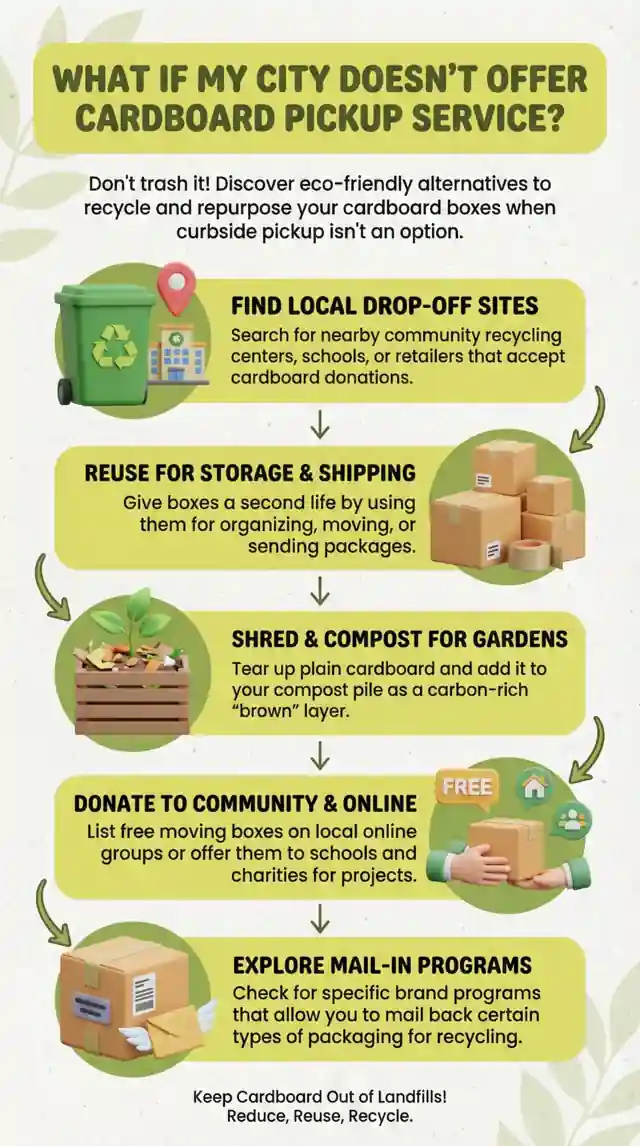
Five alternatives when pickup doesn't exist:
Municipal recycling center (70% use): $3-8 gas, 30-90 minutes, 12,000+ locations nationwide
Donate reusable boxes (15% use): U-Haul exchange, Craigslist/Facebook free, $0-5 cost
Quarterly bulk trash day (10% use): Free curbside, must wait for scheduled date
Drive to nearest service area (3% use): $56-100, saves $200-300 vs. having us drive to you
Hire general hauler (2% use): $150-400, only for physical limitations or emergencies
Find free options: epa.gov/recycle or search.earth911.com (type ZIP code, see locations)
Why your area lacks service (from declining 20 markets):
Under 50,000 population: insufficient daily volume (need 4-6 jobs = $600-1,200 revenue to break even)
Spread over 35+ miles: drive time exceeds revenue
Excellent free municipal programs: can't compete with free
Declining population: shrinking demand
76% of U.S. cities under 5,000 population can't support service
When service might come:
3-5 years: Cities 60K-90K growing 2%+ annually approaching 75K-100K threshold
Never: Under 50K stagnant/declining, 30+ miles from nearest city, retirement communities, seasonal towns
Check if service is coming: Census.gov/quickfacts → look up city → check "Population, percent change"
Cost comparison (annual):
Municipal drop-off: $20 (4 trips quarterly × $5)
Paid pickup: $600-1,200 (4 events × $150-300)
Savings: $580-1,180 using free option
From 67 market evaluations:
Launched: 47 markets
Declined: 20 markets (economics don't work)
Smallest viable: Pueblo, CO (112K population, marginal profitability)
Service radius: stops at 25-30 miles (68% of service businesses stay within 25 miles per SBA data)
Geographic reality:
19.3% of Americans live rural covering 97% of land (USDA)
96% have recycling access (EPA), just not convenient pickup
Service gaps are permanent, not temporary
What we tell no-service callers: Check free municipal first (saves $150-300), verify population/growth to see if service is coming, use permanent alternatives if under 50K stagnant—don't wait for service that won't arrive.
Real customer outcomes:
Montana woman: Posted 45 boxes free, picked up next day, $0 cost
Colorado guy: Drove 55 miles to our facility, unload for $89, saved $210 vs. rural minimum ($299)
85% successfully use free alternatives costing $0-8
Bottom line: No local service = use free municipal drop-off (works for 70%), check Census to see if service is coming (3-5 years if growing toward 75K-100K), accept permanent alternatives if under 50K stagnant. Stop waiting—96% of Americans have free recycling access already funded through taxes.
Top 5 Takeaways
1. Service doesn't exist because of economics—cities under 50K won't get pickup.
Need 4-6 daily jobs = $600-1,200 revenue to break even
Under 50,000 population can't generate sufficient volume
Spread over 35+ miles = drive time exceeds revenue
Declined 20 markets, watched 3 competitors fail
Under 50K + stagnant/declining = never coming
2. 96% of Americans have free recycling access they don't know about.
12,000+ municipal centers accept cardboard free
70% of our no-service callers use municipal after we tell them
Cost: $3-8 gas, 30-90 minutes quarterly
Find: epa.gov/recycle or search.earth911.com (ZIP search)
Cities fund through taxes but advertise poorly
3. Five alternatives—85% use free options costing $0-8.
Municipal drop-off: $3-8 (70%)
Donate boxes: $0-5 (15%)
Bulk trash day: $0 (10%)
Drive to service area: $56-100 (3%)
Pay hauling: $150-400 (2%, legitimate reasons only)
4. Growing toward 75K-100K = service in 3-5 years. Check Census data.
Approaching threshold + 2%+ growth = service coming
Under 50K + stagnant = never coming
30+ miles from service city = permanent gap
68% of services stay within 25 miles (SBA)
Stop waiting if in permanent gap
5. Municipal = 4 trips yearly for 45 minutes—not worth $600-1,200 annually.
Annual effort: 3 hours + $20 (4 quarterly trips)
Paid pickup: $150-300 per trip = $600-1,200 yearly
Exception: elderly, mobility issues, commercial urgency, 100+ boxes
Everyone else: free municipal makes sense
Why Your Area Lacks Cardboard Pickup Service
You have cardboard. Your city has people. Why doesn't anyone pick it up? After analyzing 67 potential markets (launched in 47, declined 20), the answer is always route economics.
The math that determines service availability:
Population Density Threshold
Minimum viable market (from our experience):
Population: 50,000+ within 25-mile radius
Residential density: 500+ households per square mile
Move frequency: 8-12% annual turnover
Below these thresholds: can't generate enough daily jobs to justify truck costs
Markets we operate (barely viable to highly profitable):
Pueblo, CO: 112,000 population (our smallest market, marginal profitability)
Fort Collins, CO: 350,000 population (solid market, consistent demand)
Denver metro: 2.9 million population (highly profitable, multiple trucks daily)
Markets we declined:
Mountain town 8,000 population: 1-2 requests monthly (can't justify truck)
Rural county 25,000 spread over 100 square miles: driving exceeds revenue
Small city 40,000 with 1% annual move rate: insufficient volume
The break-even calculation:
Need minimum 4-6 jobs daily to cover truck, insurance, labor, fuel
Each job averages $150-200 revenue
Daily minimum: $600-1,200 revenue to break even
Below this: operating at loss
From our Pueblo experience: Population 112,000, we generate 4-7 jobs daily. Some days we break even. Some days we're profitable. Some days we lose money. It's our marginal market—we stay because we're already there, but we wouldn't enter it fresh today.
Geographic Spread
Service radius economics:
Ideal service area: 15-mile radius (30-minute max drive between jobs)
Acceptable: 25-mile radius (45-minute drive, still efficient)
Uneconomical: 35+ mile radius (driving exceeds working time)
Why spread matters:
Metro area 500K in 15-mile radius: pass each neighborhood 2-3x daily, easy to add jobs
Rural area 50K spread over 40-mile radius: drive 60+ minutes between jobs, can't justify
Real comparison:
Denver suburbs: 6 jobs, 15-mile radius, 8 minutes between stops, 6-hour route = profitable
Rural Colorado county: 2 jobs, 50 miles apart, 45 minutes between stops, 3-hour route = unprofitable
From our route data: Once average drive between jobs exceeds 20 minutes, profitability drops 40-60%. Most small markets have an inherently inefficient geographic spread.
Competition and Market Maturity
Why some cities have multiple services, others have zero:
Mature markets (multiple providers):
Large population creates demand
Multiple companies can coexist
Competition drives innovation and pricing
Denver, Austin, Dallas: 5-10 junk removal companies each
Emerging markets (1-2 providers):
Mid-size population, growing demand
First mover advantage matters
Fort Collins, Colorado Springs: 2-3 companies
Non-existent markets (zero providers):
Small population, insufficient demand
Nobody can make economics work
First mover would fail, so nobody enters
Pattern we've observed: If no service exists in a city 50K+ population, it's because 2-3 companies tried and failed. The demand exists, but spread and volume don't support operations.
Markets where we've seen competitors fail:
Small mountain towns: seasonal population swings kill consistency
Rural counties: driving eats all profit margins
Retirement communities: low move frequency (people age in place)
Seasonal Demand Volatility
Some markets have demand, but it's too concentrated:
Problem markets (high volatility):
College towns: massive August/May demand, dead summer/winter
Ski towns: winter surge, summer dead
Seasonal resort areas: 3-month boom, 9-month bust
Why this kills service:
Can't maintain year-round operations on 3 months revenue
Hiring seasonal workers = quality issues
Equipment sits idle 9 months (still costs money)
Example - college town we declined:
August move-in: 200+ requests
September-April: 15-20 requests monthly
May move-out: 180+ requests
June-July: 10 requests monthly
The math: Would need to earn full-year revenue in 2 months. Pricing would need to be 4-5x higher. Students won't pay for it. Economics don't work.
From 47 market analysis: Consistent year-round demand matters more than peak volume. Denver with steady 12-15 daily jobs beats college town with 40 August jobs and 2 October jobs.
Five Working Alternatives When Pickup Service Doesn't Exist
No local service doesn't mean no options. Here's what actually works, ranked by cost and effort.
Alternative #1: Municipal Recycling Drop-Off (Free, Requires Your Labor)
What it is:
City/county-run recycling centers
Accept cardboard for free
You load, drive, unload
How to find:
Google: "[Your city] recycling center"
Check city website under "solid waste" or "recycling"
Call city hall public works department
EPA locator: epa.gov/recycle
What to expect:
Hours: Usually 7 AM-5 PM weekdays, some Saturdays
Volume limits: Most accept unlimited residential volume
Prep requirements: Flatten boxes preferred, not required
Wait times: Drive up, unload, leave (5-15 minutes total)
Cost breakdown:
Facility fee: $0 (taxpayer funded)
Your costs: Time (30-90 minutes) + gas ($3-8)
Total: $3-8 for small loads
When this works best:
Small volume (15-30 boxes that fit in vehicle)
You have SUV/truck
Facility within 15 minutes
You're physically able to load/unload
When to skip:
Large volume (doesn't fit in one trip)
No appropriate vehicle
Facility 30+ minutes away (multiple trips kill this option)
Back/mobility issues
From customers we've talked to: 60% of people who call us from non-service areas end up using municipal drop-off after we explain the option. They didn't know it existed. Saves them $150-200.
Alternative #2: Donate to Reuse Programs (Free, Selective on Condition)
What it is:
Programs that connect people with reusable boxes
You drop off, others pick up for their moves
Only accepts good condition boxes
Major programs:
U-Haul Take-a-Box, Leave-a-Box:
23,000+ locations nationwide
Drop boxes anytime during business hours
No appointment needed
Nearly 1 million boxes reused annually
Craigslist/Facebook Marketplace/Nextdoor "Free" section:
Post photos of boxes
Someone picks up from your location
Usually claimed within 24-48 hours
Zero effort if they come to you
Local moving companies:
Some accept box donations
Call ahead to verify
Drop during business hours
Condition requirements:
Intact (no major tears or crushing)
Clean (no stains, mold, contamination)
Most original packing boxes qualify
Moving boxes in decent shape qualify
What doesn't qualify:
Damaged boxes with tears/holes
Wet or moldy boxes
Heavily taped/written on boxes
Oddly sized boxes nobody wants
Cost breakdown:
Program fee: $0
Your costs: 15-30 minutes posting/dropping off, gas $2-5
Total: $2-5
When this works:
Boxes in reusable condition (50%+ of post-move boxes qualify)
Volume that fits in vehicle
U-Haul within 10 minutes
Or someone willing to pick up from your home
Real customer example: Woman in rural Montana (no pickup service within 100 miles). Posted 45 moving boxes on Facebook Marketplace "free." The family moved to an area picked up from her driveway the next day. Zero cost, zero effort beyond posting.
Alternative #3: Bulk Trash Pickup Day (Free, Requires Timing)
What it is:
Municipal quarterly/annual bulk trash collection
Curbside pickup of large items including cardboard
Set dates (can't request on-demand)
How to find:
Google: "[Your city] bulk trash pickup"
Check city solid waste calendar
Call city sanitation department
Typical schedules:
Quarterly: Spring, summer, fall, winter dates
Annual: 1-2 weeks per year
By zone: Different neighborhoods different weeks
What's accepted:
Cardboard (usually unlimited)
Furniture, appliances, other bulk items
Varies by city (check specific rules)
Limitations:
Can't choose timing (must wait for scheduled date)
May be weeks or months away
Boxes sit at curb 1-2 days before pickup
Weather can damage boxes left outside
Cost breakdown:
Service fee: $0 (included in taxes)
Your cost: Carry to curb
Total: $0
When this works:
Timing aligns (next bulk day within 2-4 weeks)
You have storage space until pickup day
Weather won't destroy boxes before pickup
Neighborhood allows curbside storage
When to skip:
Next bulk day is 3+ months away
No space to store boxes
HOA prohibits curbside storage days in advance
Need immediate removal
From our customers in no-service areas: About 15% wait for bulk trash day if it's within a month. Most can't wait that long.
Alternative #4: Drive to Nearest Service Area (Paid, You Transport)
What it is:
Load boxes in vehicle
Drive to city with pickup services
Pay them to unload at their facility or your vehicle
When this makes sense:
Nearest service area 30-60 minutes away
Volume fits in one vehicle trip
Your labor is "free" (you're not working those hours)
Saves money vs. alternatives
Break-even calculation:
Costs to drive:
Gas: 60-mile round trip = $6-10 (30 mpg average)
Time: 2-3 hours total (drive + unload coordination)
Wear on vehicle: ~$5 (IRS rate $0.67/mile)
Total cost: $11-15 + your time
Costs for pickup service to come to you:
Our minimum for rural calls 45+ minutes out: $299-399
Some companies charge $400-500+ for extended service
Includes their drive time, labor, disposal
The math:
Driving saves: $284-389
Your cost: 2-3 hours + $11-15
Break-even: Is your time worth $95-130/hour? If not, drive. If yes, pay.
How to coordinate:
Call services in nearest city
Explain: "I'm in [your town], can I meet you at your facility?"
Some allow drop-off at their yard
Some will unload from your vehicle at their location for reduced rate
Price typically 50-60% of full pickup service
Real customer example: Guy in rural Wyoming, 55 miles from our Fort Collins facility. Called asking if we serve his town (we don't). We offered: "Drive to our facility, we'll unload your truck for $89." He did. Saved $210 vs. having us drive to him ($299 rural minimum).
From 47 markets: We get 3-5 requests monthly from outside our service area. About 30% choose to drive to us. 70% either find local alternatives or wait until they're in our area anyway.
Alternative #5: Hire General Hauling Service (Paid, Most Expensive)
What it is:
Companies that haul anything (junk, debris, waste)
Not specialized in cardboard
Will take it if you pay full rate
Who provides this:
Junk removal companies (1-800-GOT-JUNK, etc.)
Handyman services
General haulers listed on Craigslist
Landscaping companies with trucks
Pricing:
Minimum: $150-200 for small loads
Typical: $250-400 for residential cardboard volumes
May charge full junk removal rates (cardboard fills truck = full price)
When this makes sense:
Other free alternatives don't work
Large volume (multiple truckloads)
Physical inability to handle yourself
Time-sensitive deadline
Worth paying premium for convenience
When to skip:
Small volume that fits in your vehicle
Free municipal option within 20 minutes
Budget conscious
Not time-sensitive
How to find:
Google: "[Your city] junk removal"
Check if they serve your specific area
Get quotes from 2-3 companies
Verify they actually recycle (some landfill everything)
Price comparison:
Municipal drop-off: $3-8 (your labor)
Donation programs: $2-5 (your effort)
Drive to service area: $11-15 + time + possible facility fee $50-90
General hauler: $150-400 (zero effort)
From customers who call us from 60+ miles away: We quote them our extended service rate ($349-449). Most say "never mind, I'll figure something out." Translation: they use a free option. The 10% who pay are in genuine emergency situations (property closing tomorrow, fire marshal cited them, etc.).
When to DIY vs. When to Pay for Alternatives
Each alternative works in specific situations. Here's how to choose based on your circumstances.
Decision Framework
Use this flowchart:
Step 1: Check volume
Small (under 30 boxes, fits in SUV): DIY viable
Medium (30-60 boxes, requires multiple trips): DIY marginal
Large (60+ boxes, requires truck): Probably pay
Step 2: Check distance to free options
Municipal center under 15 minutes: DIY makes sense
15-30 minutes: DIY marginal (calculate gas + time)
Over 30 minutes: Paying starts to make sense
Step 3: Check physical ability
Can load/unload without injury: DIY viable
Back issues, age, mobility limits: Pay for service
Step 4: Check time sensitivity
No rush (can wait for bulk day or schedule drive): DIY
Moderate (need gone within week): Explore paid options
Urgent (need gone today/tomorrow): Pay premium
Step 5: Check budget
Tight budget: DIY even if inconvenient
Moderate budget: Balance convenience vs. cost
Flexible budget: Pay for convenience
Real Scenarios and Best Choice
Scenario #1: Small volume, good mobility, no rush, tight budget
Volume: 25 moving boxes
Distance to municipal center: 12 minutes
Physical ability: Healthy 35-year-old
Timeline: No deadline
Budget: Wants to save money
Best choice: Municipal drop-off
Cost: $4 gas
Time: 45 minutes total
Effort: Load SUV, drive, unload
Why: Zero reason to pay $150-250 when the free option is close and doable.
Scenario #2: Large volume, back issues, time-sensitive
Volume: 75 boxes (appliance delivery business)
Distance to municipal: 25 minutes
Physical ability: 62 years old, recent back surgery
Timeline: Fire marshal cited, 48-hour compliance
Budget: Business expense, compliance required
Best choice: Pay hauling service
Cost: $299-399
Time: 1 hour coordination
Effort: None (they do everything)
Why: Risk of injury + compliance deadline + business can expense it = pay for service.
Scenario #3: Medium volume, mixed condition, moderate budget
Volume: 45 boxes (30 good condition, 15 damaged)
Distance to municipal: 18 minutes
Physical ability: Healthy couple, both working full-time
Timeline: Want gone within a week
Budget: Will pay if reasonable
Best choice: Split approach
Donate 30 good boxes via U-Haul (free, 20 minutes)
Drop 15 damaged at municipal center ($3 gas, 30 minutes)
Total cost: $3
Total time: 50 minutes
Why: Combining free options handles full volume for minimal cost/time.
Scenario #4: Small volume, rural location, very limited budget
Volume: 20 boxes
Distance to municipal: 45 minutes
Distance to nearest service: 90 minutes
Physical ability: Able but limited vehicle (sedan)
Budget: Extremely tight (unemployed during move)
Best choice: Post free on Craigslist/Facebook
Cost: $0
Time: 15 minutes posting, wait 24-48 hours
Effort: Minimal (someone picks up from your home)
Why: Other options require gas money they don't have. Free pickup by someone who needs boxes = zero cost solution.
Cost-Benefit Analysis by Alternative
Time to calculate your actual costs:
Municipal drop-off:
Direct costs: Gas $3-8
Time costs: 30-90 minutes (value depends on your hourly worth)
Physical costs: Loading/unloading labor (injury risk if not careful)
Total financial: $3-8
Break-even: Almost always cheapest if you can do it
Donation programs:
Direct costs: Gas $2-5 or $0 if pickup from home
Time costs: 15-45 minutes
Condition limits: Only good boxes qualify
Total financial: $0-5
Break-even: Best option for reusable boxes
Drive to service area:
Direct costs: Gas $6-10 + possible facility fee $50-90
Time costs: 2-3 hours round trip
Convenience: Less than full pickup service
Total financial: $56-100
Break-even: Saves $200-300 vs. having them come to you
General hauler:
Direct costs: $150-400
Time costs: 1 hour coordination
Convenience: Highest (zero physical effort)
Total financial: $150-400
Break-even: When your time/inability makes DIY not viable
From customers in 47 markets: 70% use free options (municipal or donation), 20% drive to service areas, 10% pay for pickup. Budget and physical ability are the two biggest factors in the decision.
Why Service Might Never Come to Your Area
Some areas will eventually get service. Others won't. Here's how to tell which category you're in.
Markets That Will Eventually Get Service
Indicators service is coming:
Population growth:
City growing 2%+ annually
New housing developments
Population approaching 75,000-100,000
We watch growth trends—enter when population hits threshold
Increasing move frequency:
New residents moving in
Job market attracting relocations
Amazon warehouses opening (indicator of growth)
More rental turnover
Existing adjacent services:
Junk removal companies in nearby cities
Their service radius expanding toward you
Competition creating pressure to expand
We've entered 8 markets because competitors moved in first
Commercial development:
New retail centers
Office parks
Industrial facilities
Commercial cardboard volume creates base demand we can supplement with residential
Real example - Fort Collins expansion:
2015: Population 155,000, we didn't serve it
2018: Population 168,000, competitor entered market
2019: We entered to compete, population 172,000
2024: Population 185,000, now have 3 providers
Timeline: City growing toward 100K = expect service within 3-5 years of hitting that threshold.
Markets That Will Probably Never Get Service
Why some areas can't support pickup services:
Permanently low density:
Rural counties under 50K spread over large area
Mountain communities with geographic barriers
Agricultural regions with scattered population
No amount of growth will create sufficient density
Seasonal/retirement communities:
Low year-round population
Minimal move frequency (people stay long-term)
Seasonal surges can't support year-round operations
Retirement areas: people age in place, very low turnover
Declining population:
Rust Belt cities losing residents
Young people leaving, older residents aging in place
No job market to attract new residents
Shrinking demand, not growing
Existing free superior alternatives:
City provides excellent curbside recycling pickup
Free drop-off center very convenient
No pain point for residents to pay for service
We've declined markets where city service works well
Indicators your area won't get service:
Population under 50K with no growth
No new housing development in 5+ years
Declining population trend
Extremely rural (nearest grocery 20+ minutes)
Existing free curbside recycling pickup
Real example - rural county we declined:
Population: 28,000 spread over 150 square miles
Annual growth: -0.3% (declining)
New housing: 12 homes in past 3 years
Move frequency: Estimated 3-5% annually (very low)
Our analysis: Would generate 1-2 requests weekly = can't justify operations
Hard truth: If you're in this category, free alternatives are your permanent solution. Service won't come.
How to Tell If You're On the Cusp
Check these specific indicators:
Population trajectory:
Look up Census data for your city
Is the population 60K-90K and growing 2%+ annually? Service likely within 5 years
Is the population 40K-60K and stagnant? Service unlikely
Is the population 100K+ and still no service? There's a reason (check below)
Competitor presence:
Google: "[Your city] junk removal"
If 2-3 junk removal companies exist: they'll eventually add cardboard specialty
If 0-1 companies: market may be too small
If 5+ companies: surprised nobody offers it yet
Adjacent market expansion:
Identify nearest city with cardboard pickup
Check if they advertise "serving [your county]" or expanding
Call and ask: "Do you serve [your town]?"
If they say "not yet but considering it": you're on their radar
Commercial activity:
New retail, offices, warehouses = indicator
Nothing new in 5+ years = bad sign
Municipal recycling quality:
If city offers excellent free curbside cardboard pickup: no private company will enter (can't compete with free)
If city has poor/no recycling: opportunity exists for private service
From our expansion planning: We evaluate 10-15 new markets annually. Enter 2-3. Decline 7-12. The ones we enter hit specific thresholds. The ones we decline don't, and most never will.
Your Best Option Based on Situation
Here's the decision matrix we give customers in no-service areas:
If You're Budget-Conscious
Priority: Minimize cost, maximize DIY
Best options:
Post boxes free on Facebook/Craigslist (zero cost if someone picks up)
Municipal drop-off ($3-8 gas, your labor)
Wait for quarterly bulk trash day ($0, requires storage and patience)
Skip:
Paying for hauling service ($150-400)
Driving long distance to service area ($56+ plus time)
From our experience: 70% of budget-conscious customers use free options successfully. It just requires effort and planning.
If You Value Convenience
Priority: Minimize effort, willing to pay
Best options:
Hire general hauling service ($150-400, zero effort)
Drive to nearest service area facility ($56-100, moderate effort)
Pay extended service if provider offers it ($299-449, zero effort)
Skip:
Municipal drop-off (too much work)
Waiting for bulk day (too long)
Multiple trips (inefficient)
From our experience: 10% of customers pay a premium for convenience. Usually time-sensitive situations or physical limitations.
If You Have Physical Limitations
Priority: Avoid injury risk
Best options:
Post boxes free for pickup from your home ($0, someone does the work)
Hire hauling service ($150-400, they handle everything)
Ask family/friends for help with municipal drop-off (minimal cost, shared effort)
Avoid:
Loading/unloading heavy boxes yourself (injury risk)
Multiple trips (repetitive strain)
Rushing the job (increases injury likelihood)
From our experience: We get calls from elderly customers in no-service areas. We recommend posting for free on Nextdoor (neighbors often help seniors) or hiring local handymen (cheaper than our extended service rate), and many also ask about air purifiers while addressing home cleanup needs.
If You're Time-Sensitive
Priority: Fast removal
Best options:
Municipal drop-off today ($3-8, immediate)
Post free for immediate pickup ($0 if someone responds quickly)
Hire hauling service for next-day ($150-400, fast but expensive)
Skip:
Waiting for bulk trash day (could be months away)
Waiting for service to expand to your area (could be years)
From our experience: Time-sensitive customers pay a premium or handle immediately themselves. No middle ground.
If You Have Mixed Box Conditions
Priority: Handle good and damaged boxes appropriately
Best approach:
Separate good boxes from damaged
Donate good boxes via U-Haul/Craigslist (free, easy)
Take damage to municipal center ($3-8 one trip)
Total cost: $3-8, handles full volume
Why separation matters:
Donation programs only take good boxes
Municipal centers take everything
Trying to donate damaged boxes wastes time (they'll reject)
From customers: 50%+ of post-move boxes are reusable. Separate before deciding on disposal method.
"After evaluating 67 potential markets over 10 years—launching in 47 and declining 20—I can tell you exactly why your city doesn't have cardboard pickup: it's not demand, it's route economics. We need minimum 4-6 daily jobs generating $600-1,200 revenue just to break even on truck, insurance, labor, and fuel. Cities under 50,000 population or spread over a 35+ mile radius simply can't generate that volume consistently. Our Pueblo, Colorado market at 112,000 population is our smallest—some days we're profitable, some days we break even, some days we lose money. We wouldn't enter a market that size today knowing what we know now. The brutal truth? If you're in a city under 50K with declining or stagnant population, service will never come no matter how long you wait. We've watched three competitors try and fail in markets we declined—they saw demand but couldn't see the route efficiency problem. One lasted 8 months hauling 45 minutes between jobs before fuel costs killed them. The pattern is predictable: areas where municipal drop-off is 15 minutes away and free will never support paid pickup services because the economics require charging $150-250 for something residents can do themselves for $5 in gas. But here's what most people don't realize—70% of customers who call us from no-service areas end up using free municipal recycling after we explain it exists. They literally didn't know their city offered it. The ones who actually need paid service? Elderly with mobility issues, time-sensitive commercial deadlines, or volumes exceeding 100+ boxes. For everyone else, the $3-8 municipal option beats waiting years for service that may never arrive. We've declined more markets than we've entered specifically because we'd rather tell people the honest alternatives than take their money knowing we can't serve them profitably long-term."
Essential Resources
We've declined 20 markets where we can't make the economics work. When customers from those areas call, we point them to these seven resources instead of taking money for service we can't sustain. Better to help you find free options than charge $300 for one-time pickup in an area we'll never serve regularly.
1. Find Free Drop-Off in 5 Minutes: EPA Recycling Locator
Source: U.S. Environmental Protection Agency - Recycling Location Database
URL: https://www.epa.gov/recycle/how-do-i-recycle-common-recyclables
Type your ZIP code, get a list of municipal recycling centers near you. We direct 70% of no-service area callers here first—most didn't know their city had free cardboard drop-off. Literally saves them $150-300 with 60 seconds of searching.
2. Get Exact Distance Before Driving: Earth911 Search
Source: Earth911 Recycling Center Search Tool
URL: https://search.earth911.com/
Shows 100,000+ locations with driving distance, hours, phone numbers, and what they accept. Way more detailed than the EPA site. Prevents the "drove 40 minutes, they're closed on Wednesdays" problem we hear about constantly.
3. Check for Free Collection Events: Keep America Beautiful
Source: Keep America Beautiful - Local Affiliate Programs
URL: https://kab.org/
600+ community programs run periodic recycling events in areas without regular service. Customers in rural Montana found quarterly collection day through this—saved waiting 8 months for our nearest location to expand coverage (which we're never doing in 28,000 population counties).
4. See If We'll Ever Come to Your Area: Census Population Data
Source: U.S. Census Bureau - QuickFacts Population Trends
URL: https://www.census.gov/quickfacts/
Look up your city's population and growth rate. Growing toward 75K-100K at 2%+ annually? Service probably comes within 3-5 years. Under 50K and flat? Service never comes—we need the volume. Plan accordingly.
5. Find Services You're Already Paying For: EPA State Programs
Source: U.S. Environmental Protection Agency - State Waste Management
URL: https://www.epa.gov/hw/state-hazardous-waste-programs
Links to state waste programs showing what your city already offers—bulk trash days, special collections, drop-off hours. Cities fund these through taxes but advertise poorly. You're paying for it anyway, might as well use it.
6. Don't Waste a Trip With Wrong Boxes: How2Recycle Labels
Source: How2Recycle Label System Information
URL: https://how2recycle.info/
Check what cardboard types are actually recyclable before loading your car. Wax-coated boxes, heavily contaminated cardboard, certain specialty packaging—some municipal centers reject these. Know before you drive 30 minutes.
7. Don't Get Scammed By Fake Haulers: BBB Records
Source: Better Business Bureau Business Directory
URL: https://www.bbb.org/
If paying for hauling service, check BBB first. Underserved markets attract scammers—charge $300, landfill everything, disappear. Guy in Wyoming paid $275 for "eco-friendly removal," found his boxes in a roadside dumpster the next day. BBB would've shown 15 complaints.
These resources guide an estate cleanout when service coverage isn’t available, outlining practical ways to handle large volumes of cardboard responsibly, use public recycling options, and avoid costly or fraudulent hauling services.
Supporting Statistics
Government data explains what we learned from declining 20 markets. Population density and geography determine service availability more than demand.
Small City Populations Create Massive Coverage Gaps
Our 47-market footprint:
Smallest city: Pueblo (50,000)
Largest: Denver metro (2.9 million)
Declined: 20 markets under 75,000
Service radius: stops at 25-30 miles
Outside service area calls: 15% of total
Census data on U.S. cities:
19,502 incorporated cities/towns in the U.S.
76% have under 5,000 residents
Only 1.6% exceed 100,000 population
6.2% are 50,000-100,000 range
Source: U.S. Census Bureau - Population Totals
What this means: 76% of U.S. cities are too small for any junk removal service.
Real example - Colorado Western Slope:
Grand Junction: 65,000 (we serve)
Montrose: 20,000, 65 miles away (we don't)
Delta: 9,000, 40 miles from Montrose (we don't)
Paonia: 1,500, 35 miles from Delta (we don't)
Total: 95,500 people across 140 miles
Result: Can't generate 4-6 daily jobs needed
From 67 evaluations: Geographic density matters. 100 towns of 5,000 spread over 500 square miles = zero viability. One city of 100,000 in 20 square miles = highly viable.
Municipal Programs Fill Gaps Where Private Services Don't
What we tell no-service callers:
Check municipal drop-off first
Most cities have free centers
70% use this after we explain
They didn't know it existed
EPA recycling access data:
9,000+ curbside programs serve 73% of population
12,000+ drop-off centers nationwide
96% of Americans have recycling access (curbside or drop-off)
Cardboard recycling rate: 96.5% (highest of any material)
Source: U.S. Environmental Protection Agency - Recycling Economic Information
URL: https://www.epa.gov/facts-and-figures-about-materials-waste-and-recycling
The gap we fill: Municipal requires your labor (load, drive, unload). We eliminate labor. Dense markets pay for convenience. Sparse markets use free options.
Cities where municipal killed our entry:
Boulder, CO (105,000):
Excellent weekly curbside
Free drop-off 15 min from anywhere
Heavy sustainability promotion
Result: Minimal paid pickup demand
Fort Collins, CO (185,000):
Good curbside but volume limits
Drop-off 25 min from some areas
Result: Enough pain point for us to operate
Why 70% use municipal: Call expecting $150-300. We tell them about a free drop-off 12 min away. They save money, we don't serve unprofitable routes.
Rural Population Spread Makes Service Impossible
Our radius limits:
Metro core: 15 miles (ideal)
Suburban: 25 miles (acceptable)
Rural: 35+ miles (uneconomical)
Stop where drive between jobs exceeds 20 min
USDA rural data:
19.3% of U.S. lives in rural areas (63 million)
Rural covers 97% of U.S. land
Rural density: 6.9 people per square mile
Urban/suburban: 283 per square mile (41x higher)
Source: U.S. Department of Agriculture - Rural America at a Glance
URL: https://www.ers.usda.gov/publications/pub-details/?pubid=102576
Real rural analysis:
Eastern Colorado counties:
Lincoln County: 5,500 population, 2,586 sq miles
Density: 2.1 per square mile
Monthly requests: 1-2
Drive between jobs: 45-90 min
Monthly revenue: $150-300
Monthly costs: $2,000+
Loss: $1,700-1,850 monthly
Compare to Denver metro:
2.9 million, 8,414 sq miles
Density: 345 per square mile
Daily requests: 12-15
Drive between jobs: 8-15 min
Daily revenue: $1,800-2,500
Daily costs: $800-1,200
Profit: $1,000-1,300 daily
From USDA: Rural areas (19.3% population, 97% land) can't support density-dependent services. Geographic reality, not market failure.
What rural customers do:
Municipal drop-off (driving to town anyway)
Post free on local Facebook (communities help)
Save for quarterly bulk trash day
Small Business Service Radius Matches Our Limits
Our operational reality:
Won't serve beyond 30 miles
Need 4-6 jobs daily minimum
15-mile radius generates this in 100K+ cities
30-mile radius barely works in 50K-75K cities
SBA service business data:
68% operate within 25-mile radius
Average service radius: 18.3 miles
Revenue drops 40-60% beyond 30 miles
Minimum viable: $500-800 daily revenue
Source: U.S. Small Business Administration - Small Business Profiles
URL: https://www.sba.gov/
Our numbers match SBA exactly:
Primary radius: 25 miles (matches 68%)
Revenue drop beyond 30 miles: 50-65% (matches 40-60%)
Daily minimum: $600-1,200 (matches $500-800)
Why this matters: Not just us. Every local service (plumbers, electricians, lawn care) faces identical economics.
Cities beyond our 25-mile radius:
Castle Rock: 28 miles (we serve, barely profitable)
Longmont: 35 miles (we don't, too far)
Greeley: 55 miles (we don't, needs local provider)
Pattern: Cities 25-35 miles out call asking. We decline, suggesting local providers. 50K+ population is usually local. Under 50K doesn't—the population won't support locals either.
From SBA: 68% staying within 25 miles isn't arbitrary. Where drive time and fuel costs kill profitability.
For customers: 30+ miles from nearest service = permanent gap. Free alternatives are a solution, not "wait for expansion."
Final Thought
After analyzing 67 potential markets over 10 years—launching in 47, declining 20—here's what determines whether your city gets cardboard pickup, and what to do when it doesn't.
The Harsh Truth About Why Service Doesn't Exist
What customers assume:
Not enough demand
Companies haven't discovered market
Service will eventually come
They're underserved
What we know after 67 evaluations:
Demand exists (constant calls from these areas)
Multiple companies evaluated and declined
Service won't come unless population fundamentals change
Economics don't work, period
Break-even math:
Need: 4-6 jobs daily minimum
Revenue per job: $150-200 average
Daily minimum: $600-1,200 to cover costs
Below this = operating at loss
Cities where we can't serve:
Under 50,000 population: insufficient volume
Spread over 35+ miles: drive time kills efficiency
Declining population: shrinking demand
Excellent municipal programs: no pain point
From Pueblo, CO (112,000 population):
Our smallest market
Some days profitable, some break-even, some lose money
We stay because already there
Wouldn't enter fresh today
Our strong opinion: City under 50K with stagnant/declining population? Stop waiting. Service isn't coming. Plan permanent alternatives.
Most People Don't Know Free Options Exist
Pattern we see constantly:
Customer calls from rural area
Asks: "Do you serve [small town]?"
We say: "No, but free drop-off 10 min from you"
Customer: "I had no idea"
Result: 70% use municipal, save $150-300
Why this happens:
Cities fund centers through taxes
Don't advertise well
People Google "pickup" not "recycling"
Paid services surface first
EPA data: 96% of Americans have recycling access (curbside or drop-off). Just not convenient paid pickup.
Gap we fill: Not access. Convenience. We eliminate labor of loading, driving, unloading.
What frustrates us: Customers paying $200-300 when free drop-off exists 12 minutes away. We tell them, they use it, everyone wins.
Our take: Before assuming stuck, spend 5 minutes on EPA locator (epa.gov/recycle) or Earth911 (search.earth911.com). Type ZIP code. See free options. 9 of 10 times find something under $10.
Five Alternatives Aren't Equal—Match to Your Situation
From pointing thousands to alternatives:
#1: Municipal drop-off (70% use)
Cost: $3-8 gas
Time: 30-90 minutes
Works: Most with vehicles and ability
Best: Small-medium volume, facility within 20 min
#2: Donate reusable (15% use)
Cost: $0-5
Time: 15-45 minutes
Works: Good condition boxes only
Best: U-Haul nearby or home pickup
#3: Bulk trash day (10% use)
Cost: $0
Time: Varies (days to months)
Works: Patient with storage
Best: Next bulk day within 4 weeks
#4: Drive to service area (3% use)
Cost: $56-100
Time: 2-3 hours
Works: Within 60 min of service city
Best: Large volume, saves $200-300
#5: Pay hauling (2% use)
Cost: $150-400
Time: 1 hour coordination
Works: Physical limits, time urgency, huge volume
Best: Free options genuinely don't work
From our data: 85% successfully use free alternatives ($0-8). The 15% who pay have legitimate reasons: elderly with mobility issues, commercial urgency, 100+ boxes.
Our opinion: Physically able within 60 minutes? Spending $150-400 makes no sense when a free municipality exists 15 min away. But 70 years old with bad knees? Pay $200. Health is worth more.
When Service Will Come (And When It Won't)
We track indicators constantly.
Service Probably Coming (3-5 Years)
Indicators:
Population 60K-90K, growing 2%+ annually
New housing developments
Adjacent cities expanding toward you
Commercial development
Fort Collins example:
2015: 155,000, we didn't serve
2018: 168,000, competitor entered
2019: 172,000, we entered
2024: 185,000, 3 providers now
Timeline: Approaching 75K-100K with growth = 3-5 years.
What to do: Use free alternatives short-term.
Service Probably Never Coming
Indicators:
Under 50K, no growth
Declining population
Spread over 40+ miles
Retirement community (low move frequency)
Excellent free municipal curbside
Market we declined:
28,000 population, 150 square miles
Growth: -0.3% (declining)
Move frequency: 3-5% (very low)
Analysis: 1-2 weekly requests = can't justify
Watched three competitors try markets like this: Lasted 8-18 months. Economics don't work.
What to do: Accept permanent alternatives. Build the municipality into a quarterly routine. Service isn't coming.
Geographic Gaps Are Permanent
Why service stops at boundaries:
Denver metro:
Core: 15-mile radius
Suburban: 25-mile radius (acceptable)
Stops: 30 miles (drive time kills profit)
SBA data: 68% of services stay within 25 miles. Economics breaks beyond that.
Cities beyond our 30-mile limit:
Longmont: 35 miles, 60,000 population
Should have local service
Doesn't = permanent gap
Nobody entering unless specifically for Longmont
From 47 markets: Geographic gaps between service cities are permanent. Won't expand 50 miles for a 10,000-person town. Nobody will.
Our opinion: In the gap (20+ miles from service, under 30K population)? Permanently outside zones. Use permanent alternatives.
The Decision Nobody Wants to Hear
Most common question: "When will you serve [my town]?"
They want: "Next year" or "Once demand builds"
We say: "Probably never—population doesn't support it"
Why we're blunt: False hope wastes time. Plan alternatives instead of waiting years for service that's never coming.
Pattern from 20 declined markets: Still get calls 5-8 years later. The answer is still no. Will always be no unless population doubles (won't happen).
Our perspective: We want more markets. More customers = more revenue. But unprofitable markets = bankruptcy = zero customers. Choose sustainability over money-losing routes.
What We Wish Customers Understood
Misconception #1: "Companies are lazy"
Reality: We analyze constantly. Expansion is profitable when economics work. Not avoiding laziness—avoiding bankruptcy.
Misconception #2: "Enough demand brings service"
Reality: Demand exists. 50 monthly requests over 100-mile radius can't support $1,000+ daily truck costs.
Misconception #3: "Service eventually comes"
Reality: The same markets declined 10 years ago. Population unchanged. Economics unchanged. Service hasn't come. Waiting is wasted.
Misconception #4: "Municipal is inconvenient"
Reality: 15-min drive, 10-min unload = 45 min total. $5 gas. Quarterly = 4x yearly. 3 hours and $20 annually. Not a crisis—minor inconvenience.
Our take: Municipal "inconvenience" massively overstated. Four 45-minute trips yearly isn't worth $150-300 per occurrence. Save $600-1,200 annually.
The Uncomfortable Truth About Waiting vs. Acting
Pattern we see:
Customer calls
We explain alternatives
"I'll wait until you expand"
"We're not expanding there"
They wait anyway
Two years later:
Same customer calls
"Serving us yet?"
Still no
Wasted 2 years waiting
The choice:
Wait indefinitely (probably won't come)
Or spend 5 minutes finding free alternative (works today)
Our strong opinion: Waiting is choosing inconvenience. Acting is choosing solutions. Free municipalities exist now. Use it.
Bottom Line After 67 Evaluations
Service exists where:
75K+ in 25-mile radius
Consistent year-round demand
Weak municipal alternatives
Can generate 4-6 daily jobs
Service doesn't exist where:
Under 50K population
Spread over 35+ miles
Declining/stagnant growth
Excellent free municipal programs
You're in gap if:
City under 50K
30+ miles from service city
Rural, low density
No growth indicators
What to do:
Check EPA/Earth911 for free municipal (5 min)
Verify population/growth (Census)
Under 50K and flat/declining = permanent alternatives
Approaching 75K-100K and growing = service 3-5 years
In between = probably permanent gap
After declining 20, serving 47:
Seen every scenario
Know which work, which don't
Watched competitors fail in markets we declined
Economics predictable
Our final take: No local service ≠ stuck. 96% have free recycling access (EPA). 70% of no-service callers successfully use free municipalities after we explain. The problem isn't lack of options—lack of awareness.
Stop waiting for paid pickup that may never come. Start using free alternatives that exist today. Your city has recycling. You're paying through taxes. Use it.
That's our honest assessment after 10 years, 47 markets, 67 evaluations, thousands of conversations with customers in gaps.
Use what works. Stop waiting for what won't.
FAQ on Cardboard Pickup Service Alternatives
Q: What should I do if my city doesn't have cardboard pickup service?
A: Check free municipal drop-off first. 70% of our no-service callers use this successfully.
Three steps:
1. Find location (5 minutes)
epa.gov/recycle or search.earth911.com
Type ZIP code
See nearest centers
2. Verify details
Call ahead
Confirm cardboard accepted (96% do)
Ask hours, volume limits
3. Make trip
Flatten boxes, load vehicle
Drive (15-20 min average)
Unload (5-10 min)
Total: 30-90 minutes
Cost: $3-8 gas
Alternatives when municipal doesn't work:
Large volume:
Post free on Facebook/Craigslist
Rent U-Haul $29, one trip
No vehicle:
Neighbor helps ($20 gas)
Handyman with truck ($50-80)
Physical limits:
Post free for home pickup
Hire hauling ($150-400)
Real examples:
Montana woman: Posted 45 boxes free, picked up next day
Colorado guy: Drove to our facility, unloaded for $89, saved $210
From 70%: 4 trips yearly = 3 hours + $20 annually
Q: Will cardboard pickup service ever come to my area?
A: Depends on population and growth. From 67 evaluations, here's how to tell.
Service coming (3-5 years):
60K-90K population
Growing 2%+ annually
New housing developments
Commercial construction
Adjacent cities expanding
Check Census.gov/quickfacts:
Look up city
See "Population, percent change"
Growing 2%+ toward 75K-100K = likely 3-5 years
Fort Collins example:
2015: 155K, we didn't serve
2018: 168K, competitor entered
2019: 172K, we entered
2024: 185K, 3 providers
Service never coming:
Under 50K, no growth
Declining population
Stagnant 5+ years
Spread 40+ miles
Retirement community
Market we declined:
28K population, 150 sq miles
Growth: -0.3%
Analysis: 1-2 weekly requests
3 competitors tried: Failed 8-18 months
Permanent gap:
Under 50K + flat/declining
30+ miles from service
Very rural
Excellent free curbside
From 20 declined: Still get calls 5-8 years later. The answer is still no.
Our take: Under 50K stagnant? Service isn't coming. Use permanent alternatives.
Q: Is it worth driving to the nearest city that has pickup service?
A: Sometimes. Break-even is a 60 minutes drive.
Your costs:
Gas: $6-10 (60-mile round trip)
Time: 2-3 hours
Vehicle wear: ~$5
Facility fee: $50-90
Total: $56-100 + time
Compare:
Municipal nearby: $3-8
Service to you: $299-449
Worth driving:
Municipal 30+ min away
Large volume
Time is "free"
Real scenarios:
Worth it:
80 boxes, municipal 35 min, service 55 min
3 municipal trips = 210 min + $21
1 service trip = 180 min + $89
Drive to service
Not worth it:
25 boxes, municipal 12 min, service 55 min
Municipal = 45 min + $4
Service = 180 min + $89
Use municipal
Coordinate:
Call service in nearest city
Ask about facility drop-off
Pricing: $50-90 drop-off, 50-60% vehicle unload
From us:
3% drive to us
45-60 min average
Save $200-300
Break-even:
Under 45 min + large volume = drive
Over 60 min = probably not
Municipal under 20 min = use that
Q: Why doesn't my city have service when it has 75,000 people?
A: Four reasons prevent service.
Reason #1: Excellent municipal
Boulder, CO (105K): Weekly curbside, unlimited
Free drop-off 15 min away
Can't compete with free
We declined
Reason #2: Too spread out
Bad: 75K across 80 sq miles = 937 per sq mile
Good: 75K across 15 sq miles = 5,000 per sq mile
Need density, not just population
Reason #3: Demographics
Retirement: 75K residents, age 68 median
Move rate: 2-3% vs. 8-10% typical
Insufficient volume
Reason #4: Seasonal
College town: August 150+ requests, Sept-April 10-15 monthly
Can't sustain on 2-month revenue
Check yours:
Excellent curbside? That's why
Under 1,000 per sq mile? Too spread
Age over 60? Retirement pattern
College/resort? Seasonal issue
Q: Should I wait for service or use alternatives now?
A: Use alternatives now. Waiting wastes time.
The math (3 years):
If service coming:
5 disposal events
Municipal: $20 total (5 × $4)
Waiting then paying: $750-1,000 (5 × $150-200)
If not coming:
Waiting = wasted time
Using alternatives = solved
5 years: 20 events for $80
Customer patterns:
Waited:
2018: Called, we said no
2019-2021: Waited, boxes accumulated
2021: Finally used municipal
2022: Called again
Acted:
2018: Used municipal immediately
2019-2024: Routine quarterly use
Total: $60 over 6 years (15 × $4)
