The good news: you do not need a truck, a friend with a truck, or a lost Saturday to clear out an old piece of furniture. Between charity pickups that come to your door, junk removal companies that handle everything from disassembly to disposal, free city bulk-trash days, and resale apps that turn yesterday's ottoman into next month's grocery budget, every renter has at least four no-truck options. The trick is knowing which one fits the piece, the timeline, and the building.
We've helped readers offload everything from West Elm sectionals to inherited armoires that wouldn't survive another move, and the same handful of methods solve roughly 95 percent of cases. This guide walks through what works, what costs what, and what to plan for before you so much as nudge a coffee table off the rug.
TL;DR Quick Answers
Getting Rid of Old Furniture
For most pieces, the fastest free option is a charity pickup from Salvation Army, Habitat for Humanity ReStore, or a Furniture Bank Network member. The fastest paid option is a full-service junk removal company, which averages $180 per pickup according to HomeAdvisor's 2025 data.
Six working methods, ranked by cost:
Free: Charity pickup
Free: Buy Nothing or Craigslist Free post
Free or low-cost: City bulk-trash day
$50–$150: Labor-only mover (Lugg, Dolly, TaskRabbit) plus dump fee
$75–$250: Full-service junk removal
Net positive: Resale on Facebook Marketplace, OfferUp, or AptDeco for brand-name pieces
The most common mistake we see is skipping the egress measurement. Walk the path from the room the piece is in to where the truck will park before scheduling anything. Chokepoints kill more pickups than weight does.
Top Takeaways
You do not need a truck. Charity pickups, junk removal, resale apps, and city bulk-trash programs all work without a personal vehicle.
Measure the egress route before you commit to a method. Doorways, stairwell turns, and elevator depths kill more pickups than weight does.
Donation pickups are free but require lead time. Plan for 3 to 7 days for most ReStores; 1 to 2 weeks for some Salvation Army regions.
Junk removal averages $180 per pickup but scales down per-item when you have multiple pieces.
Mattresses have separate disposal rules in most cities. Bag them, recycle through Bye Bye Mattress where eligible, or include them in a junk removal pickup.
Always check your lease and building rules before staging anything in a hallway, lobby, or dumpster room.
Why Apartment Furniture Removal Is Genuinely Harder
Apartment-specific friction is what makes this question harder than it sounds on paper. Four obstacles come up over and over again:
No staging space. A homeowner can park a couch in the driveway for a day while a buyer comes to pick it up. A renter typically cannot. Most leases prohibit storing furniture in hallways, lobbies, or stairwells, and HOA rules often forbid leaving items in dumpster enclosures.
Narrow chokepoints. Doorways, stairwell turns, and elevator depths all become real constraints. We have seen plenty of pieces — particularly large sectionals and king-size box springs — that came into the apartment via balcony hoist or a since-renovated door and now cannot go out the way they came in.
Building-imposed timing rules. Many buildings only allow freight elevator use during specific hours, often midweek and never on weekends. Bulky-item disposal in the building's compactor room is almost always prohibited.
No truck and no help. Renters in dense urban areas frequently do not own a vehicle, and even those who do rarely own a pickup truck or have nearby friends who can lift one end of a sleeper sofa.
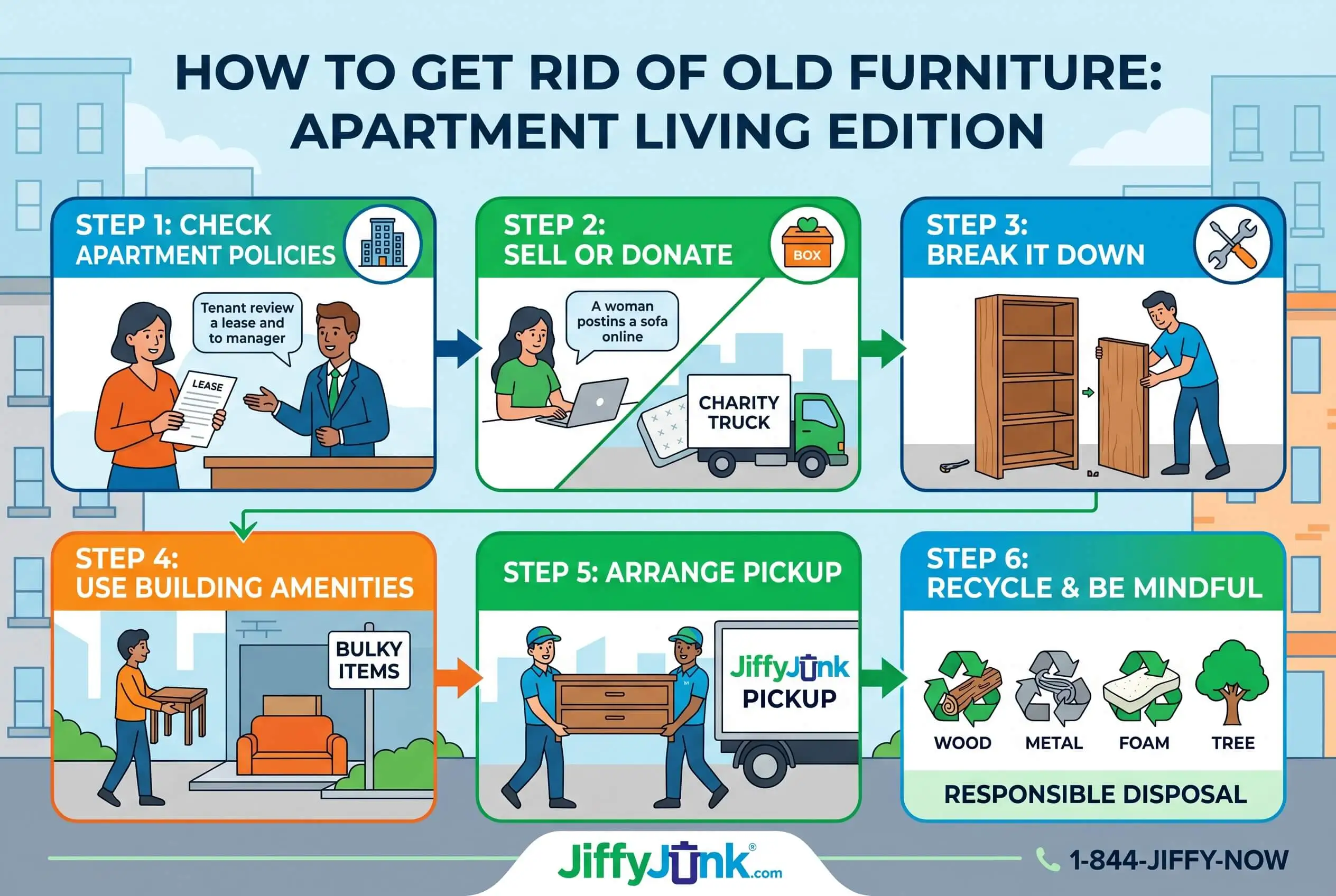
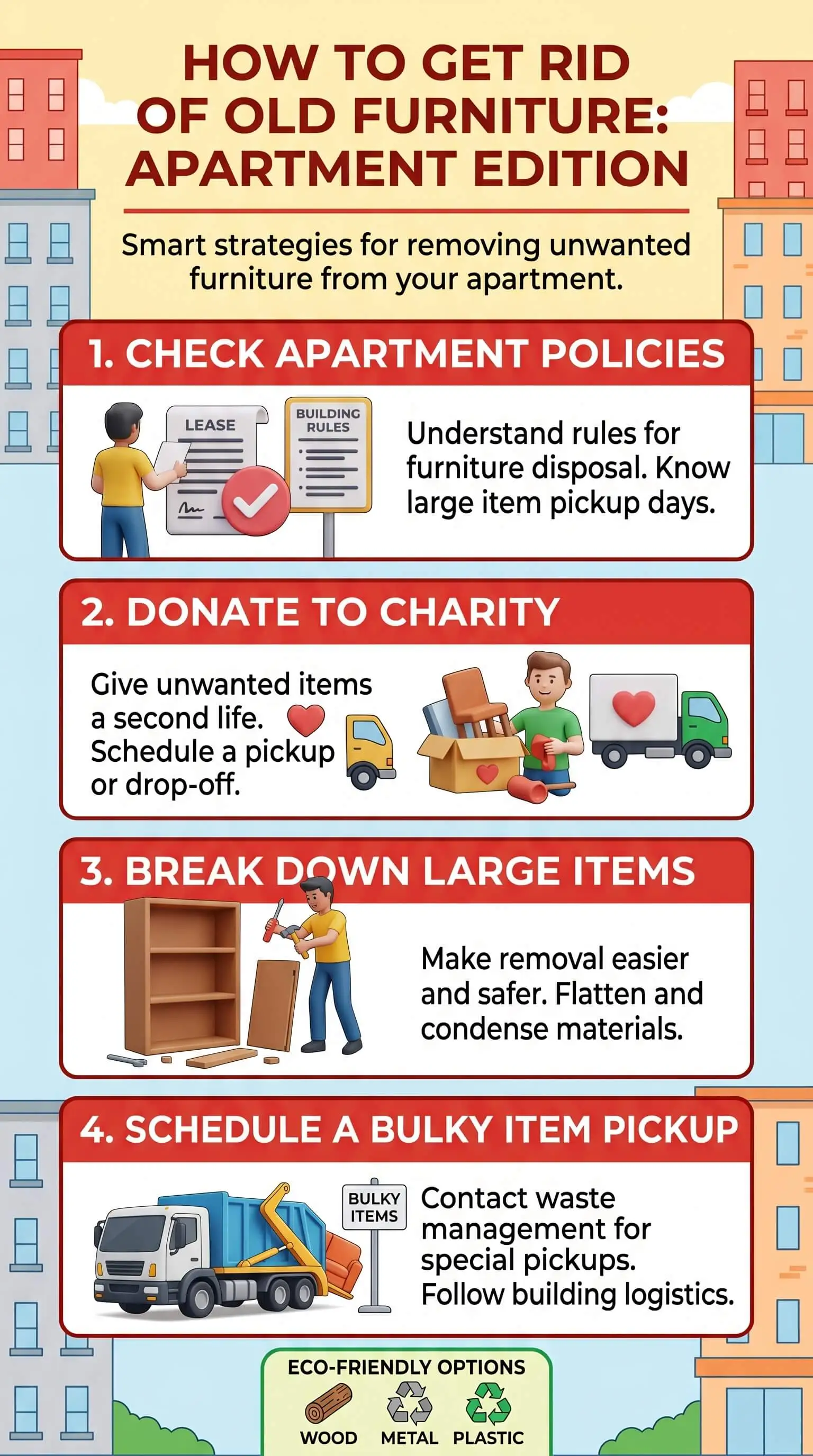
With those constraints in mind, here are the six methods that consistently work for getting rid of old furniture in an apartment, ranked roughly from cheapest to most convenient:
Donate to a charity that offers free pickup. The Salvation Army, Habitat for Humanity ReStore, Goodwill (in many regions), and member organizations of the Furniture Bank Network will collect gently used pieces from your home. Many regional ReStores require items at ground level or curbside; some, including Habitat ReStore's Priority Pickup partners, will retrieve from inside an apartment for an additional fee. Donations are tax-deductible.
Post it on Buy Nothing, Craigslist Free, or Facebook Marketplace. A clean photograph, accurate dimensions, and a "first come, first served, must pick up by Saturday" line is usually enough to find a taker for anything still functional.
Sell it on resale apps. Facebook Marketplace, OfferUp, AptDeco, and Chairish (for design-forward pieces) can recoup real money on brand-name furniture. Plan for the buyer to handle pickup; price aggressively if your timeline is tight.
Schedule city bulk-trash pickup. Most US cities offer free or low-cost curbside pickup of large items. New York City's DSNY, for example, allows up to six bulk items at the curb on a resident's regular trash day, with mattresses required to be sealed in plastic encasements before set-out. Always check your municipal sanitation site for specific rules; fines for incorrect set-out are common and steep.
Hire a full-service junk removal company. This is the fastest route for renters in walk-ups, anyone with multiple items, and anyone whose timeline does not accommodate scheduling around donation windows. A reputable junk removal team handles disassembly, staircase navigation, and landfill diversion, often donating sellable pieces to local charities on your behalf. For a step-by-step look at the full process — what to expect on pickup day, how pricing is calculated, and how to vet a company — Jiffy Junk's complete guide to disposing of old furniture is the most thorough walkthrough we've come across.
Use a labor-only service like Lugg, Dolly, or TaskRabbit. If you can rent a Home Depot truck or have access to a vehicle, an on-demand mover can handle the lifting and stair-work for $50 to $150, plus the dump fee at your local transfer station.
"After more than a decade of writing about home renovation, the single biggest mistake we see renters make when getting rid of old furniture isn't choosing the wrong disposal method — it's failing to measure the path out before they start. This matters even if your plan is to leave furniture on the curb, because the item still has to make it safely from the room to the pickup spot without getting stuck, damaging walls, or blocking a hallway. We've watched four-person crews wedge a sectional in a stairwell turn for forty minutes because nobody pulled out a tape measure beforehand. Our rule is simple: before you list, donate, schedule a pickup, or leave furniture on the curb, walk the entire egress route — from the room the furniture is in, through every doorway, around every corner, into the elevator or down each flight of stairs, and out to the curb where the truck or municipal pickup crew will access it. If any chokepoint is narrower than the longest dimension of the piece, you have two choices: disassemble, or call a professional crew that brings disassembly tools. Skipping that ten-minute walk is what turns a $150 pickup into a $400 problem with a damaged drywall corner, an unhappy super, and furniture sitting at the curb longer than allowed."
7 Essential Resources
Each of the following has been verified directly with the source and reflects the most recent program details available:
The Salvation Army — Schedule a Free Donation Pickup. satruck.org. National coverage with regional variation. Free in-home pickup is available in most US zip codes; drop-off sites elsewhere. Provides tax-deductible receipts.
Habitat for Humanity ReStore — Donate Goods. habitat.org/restores/donate-goods. Independently operated stores that accept and resell furniture, with most locations offering pickup for large items. Proceeds fund affordable home construction.
Goodwill Industries — Donate Goods. goodwill.org/ways-to-give/donate-goods. Donation policies vary by regional Goodwill organization. Many partner with ReSupply for residential pickup; others accept furniture only at staffed donation centers.
Furniture Bank Network — Find a Furniture Bank Near You. furniturebanks.org/furniture-bank-directory. Directory of regional furniture banks across the US and Canada serving families exiting homelessness, domestic violence, or extreme poverty. Many member banks offer free or low-cost pickup.
Buy Nothing Project. buynothingproject.org. Hyperlocal gift economy with 14 million-plus members across more than 50 countries. Available via Facebook groups and the standalone Buy Nothing app on iOS and Android.
Bye Bye Mattress (Mattress Recycling Council). byebyemattress.com. Free mattress recycling drop-off in California, Connecticut, Oregon, and Rhode Island. Includes a national directory of non-program recyclers for residents in other states.
Earth911 Recycling Locator. search.earth911.com. Searchable database of more than 100,000 recycling facilities across North America, including locations that accept furniture, mattresses, electronics, and patio furniture for material recovery.
3 Statistics
Americans threw out 12.1 million tons of furniture in 2018 — a 450 percent increase since 1960. Of that total, roughly 80 percent went to landfills and only 0.3 percent was recovered for recycling, according to EPA durable-goods data. Source: EPA Facts and Figures, Durable Goods.
Professional furniture removal costs $180 on average, with most pickups falling in the $75 to $250 range. Cost varies by item size, building accessibility, geographic location, and number of items removed in a single visit. Source: HomeAdvisor 2025 Furniture Removal Cost Guide.
Buy Nothing groups now move more than 162,000 metric tons of items per year — worth roughly $360 million — across a network of 14 million members in over 50 countries. That includes a significant volume of household furniture changing hands without a dollar exchanged. Source: Buy Nothing Project — About.
Final Thoughts and Opinion
If we were advising a friend who had to clear an apartment by month-end, here's the order we'd actually run the playbook in real life: donate first, sell second, schedule junk removal third, and curb-pickup last. That ordering reflects what we've learned about renter timelines and stress levels.
Donation comes first because it's free, it solves the disposal problem in a single appointment, and — this is the part most people undervalue — it forces you to commit to a date that's usually two to seven days out. That window is enough to declutter without dragging into a "I'll deal with it next weekend" loop that consumes an entire month.
Selling comes second because it can recoup real money on the right pieces, but only if the piece is worth more than your hourly wage times the time it takes to photograph, list, message strangers, and coordinate pickup. Below that bar, donate.
Junk removal comes third because it's the highest-convenience option and the right tool for walk-ups, multi-item clear-outs, and tight timelines. The premium you pay buys you a guaranteed pickup window, professional disassembly, and a clean apartment by sundown.
Curb pickup is the fallback. It's free in most cities, but the rules are particular and the fines for misset bulk are real. Donate or hire out if you can; curb if you must.
The deeper point is that getting rid of old furniture, done well, is also an environmental decision. With more than 12 million tons of furniture going to US landfills every year and recycling rates hovering near zero, every piece you donate or pass along through Buy Nothing is a small but real subtraction from that total, just as choosing a reusable or well-maintained air purifier can support a healthier home without adding unnecessary waste.
Frequently Asked Questions
Can I leave old furniture in the apartment dumpster?
In nearly every case, no. Bulky furniture is excluded from standard apartment dumpsters under most municipal waste contracts and building leases, and tenants who set out a couch can be fined or charged a removal fee passed through from the property manager. Always check your lease and confirm with your building before leaving anything oversized.
Will Goodwill or Salvation Army pick up furniture from a third-floor walk-up?
Policies vary regionally. Most Salvation Army and Habitat ReStore standard pickups require items to be at ground level — driveway, garage, or curb — at the time of pickup. For third-floor and higher units, look for "Priority Pickup" or partner services like ReSupply that offer in-home retrieval and disassembly for a flat fee.
How do I get rid of a couch that won't fit through the door?
Three options. First, disassemble: most modern sofas have removable legs, and many sectionals separate into pieces. Second, hire a junk removal team — reputable companies bring disassembly tools and are insured against drywall or doorframe damage. Third, in extreme cases, hire a professional moving company with hoisting equipment, though for a piece you are discarding, this is rarely cost-effective.
Is it illegal to put a mattress on the curb?
Not inherently illegal in most cities, but heavily regulated. New York, for example, requires every curbside mattress to be sealed in a city-approved plastic encasement to prevent bedbug spread, with fines for non-compliance. Many cities also require an appointment or a specific collection day. Always check your municipal sanitation department's rules before set-out.
How much does it cost to remove a single sofa?
Expect $75 to $160 for standard sofa removal from a junk hauling company, with sectionals running $200 to $300 and high-rise pickups commanding a premium. The 2025 national average for furniture removal is roughly $180 per pickup according to HomeAdvisor.
What's the cheapest way to get rid of old furniture as a renter?
Charity pickup is the cheapest legal option — free, with a tax receipt. Buy Nothing posts and Craigslist Free are tied for second. Curbside bulk pickup is third where it's available. Junk removal and labor-only services cost the most but offer the highest convenience.
Ready to Reclaim That Square Footage?
If you are staring at a section that needs to be gone before the next lease cycle starts, do not wait until the last weekend. Donate it on Tuesday, list it on Wednesday, or book a junk removal pickup before Friday — whichever path fits the piece. Save this guide, share it with the friend who texted you about their old futon last week
