Holiday weekends complicate an already inconsistent system. Federal holidays push collection routes back. Bulk furniture pickup runs on a less frequent schedule than household trash, so it absorbs disruption poorly. With the right timing, leaving furniture on curb can still be a practical and convenient disposal option, especially when you understand your city’s holiday collection rules. Planning ahead helps prevent weather damage, missed pickups, and items being refused by the city. This guide covers the timing rules that apply across major U.S. cities, what happens when items aren't collected on schedule, and the practical alternatives when curbside disposal isn't the right fit.
TL;DR Quick Answers
Leaving furniture on curb
Most U.S. cities allow you to leave furniture on the curb for free bulk pickup, but only within a 24-hour set-out window before scheduled collection. Place items out earlier than that, and you risk a code enforcement citation that typically runs $50 to $500.
Key rules:
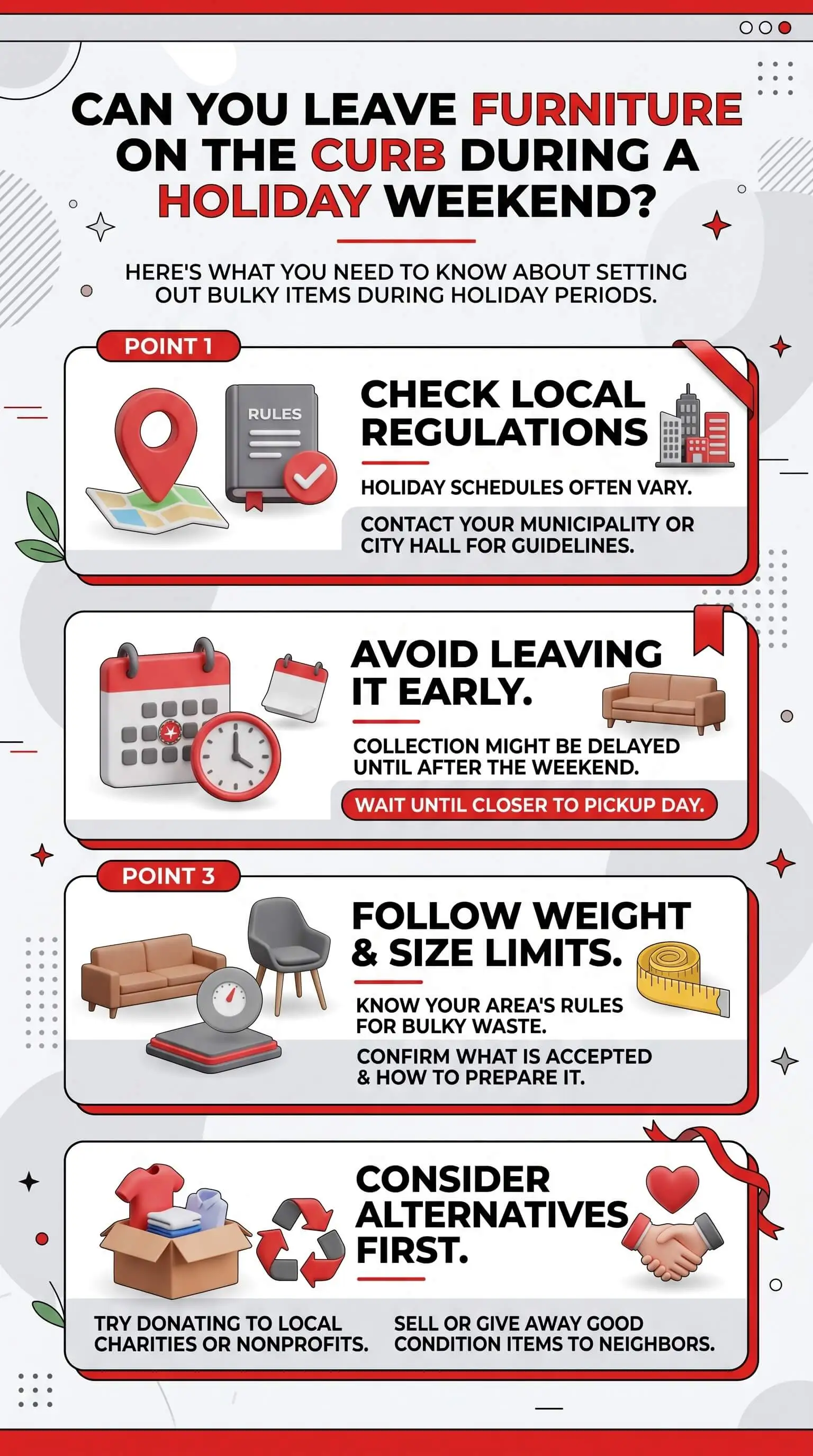
Set-out window: no earlier than the night before scheduled pickup in most cities
Mattresses: NYC and several other cities require sealing in heavy-duty plastic bags (Local Law 145), with fines up to $300 for non-compliance
Refrigerant appliances (fridges, AC units, freezers): cities require a separate scheduled pickup, not standard curbside
Holiday weeks: pickup typically slips one to two business days, and the set-out window shifts with the new collection date
Damaged items: cities frequently refuse waterlogged or weather-damaged upholstery on the rescheduled date
If pickup is missed or your city won't accept the item, private same-day junk removal services run independently of municipal calendars, including weekends and holidays.
Top Takeaways
Holiday weekends typically delay curbside furniture pickup by one to two business days. Bulk collection runs on a less frequent schedule than regular trash, so it absorbs disruption harder than weekly garbage.
The 24-hour set-out rule shifts with the rescheduled pickup date. Placing furniture out on the original day instead of the new collection day is the single most common cause of holiday-weekend code enforcement citations.
Eleven federal holidays commonly trigger sanitation schedule changes. Memorial Day, Independence Day, Labor Day, Thanksgiving, and Christmas are the most consistently observed.
Cities including NYC require residents to seal mattresses in heavy-duty plastic bags under Local Law 145. Non-compliance results in non-collection plus fines up to $300.
Furniture exposed to weather over a long holiday weekend is frequently rejected on the rescheduled pickup date, which leaves residents responsible for private removal anyway.
Illegal dumping penalties are more severe than residents typically expect. California allows fines up to $10,000, and Philadelphia's per-object fines can stack into civil suits worth tens of thousands.
For time-sensitive removals or items the city won't accept, private same-day junk removal is the more reliable path on holiday weekends.
How Holiday Weekends Affect Bulk Furniture Pickup
When a federal holiday lands on a weekday, most municipal sanitation departments and private waste haulers shift collection back by one business day for the rest of that week. The pattern is consistent enough across major U.S. cities to be predictable. A Monday holiday pushes Monday's pickup to Tuesday, Tuesday's to Wednesday, and so on through Saturday. Bulk furniture collection runs on a separate schedule in most cities, often biweekly or by appointment, and it tends to absorb disruption worse than weekly garbage because there are fewer chances to recover a missed route.
Eleven federal holidays commonly trigger sanitation schedule changes:
New Year's Day
Martin Luther King Jr. Day
Presidents' Day
Memorial Day
Juneteenth
Independence Day
Labor Day
Columbus Day / Indigenous Peoples' Day
Veterans Day
Thanksgiving Day
Christmas Day
Not every city observes every holiday for sanitation purposes. Memorial Day, Independence Day, Labor Day, Thanksgiving, and Christmas are the most consistently observed across municipal and private waste systems. Less universally observed days like Columbus Day and Veterans Day depend heavily on the local jurisdiction. Confirm with your city's sanitation department or hauler before assuming a delay.
When You Can Legally Place Furniture at the Curb
The dominant rule across major U.S. cities is the 24-hour set-out window: items can go out at the curb no earlier than the night before scheduled pickup. New York City's Department of Sanitation requires bulk items to go out between 6:00 PM and midnight the night before collection. Los Angeles allows curbside placement no earlier than the night before pickup. Chicago's Department of Streets and Sanitation requires that residents schedule bulk collection through 311 before placing items outside, and unscheduled curbside dumping in alleys is treated as a code violation.
On a holiday weekend, the 24-hour window shifts with the rescheduled pickup date. If your normal Monday collection moves to Tuesday because of Memorial Day, you cannot legally place furniture at the curb until Monday evening. Not Sunday evening, even though Sunday would have been the "night before" under your standard schedule. This single timing detail produces a disproportionate share of holiday-weekend code enforcement citations.
Cities issue early set-out citations for several practical reasons. Items left out for multiple days obstruct sidewalks, attract additional dumping, become weather-damaged and unsafe to handle, and create the appearance of illegal dumping that triggers neighbor complaints. Fines for early set-out typically run from $50 to $500 depending on the jurisdiction and whether it's a repeat offense.
What Counts as Curbside-Eligible Furniture
Most cities accept the following items for free curbside bulk pickup: sofas and loveseats, dressers and bookshelves, tables and chairs, disassembled bed frames, and mattresses. Cities including New York require residents to seal mattresses in heavy-duty plastic bags under Local Law 145, with non-compliant items subject to fines of up to $300.
Commonly rejected items include appliances containing refrigerants such as refrigerators, freezers, air conditioners, and dehumidifiers, which require separate CFC recovery appointments. Cities also refuse construction debris from renovations and electronics, which most states classify as e-waste and prohibit from regular curbside trash. Any furniture contaminated with bedbugs, mold, or biohazards is rejected on sight. Glass tabletops and mirrors usually need to be taped or wrapped to prevent injury to sanitation workers.
What Happens If Your Furniture Isn't Picked Up
A missed pickup is rarely a one-step problem. The typical sequence runs as follows. The sanitation truck skips the route on the holiday. The item sits through the long weekend exposed to weather and foot traffic. A neighbor files a 311 complaint, or a code enforcement officer documents it. The property owner receives a citation requiring removal within a defined window, often 24 to 72 hours. Items left beyond the abatement window result in escalating fines, and in some cities, repeat violations can attach as liens to the property.
Items damaged by rain, snow, or sun exposure are often refused on the rescheduled pickup date, which leaves residents responsible for arranging private removal anyway. Upholstered furniture is particularly vulnerable. Most municipalities will not collect water-saturated sofas because of weight, biohazard, and disposal-site restrictions.
Practical Alternatives When Curbside Pickup Isn't Working
When a holiday weekend puts curbside pickup out of reach, whether because the schedule has shifted past your timeline, the city has refused a damaged item, or you simply cannot afford to leave furniture out for several days, private haul-away services are the standard fallback. Same-day and scheduled junk removal companies operate independently of municipal calendars, including on weekends and holidays. For homeowners working through this situation,
Jiffy Junk's professional curbside furniture removal overview walks through how scheduled haul-away works, what's typically included in pricing, and how to handle items the city won't accept.
Other options include donation pickups from organizations like Salvation Army and Habitat for Humanity ReStore. These are free but generally need 1 to 3 weeks of lead time, and they only accept items in usable condition. Residential dumpster rental works for whole-home cleanouts but is overkill for a single sofa, and many cities require a permit for dumpsters placed on public streets. DIY drop-off at municipal transfer stations often runs Saturday hours that can bridge holiday weekend gaps for residents with truck access.
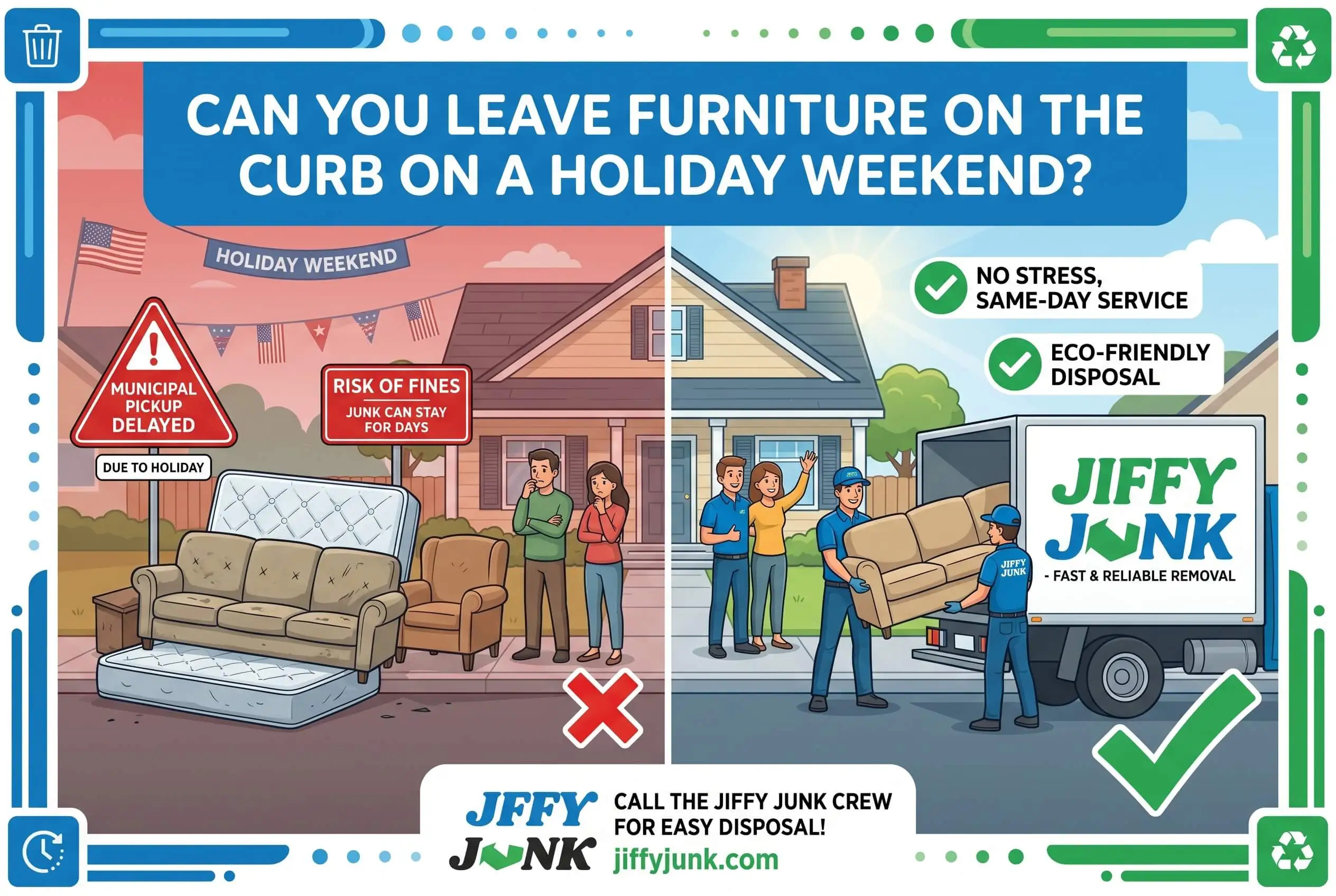
"In our review of curbside set-out rules across more than two dozen U.S. cities, the most common cause of holiday-weekend pickup problems is rarely the holiday itself. The real culprit is the assumption that the standard 24-hour set-out window still applies on the original day. It doesn't. The window shifts with the rescheduled collection date. We've documented cases where residents placed furniture out on a Sunday before a Monday holiday, expecting Monday pickup to be 'a little late,' only to find the items still there four days later, weather-damaged and the subject of a code enforcement complaint from a neighbor. The cost of getting this wrong runs from a $150 first-offense citation in cities like Seattle to civil suits in the tens of thousands of dollars in jurisdictions like Philadelphia, where 2022 ordinance changes raised illegal dumping penalties to $5,000 per object. The practical advice we give every reader is the same. Confirm the rescheduled date with your city before placing anything outside. Photograph items at the curb on set-out day. Have a private removal service identified in advance for any holiday weekend cleanout. The five minutes that it takes will save the worst-case scenarios we've seen."
7 Essential Resources
These were verified at the time of publication. Each links to the primary source rather than a secondary reference.
Wikipedia: Furniture (general definition and historical reference). https://en.wikipedia.org/wiki/Furniture. Useful for understanding what categories of items qualify as furniture for disposal purposes.
U.S. EPA, Durable Goods: Product-Specific Data. https://www.epa.gov/facts-and-figures-about-materials-waste-and-recycling/durable-goods-product-specific-data. Federal data on furniture and furnishings in U.S. municipal solid waste, including landfill rates and disposal trends.
NYC Department of Sanitation, Furniture, Mattresses & Rugs. https://www.nyc.gov/site/dsny/collection/get-rid-of/furniture-mattresses.page. The authoritative source for New York City's curbside bulk pickup rules, including mattress bagging requirements and item categories.
LA Sanitation, Bulky Item Collection. https://sanitation.lacity.gov/bulky. Official Los Angeles guidelines on free residential bulky item pickup, scheduling through MyLA311, and S.A.F.E. Center drop-off locations.
City of Chicago, Sanitation Code & Bulk Pick-Up. https://www.chicago.gov/city/en/depts/streets/provdrs/streets_san/svcs/sanitation_ordinance.html. Chicago's residential sanitation code, including ward-based bulk pickup procedures and code violations.
U.S. EPA, National Overview: Facts and Figures on Materials, Wastes and Recycling. https://www.epa.gov/facts-and-figures-about-materials-waste-and-recycling/national-overview-facts-and-figures-materials. National-level statistics on the 292.4 million tons of MSW generated annually in the U.S., including the durable goods category.
LA County Public Works, CleanLA Illegal Dumping. https://cleanla.lacounty.gov/illegal-dumping/. Documentation of California Penal Code 374.3 penalties for illegal dumping, including the role of bulky-item pickup in avoiding violations.
3 Statistics
The data below quantifies the scale of the furniture disposal problem and the legal stakes attached to getting curbside placement wrong.
12.1 million tons of furniture and furnishings entered the U.S. municipal solid waste stream in 2018, and 80.1% of it went to landfills. Source: U.S. EPA Durable Goods data. https://www.epa.gov/facts-and-figures-about-materials-waste-and-recycling/durable-goods-product-specific-data
Furniture has one of the lowest recycling rates of any major MSW category, at roughly 0.3%. That places it well below carpets (9.2%) and small appliances (5.6%) for material recovery. Source: University of Michigan Center for Sustainable Systems, Municipal Solid Waste Factsheet. https://css.umich.edu/publications/factsheets/material-resources/municipal-solid-waste-factsheet
California Penal Code 374.3 makes illegal dumping on public or private property punishable by fines up to $10,000, plus potential jail time of up to six months. Many local jurisdictions stack additional fines on top of state penalties. Philadelphia's 2022 ordinance, for example, raised civil penalties to $5,000 per illegally dumped object. Source: LA County CleanLA. https://cleanla.lacounty.gov/illegal-dumping/
Final Thoughts and Opinion
Our editorial position after reviewing curbside disposal rules across the country: the framework is more punitive than residents realize, and the safest assumption is that anything left curbside past its legal window will eventually generate a problem.
The rule structure was designed for a system where collection happens on predictable, weekly schedules. Holiday weekends break that assumption, and the burden of adjusting falls entirely on residents. We see this as a meaningful gap in how municipal sanitation services communicate with the public. Most cities publish holiday calendars, but few proactively notify residents of bulk-collection delays in advance, and even fewer extend grace periods on set-out windows during holiday weeks.
Our practical opinion: for any furniture removal that involves a holiday weekend or coincides with a hard deadline (a move-out date, a closing, an unexpected damage event), private removal is the lower-risk path. The cost difference between waiting for a free city pickup that may slip several days and booking a same-day private haul is often smaller than the potential cost of a single fine, and the timing certainty is meaningfully better, especially for homeowners who want to keep indoor spaces cleaner and more comfortable with the help of an air purifier while old furniture, dust, and odors are being cleared out. For non-urgent furniture removal, free city pickup remains a reasonable default, provided the schedule is verified in advance and the 24-hour set-out window is respected.
Frequently Asked Questions
Can I put my couch on the curb the night before pickup?
In most U.S. cities, yes. The standard 24-hour set-out window allows curbside placement no earlier than the night before scheduled collection. NYC requires placement between 6:00 PM and midnight the night before pickup. Always verify your city's specific window before placing items outside, especially during holiday weeks when the collection date itself has shifted.
Will my city pick up furniture on a federal holiday?
Almost universally, no. Most municipal sanitation departments and private haulers observe federal holidays and shift collection to the next business day. Memorial Day, Independence Day, Labor Day, Thanksgiving, and Christmas Day are the most consistently observed across U.S. cities. Smaller observances like Columbus Day vary by jurisdiction.
What happens if it rains on my furniture before pickup?
Most cities decline to collect water-saturated upholstered furniture because of weight, biohazard concerns, and transfer-station restrictions. A holiday weekend with rain in the forecast is the worst-case scenario for curbside furniture. Items can sit through the long weekend, become non-collectible, and leave residents responsible for arranging private removal in addition to the original pickup attempt.
Can someone legally take furniture I left on the curb?
In most U.S. jurisdictions, yes. Once an item goes to the public right-of-way for collection, the item becomes abandoned property under most local rules, and anyone can legally take it. Some cities have ordinances that specifically address scavenging of recyclables, but those rarely apply to bulk furniture. If you don't want an item taken, don't place it curbside.
Do I need to schedule a holiday-weekend pickup in advance?
Many cities require scheduled appointments for bulk furniture pickup regardless of holiday status. Chicago, for example, requires bulk pickup to be requested through 311 before items go outside. NYC moved to a no-appointment system for most bulk items, but specific categories like refrigerators with refrigerants still require advance scheduling. Book at least one to two weeks ahead during holiday weeks, when demand peaks.
How do I avoid a fine for furniture left on the curb too long?
Confirm the rescheduled pickup date with your sanitation department. Observe the 24-hour set-out window from the new collection date. Photograph items at set-out for documentation. And identify a private removal service in advance for any item that doesn't get collected on the first attempt. Acting within 24 to 72 hours of a missed pickup typically prevents escalation to a code enforcement citation.
Call to Action
Holiday weekends turn small disposal decisions into multi-day problems if the timing slips. Before placing anything at the curb this weekend, take three minutes to confirm your city's rescheduled pickup date, review the 24-hour set-out window for that new date, and identify a private removal service as a backup for any weather-damaged item the city refuses to collect.
If you've already missed a holiday pickup, are dealing with items the city won't accept, or simply need a sofa gone before the long weekend ends, scheduled junk removal services can typically arrange same-week haul-away on weekends and holidays when municipal services are paused. A five-minute booking now beats a five-day curbside problem and the fines that come with it.
