I've spent years writing about indoor air quality and the household contaminants that quietly compromise it. Bed bugs sit at the intersection of two things our readers care about: home health and home preservation. When those two priorities collide over a single piece of furniture, you need a framework, not a slogan.
This guide walks you through the three paths available to you — treat, save, or dispose — and shows you how to choose between them based on the piece's construction, the severity of the infestation, and the value (financial and sentimental) at stake. Whichever path you take, the goal is the same: end the infestation without losing what matters.
TL;DR Quick Answers
companies that remove bed bug infested furniture
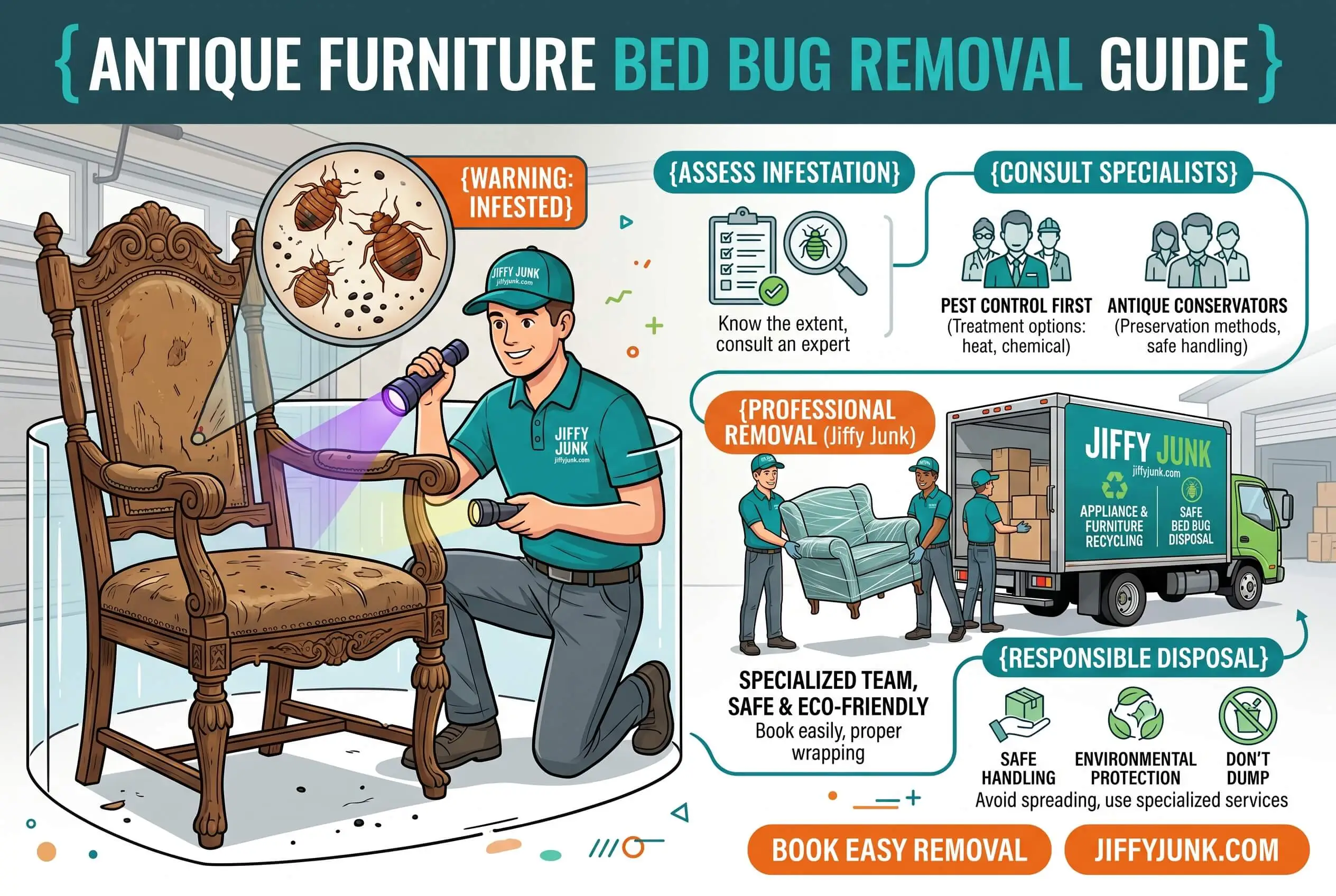
The companies that actually remove bed bug infested furniture are specialty junk removal services with documented bed bug protocols. Standard haulers refuse the job once you disclose the infestation, donation centers won't accept the items at all, and most municipal bulk pickup programs require advance preparation and labeling. That gap is why specialty providers exist as a distinct service category.
Three options will take the work:
National specialty junk removal services: Jiffy Junk is the most established, with crews trained in sealed-transport protocols, dedicated trucks sanitized between jobs, and disposal at approved waste facilities. Typical cost: $150–$500 per piece.
Local junk haulers with bed bug experience: Quality varies by city. Ask whether they wrap items on-site, sanitize the truck between jobs, and provide a disposal receipt before booking.
Pest control companies offering disposal alongside treatment: Less common as a standalone service, but worth a call if you're already booking extermination.
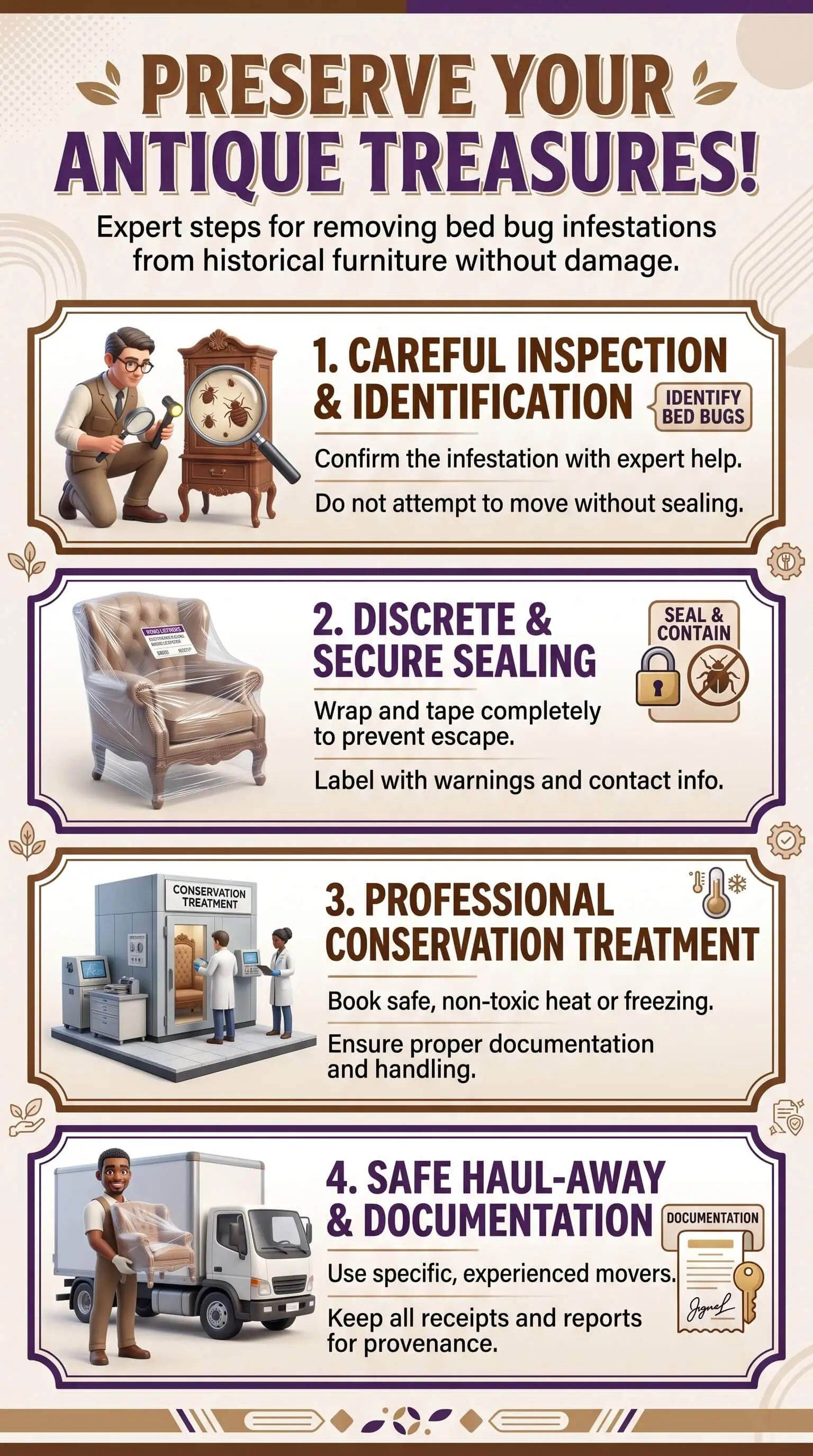
Before any pickup, wrap the piece in heavy plastic, tape the seams, and label it "BED BUGS" so neighbors don't scavenge the item from the curb.
Top Takeaways
Confirm first, decide second. A professional pest inspection costs $100–$250 and saves you from making a four-figure mistake in either direction.
Antiques aren't generic furniture. Hide-glue construction, sensitive finishes, and dense joinery mean standard treatment advice often doesn't apply. Adjust accordingly.
Use the three-path framework. Light infestation + valuable piece = treat. Moderate infestation + sentimental value = save with professional help. Heavy infestation + low value or upholstered = dispose.
Choose treatment methods carefully. Diatomaceous earth and localized steam are antique-safe. Whole-room heat, foggers, and OTC sprays often are not.
Disposal is sometimes the right answer. When it is, accept it without guilt — but never via curbside dumping. The bugs survive transport and your problem becomes someone else's.
Use specialized removal services. Companies that handle bed bug furniture specifically use sealed in-room containment and certified disposal. General junk haulers do not.
Protect what's left. After treatment or removal, use bed bug interceptors, encasements, and HEPA air filtration in adjacent rooms. Monitor for 6–12 months minimum.
The first thing to do is confirm what you're dealing with
Only a fraction of people can correctly identify bed bugs on sight, and antique pieces — with their carved details and tight joinery — hide them better than any modern piece of furniture. Look for live bugs the size of an apple seed, dark fecal spotting along drawer interiors and seams, pearl-white eggs in crevices, and cast skins clinging to wood joints. If you're not certain, a licensed pest inspection costs $100–$250 and removes the guesswork before you make a four-figure decision.
Why antiques need a different playbook
Three things separate antique furniture from the modern pieces most bed bug guides discuss. Construction is more sensitive — hide glue softens at the temperatures used in standard heat treatment, and shellac or French polish finishes can blister. Crevice density is higher — carved relief, dovetail joinery, and dry-jointed construction create three to five times more harborage than typical modern furniture. And value asymmetry changes the math — a $4,000 Eastlake sideboard justifies a $400 specialty treatment that would be irrational for a $200 modern piece.
The decision framework
Use this as a starting point:
Light infestation, solid wood, valuable → Treat (often DIY-eligible)
Moderate infestation, sentimental or appraised value → Save with professional help ($200–$800 typical)
Heavy infestation, upholstered, or low value → Dispose, with proper containment
If treatment is the right call
For all-wood pieces with light infestations, food-grade diatomaceous earth applied with a bulb duster into crevices is finish-safe and effective over 7–14 days. For higher-value pieces, professional integrated pest management — combining monitoring, low-impact treatment, and encasement — is worth the cost. Localized steam treatment from a pest professional experienced with antiques is generally safer than whole-room heat. Avoid foggers, OTC pesticide sprays applied directly to finishes, and garage heat-bagging — all three can ruin the piece while inconsistently killing the bugs.
If disposal is the right call
This is where most homeowners go wrong. Curbside disposal of bed bug furniture is irresponsible at best and illegal at worst. The bugs survive transport, infest scavengers' homes, and many municipalities now issue fines for improper disposal of pest-contaminated furniture. The right path is to look specifically for companies that remove bed bug infested furniture — services that wrap and seal items in the room before they ever move, transport in dedicated vehicles, and dispose at facilities equipped for contaminated materials. General junk haulers do none of those things, and the difference shows up later as a reinfestation in the room the furniture passed through, the truck that carried it, or the home that found it on the curb.
"What I've come to believe, after years of writing about indoor air quality and the contaminants that compromise it, is that bed bug furniture decisions get made under stress — and that's exactly when people make the wrong call. They throw out heirlooms that could have been saved, or they try to save pieces that have already lost the structural battle. The framework matters more than the urgency. Slow down, get a professional inspection, weigh the construction against the infestation severity, and let the math tell you what to do. The piece either passes the test or it doesn't — and either answer is acceptable as long as you reach it deliberately."
7 Essential Resources
Making informed decisions about bed bug infestations — especially when antique furniture is involved — depends on access to authoritative information. The following seven resources are drawn from federal agencies, leading universities, and the pest management industry. Each one supports a different part of the decision you're making.
1. EPA's Do-It-Yourself Bed Bug Control Guide
The U.S. Environmental Protection Agency walks through containment, treatment options, and disposal practices in plain language. For antique-furniture owners, the value here is the agency's clear position on chemical treatments and what to avoid — particularly relevant when finishes and joinery are at stake.
Source: U.S. Environmental Protection Agency URL: https://www.epa.gov/bedbugs/do-it-yourself-bed-bug-control
2. CDC's Bed Bug Health Information
The Centers for Disease Control and Prevention provides medically reviewed information on bed bug bites, allergic reactions, and when to seek care. Important context for households where the infestation is causing skin reactions or sleep disruption alongside the furniture problem.
Source: Centers for Disease Control and Prevention URL: https://www.cdc.gov/bed-bugs/about/index.html
3. NPMA's Bed Bug Best Practices
The National Pest Management Association's Best Practices document explains how licensed professionals evaluate which items can be treated versus which truly need removal. This is the resource I most often recommend when readers ask, "Can this piece really be saved?"
Source: National Pest Management Association URL: https://www.pestworld.org/all-things-bed-bugs/best-practices/
4. Purdue University Extension — Bed Bug Resources
Purdue's entomology extension is one of the most respected research-backed bed bug resources available. The site covers identification, treatment preparation, and the science of why some methods work better than others — useful when you're trying to evaluate what a pest professional is proposing for a high-value piece.
Source: Purdue University Extension URL: https://extension.entm.purdue.edu/bedbugs/
5. University of Minnesota Extension — Prevention and Control
This university extension resource excels at the after side of the problem: how to prevent reinfestation once you've taken action. For owners with multiple antique pieces in proximity, the prevention protocols here are essential reading.
Source: University of Minnesota Extension URL: https://extension.umn.edu/bed-bugs/bed-bug-prevention-and-control-home
6. EPA's Public Health Position on Bed Bugs
This page documents the joint EPA, CDC, and USDA classification of bed bugs as a pest of significant public health importance. Worth reviewing if you're a renter, condo owner, or HOA member trying to understand your rights and responsibilities.
Source: U.S. Environmental Protection Agency URL: https://www.epa.gov/bedbugs/bed-bugs-are-public-health-pests
7. NPMA's Bed Bug Facts and Statistics
The National Pest Management Association maintains a regularly updated set of statistics on bed bug prevalence, geographic patterns, and identification rates. The page is useful for context when you're trying to gauge how unusual or common your situation actually is — and the answer, as you'll see, is not unusual at all.
Source: National Pest Management Association URL: https://www.pestworld.org/all-things-bed-bugs/bed-bug-facts-statistics/
3 Statistics
Statistic 1: Bed Bugs Are a Federally Recognized Public Health Pest
In 2002, the U.S. Environmental Protection Agency, Centers for Disease Control and Prevention, and U.S. Department of Agriculture jointly classified bed bugs as a "pest of significant public health importance." The classification reflects the documented health effects — allergic reactions, secondary skin infections, anxiety, and sleep disruption — that infestations cause.
Why this matters for antique furniture owners: the classification is part of why municipalities are increasingly aggressive about disposal regulations and why proper containment protocols exist. Treating an infested antique isn't just about saving the piece — it's about a federally recognized health concern.
Source: U.S. Environmental Protection Agency URL: https://www.epa.gov/bedbugs/bed-bugs-are-public-health-pests
Statistic 2: One in Five American Households Has Been Affected
According to the National Pest Management Association, approximately 20% of Americans have either experienced a bed bug infestation directly or know someone who has. The infestations cross every demographic — urban and rural, low-income and high-income, immaculately kept and chaotically cluttered.
Why this matters: if you're embarrassed about the situation, you shouldn't be. The math says one in five of your neighbors has been through some version of it. Bed bugs are a fact of modern life, not a verdict on your housekeeping or your antique-buying judgment.
Source: National Pest Management Association URL: https://www.pestworld.org/all-things-bed-bugs/bed-bug-facts-statistics/
Statistic 3: Only 29% of Americans Can Correctly Identify Bed Bugs
A 2025 Harris Poll commissioned by the National Pest Management Association found that fewer than one in three Americans can correctly identify a bed bug by sight. Most homeowners don't recognize an infestation until it has already spread.
Why this matters for antique pieces specifically: the carved details, dovetail joinery, and tight crevices in antique furniture make visual identification even harder than it is on modern pieces, even when homeowners are already using air purifiers to improve the surrounding indoor environment. If you're unsure, get a professional inspection before you decide whether to treat or dispose. The cost of being wrong — either by treating a piece that didn't need it, or by discarding a piece that could have been saved — is almost always higher than the inspection fee.
Source: National Pest Management Association & Harris Poll (April 2025) URL: https://www.pestworld.org/news-hub/pest-articles/bed-bug-survey-results-facts/
Final Thoughts and Opinion
Here's where I have to stop being neutral.
The bed bug furniture industry — including a significant portion of the pest control industry that's adjacent to it — has a transparency problem. Too many homeowners are pushed toward disposal when treatment was viable, and too many are pushed toward expensive treatments when disposal was the right answer. The decision rarely gets framed honestly because the people advising on it usually have a financial interest in one outcome or the other.
I think the right approach is uncomfortable and unsexy: slow down and let the math decide.
For antique furniture specifically, that means three commitments. First, never make the treat/save/dispose call without a professional inspection. A $150 inspection that prevents you from discarding a $3,000 piece is the highest-ROI decision you'll make in this entire process. Second, don't trust generic advice — whole-room heat treatment is good general advice and bad antique advice. The construction sensitivity of pre-1900s pieces means your treatment options are genuinely narrower, and pretending otherwise wrecks furniture. Third, if you do dispose, dispose properly. Curbside dumping of bed bug furniture is the single most antisocial mistake you can make in this situation. It moves your problem to your neighborhood, and it usually violates local ordinance.
What I want people to take away from this article is permission. Permission to save the piece if it can be saved. Permission to let it go if it can't. And permission to take the time you need to know which it is. The infestation will not get meaningfully worse in the 48 hours it takes to get a professional inspection. The decision will, however, get measurably better.
Frequently Asked Questions
Can bed bugs actually live inside solid wood antique furniture?
Yes. While bed bugs prefer fabric and porous surfaces, they readily harbor in wood joints, behind veneer, and in any crevice wide enough to fit a credit card edge. Antique construction with hide glue, dovetails, and carved relief work creates near-ideal hiding conditions.
Will heat treatment damage my antique?
It can. Whole-room heat treatments at 135°F and above may soften shellac, blister French polish, and weaken hide-glue joints. Localized steam treatment performed by a pest professional experienced with vintage materials is typically safer. Always document the piece's condition with photographs before any thermal treatment.
What does professional treatment of an antique typically cost?
Most professional treatments fall in the $200–$800 range per piece, depending on size, construction, and method. Compare that figure against the piece's appraised value before deciding. A reasonable rule of thumb: if treatment cost exceeds 30% of the piece's value and sentimental value is moderate, dispose; below 30%, treat.
Is curbside disposal of bed bug furniture illegal?
It varies by jurisdiction. Many municipalities now fine improper disposal of pest-contaminated furniture, and even where it's technically legal, it's irresponsible — the bugs survive transport and infest the homes of anyone who picks up the piece. Either way, sealed professional removal is the right answer.
What if I inherited the piece and can't bring myself to throw it away?
Get a professional inspection and treatment quote first. A surprising number of pieces that homeowners assume are beyond saving turn out to be treatable. Disposal should be the last option, not the first — but if it does become the right call, the piece's history is preserved through documentation, photographs, and the memory of what it meant. None of those require keeping the wood.
Are there services that specialize in removing bed bug infested furniture?
Yes. Specialized removal services use sealed containment wrapping applied in the room before extraction, dedicated transport vehicles, and disposal at facilities equipped for contaminated materials. The difference between a specialty service and a general junk hauler usually shows up in whether the infestation actually ends — or simply moves.
CTA
If you're dealing with an antique piece you're not sure about, don't make the decision alone and don't make it under pressure. Take a few hours to get a professional pest inspection, photograph the piece for your records, and weigh the treatment cost against the value. If the math tells you to save it, save it. If it tells you to let it go, let it go properly — through a specialized removal service that treats containment as a non-negotiable part of the job, not an afterthought.
If you found this guide useful, consider sharing it with anyone you know who might be facing the same decision. And while you're protecting your home from one indoor health concern, take a few minutes to look through our other guides on improving your indoor air quality — because the cleanest home isn't just bug-free, it's allergen-free, dust-free, and built to keep you healthy long after this particular crisis is behind you.
