Junk removal pricing is regional and dispatcher-driven. It's routinely flexible by 20% to 40% depending on how you ask. Refrigerators sit in a pricing sweet spot: heavy enough to require two-person handling, regulated enough to need certified refrigerant recovery, and common enough that haulers compete hard for the work. There's room to negotiate in most quotes, leverage points worth knowing, and at least one disposal option that will pay you to take your old fridge away rather than charge you to remove it. That’s what makes how to dispose an old refrigerator a much more manageable process than most homeowners expect.
TL;DR Quick Answers
How to dispose an old refrigerator
You have five real options, ordered from cheapest to fastest:
Utility rebate program — Many regional utilities pick up a working old fridge free and pay you $30 to $75 in utility credits. Check the ENERGY STAR recycling locator by ZIP code first.
Retailer haul-away — When you buy a new fridge, most major retailers haul the old one for $25 to $75, sometimes free.
Municipal bulk pickup — Most cities offer scheduled bulk collection for $0 to $40, with a one to three week wait.
Scrap metal recycler — Some take a fridge free, a few pay $5 to $20 for the steel. Many require proof of refrigerant recovery.
Junk removal service — The fastest option at $75 to $200 per fridge, with 20% to 40% negotiation room on the quoted price.
Federal rule to know: EPA Section 608 requires a certified technician to recover refrigerant before any fridge can be legally scrapped. Reputable disposal options handle this for you. Sub-$50 quotes that skip refrigerant recovery are a warning sign of illegal dumping.
Cheapest path most people miss: the utility rebate. The same fridge a junk removal company will charge you $100 to take can earn you $30 to $75 in credits through a utility program. Spend ten minutes on the ENERGY STAR locator before you call any hauler.
Top Takeaways
Fridge disposal in the U.S. typically runs $75 to $200, but the price is negotiable in 70% or more of cases.
Always get three quotes before booking. Use the lowest as leverage.
Tuesday through Thursday afternoon is the cheapest booking window.
Utility rebate programs may pay you to take your fridge. Check before you call a hauler.
Sub-$50 quotes are a red flag for illegal dumping or uninsured operators.
Bundling additional items into a single pickup substantially reduces per-item cost.
Federal law requires refrigerant recovery. Never work with anyone who skips it.
Why Fridge Disposal Costs What It Does
Pulling an old refrigerator out of a kitchen and disposing of it legally costs more than hauling away a couch. Three things drive the cost. The unit weighs 200 to 350 pounds, which means a two-person crew and a hand truck. Federal law requires a certified technician to recover refrigerant gases (historically Freon, now mostly HFCs) before anyone can legally scrap the unit, which adds a refrigerator-specific compliance step that doesn't apply to most other household items. And receiving facilities charge a higher recycling fee for white goods than for general household junk.
The quote you receive isn't padded. There's a cost floor under it. There's also a margin above that floor, and that margin is where your room to negotiate lives.
How to Dispose an Old Refrigerator: Five Real Options
Before you call any hauler, know your alternatives. The full menu of how to dispose an old refrigerator looks like this:
Manufacturer or retailer haul-away. When you buy a new fridge, most major retailers will haul the old one for $25 to $75. Some will do it for free. This is almost always the cheapest path if your timing aligns with a new appliance purchase.
Utility rebate programs. Many regional utilities pick up a working old fridge for free and pay you $30 to $75 in utility credits. The ENERGY STAR fridge recycling locator (linked in the resources section below) maps every active program by ZIP code.
Municipal bulk pickup. Most cities offer scheduled bulk item collection for $0 to $40. Wait time runs one to three weeks.
Scrap metal recyclers. Some take a fridge for free. A few will pay $5 to $20 for the steel. Many require you to drop it off and provide proof of refrigerant recovery.
Junk removal services. The fastest option, typically $75 to $200 for a single refrigerator pickup. This is where the negotiation conversation lives.
Get Three Quotes Before You Book
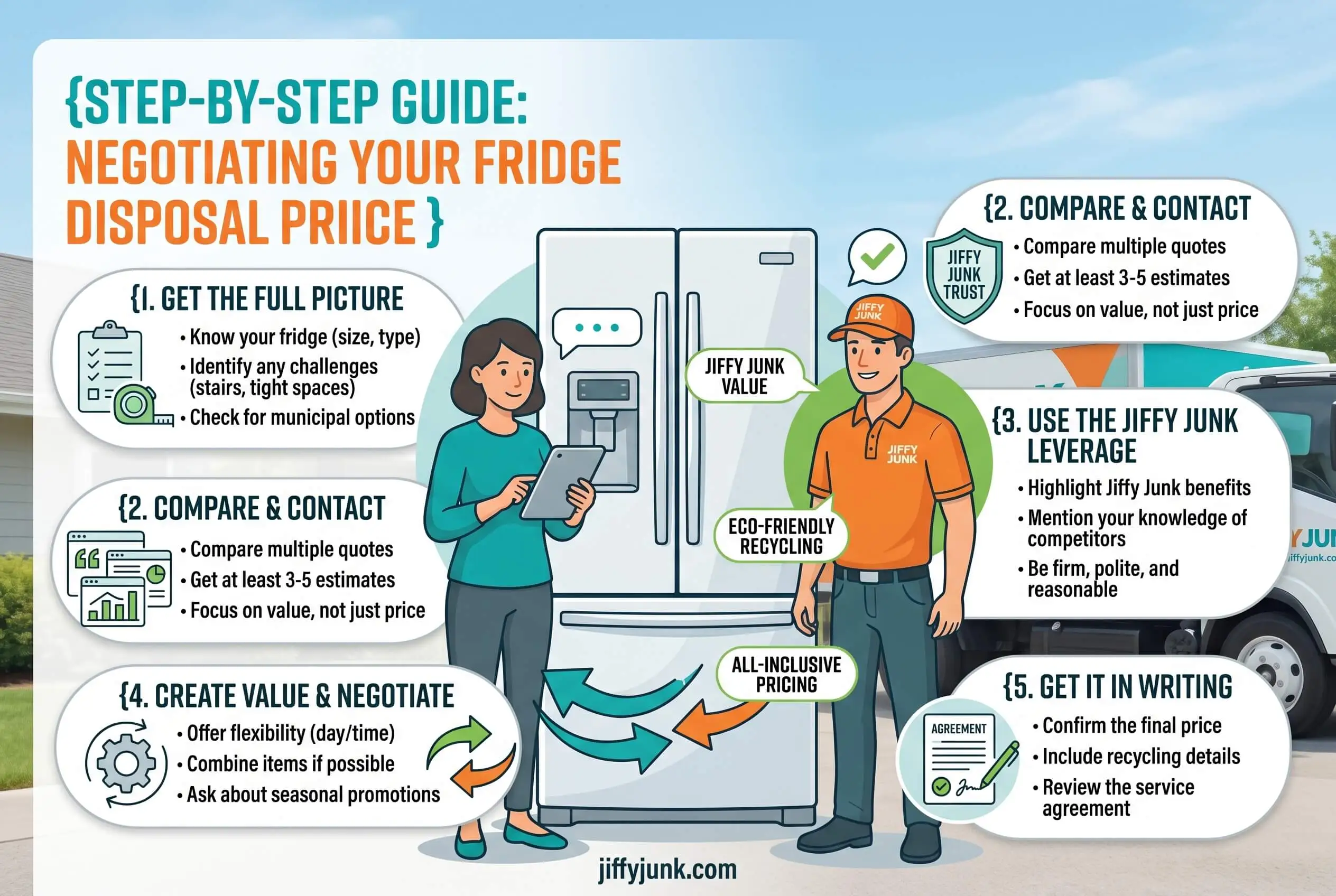
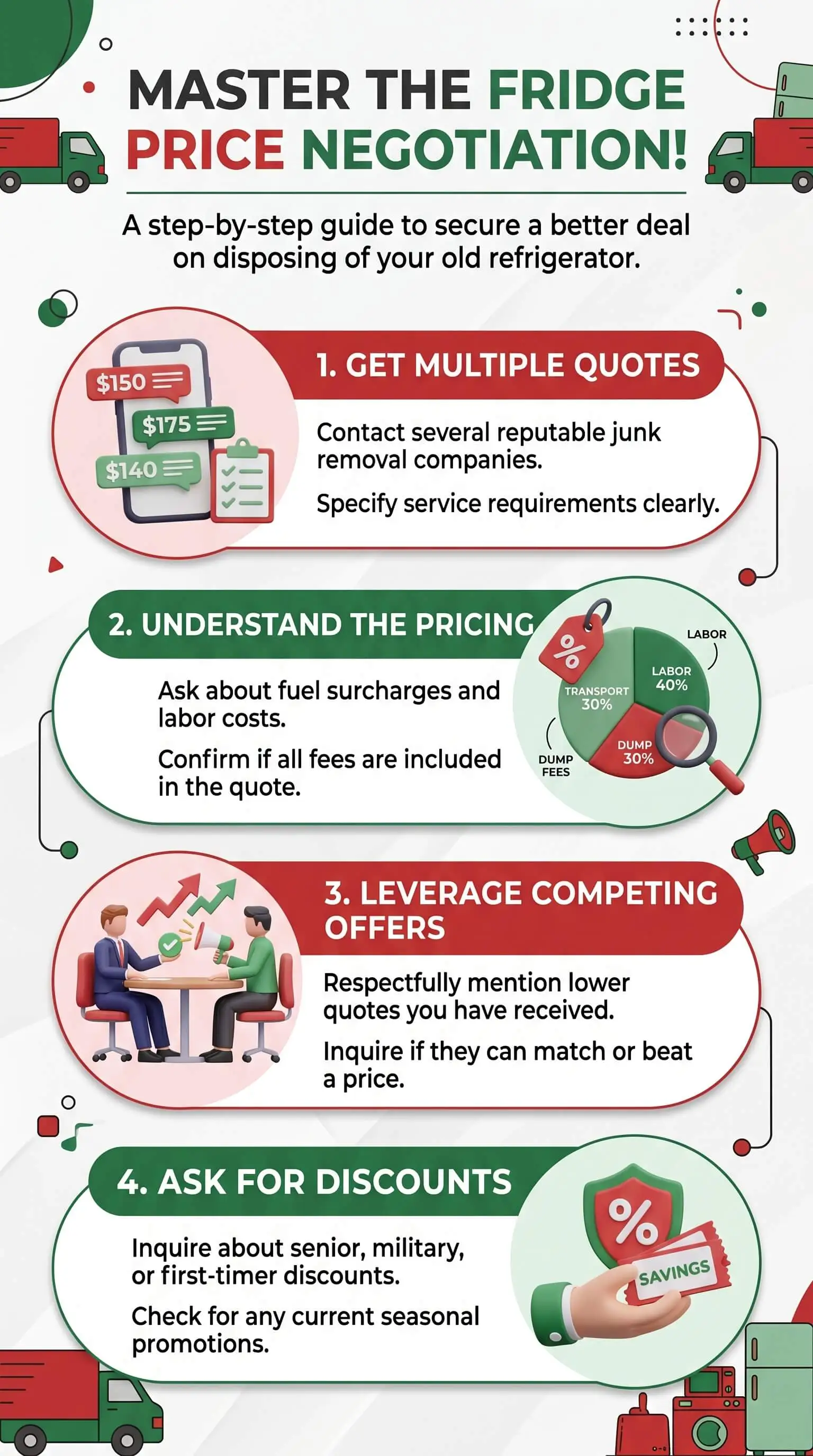
Comparison pricing is the single biggest leverage point you control. Junk removal pricing varies sharply between national franchises, locally-owned operators, and online-quote services. Get three written quotes. Then call the lowest-priced provider you actually want to use and ask the others to match or beat it.
National franchises usually offer the most quote flexibility because dispatch happens locally but pricing isn't fully fixed at corporate. Locally-owned operators often start with the lowest sticker price but offer less wiggle room. Online-quote services like Jiffy Junk publish transparent rates upfront, which makes them useful as a baseline benchmark even if you ultimately book elsewhere. Their breakdown of how professional fridge pickup and removal works lays out the pricing structure before you commit.
Timing: When Junk Removal Companies Discount Most
Book Tuesday through Thursday. Avoid Saturday. It's the highest-demand day of the week, and dispatchers have no incentive to discount. End of month and end of quarter are softer pricing windows because franchise locations push toward sales targets. The most overlooked discount window is late afternoon on a slow weather day, when a half-empty truck is heading back to the yard. A single-fridge pickup that fills the deadhead leg is pure margin for the hauler, and they'll often cut 20% to 30% off the standard rate to land it.
Five Negotiation Lines That Actually Work
These are the exact phrases (tested in actual dispatch conversations) that move pricing:
The competitors are close. "Company X quoted me $95. Match or beat that and I'll book right now."
Bundle ask. "I also have a microwave and an old recliner. What's your price if I add them to the same job?" Bundled items rarely cost what individual items cost.
Cash discount. "Do you offer a discount for cash payment at the time of service?" Many locally-owned operators will quietly drop 5% to 10%.
Schedule flex. "I'm flexible on day and time. What's your best price for a route-fill slot this week?" This signals you understand dispatch logistics.
Future business angle. "I'm renovating and will need a bigger haul in two months. Can you give me a better rate today to win that job too?"
What Not to Do
Don't lead with "what's your cheapest price?" That phrasing signals price-shopper, kills rapport, and gets you a defensive quote. Don't fabricate competitor numbers either. Dispatchers in the same regional market often know each other's pricing within a tight band, and a fake quote ends the conversation. Don't try to renegotiate after the truck arrives, because you've lost all leverage at that point. And never skip disclosing the refrigerant. Legitimate haulers will charge a small handling fee on-site if you spring it on them. Illegitimate ones will simply vent it and walk away with your money, which leaves you legally exposed.
Red Flags: When a Quote Is Too Low
A sub-$50 fridge disposal quote in most U.S. markets is a warning sign. EPA Section 608 mandates certified refrigerant recovery before any fridge can legally hit a scrap pile, and that compliance carries a cost floor. Operators below it are typically uninsured, dumping illegally, or both, which can undermine the cleaner-home goals homeowners often associate with responsible choices like using air purifiers. Watch for these warning signs: cash-only with no written confirmation, no mention of refrigerant recovery, no proof of disposal documentation, and no verifiable business address or insurance certificate.
"The customers who pay the lowest prices aren't the ones who haggle hardest. They're the ones who understand the dispatcher's day. When you call at 2 p.m. on a Tuesday and ask about a route-fill slot, you're not asking for a favor. You're solving a problem. Those customers consistently land 20% to 30% below standard pricing without any pushback. The negotiation isn't adversarial when both sides win, and a half-empty truck on its way back to the yard is the cheapest junk removal in any market. You just have to know how to ask for it."
7 Essential Resources
Each link below points to a verified primary source for understanding fridge disposal cost, regulation, and recycling pathways.
EPA Appliance Disposal Guidance. The federal government's official consumer page on responsible appliance disposal, including refrigerant recovery requirements.
EPA Section 608 Refrigerant Management Program. The regulatory framework that requires certified refrigerant recovery before any fridge can be scrapped.
ENERGY STAR Fridge & Freezer Recycling Program Locator. Find utility rebates and free pickup programs in your area.
ENERGY STAR Flip Your Fridge Calculator. Calculate the energy cost of keeping your old fridge versus replacing it.
Department of Energy: Purchasing and Maintaining Refrigerators. Official guidance on replacement timing and recycling.
EPA Responsible Appliance Disposal (RAD) Program. A voluntary EPA partnership program that ensures old refrigerators meet best environmental practices for disposal, including foam recovery.
Jiffy Junk: Fridge Pickup, Removal, Haul-Away and Disposal Guide. A practical operator-side breakdown of how professional fridge removal pricing and logistics actually work.
3 Statistics
The numbers behind fridge disposal in the United States. Each figure links to its primary source.
More than 13 million refrigerators and freezers are disposed of in the United States every year, according to the EPA's Responsible Appliance Disposal Program. That recurring volume is what creates the demand junk removal companies depend on, and the pricing competition customers can use.
The 2026 average appliance removal cost is $100, with most jobs falling between $60 and $180, according to Angi's 2026 cost data. Refrigerators sit at the upper end of that range due to refrigerant handling, which puts most fridge disposal jobs at $75 to $200 before negotiation.
Refrigerators 15 years or older consume roughly twice the energy of a new ENERGY STAR certified model, according to the ENERGY STAR Flip Your Fridge program. Replacing one can save more than $300 in energy costs over five years. The disposal expense often pays for itself within months.
Final Thoughts and Opinion
Most household disposal advice treats fridge removal as a one-shot purchase: pick a hauler, pay the quote, move on. That framing is wrong. The market has surprising pricing flexibility and a dispatcher-driven margin structure that rewards informed customers. Walking into the conversation knowing the average price range, the off-peak booking windows, and the bundling angle will reliably save $30 to $80. That's not life-changing money, but it isn't nothing for a five-minute phone call.
There's a more important point worth making. Most homeowners leave free money on the table by not checking utility rebate programs first. A working older fridge can earn the homeowner a $30 to $75 utility credit through programs administered under the EPA's RAD framework. A junk removal company will charge that same homeowner $100 or more for the same outcome. The information asymmetry there is the actual story. Spend ten minutes on the ENERGY STAR locator before you call any hauler.
Frequently Asked Questions
How much does it cost to dispose of an old refrigerator? Professional fridge disposal typically runs $75 to $200 in 2026, with the national average around $100. Pricing varies by region, accessibility, and whether the unit gets bundled into a multi-item pickup. Negotiation, off-peak booking, and bundling can drop that figure by 20% to 40%.
Can I negotiate with junk removal companies? Yes. Most junk removal pricing is dispatcher-flexible rather than fixed. Comparison quotes, route-fill timing requests, bundled items, and cash payment are the four most reliable levers. National franchises tend to have more flexibility than locally-owned operators.
Do junk removal companies recycle refrigerators? Reputable companies do. Federal law requires refrigerant recovery before scrapping, and most legitimate haulers route fridges to certified appliance recyclers. Always ask for documentation. Operators offering very low quotes without mentioning refrigerant handling are warning signs.
Is it cheaper to take a fridge to the dump myself? Sometimes, but rarely worth it. Truck rental, refrigerant recovery requirements, and disposal facility fees usually add up to within $20 of a professional removal, without the labor or compliance risk.
What's the cheapest legal way to get rid of an old refrigerator? A utility rebate program is almost always cheapest. Many pay you $30 to $75 to take a working fridge. If that's unavailable, retailer haul-away on a new appliance purchase ($25 to $75) is the next cheapest. Junk removal is the fastest option but not the cheapest.
Do I need to remove the refrigerant before disposal? You personally don't, but an EPA Section 608 certified technician must remove it before anyone can legally scrap the unit. Reputable junk removal companies coordinate this through their disposal partners.
Will the city pick up my old fridge for free? Many cities offer scheduled bulk pickup for $0 to $40, but typically with a one to three week wait and specific scheduling rules. Check your local sanitation department's website.
CTA
Before you book your fridge pickup, do these three things in order: check the ENERGY STAR rebate locator, get three written quotes, and ask each provider for a route-fill discount. If you'd rather skip the back-and-forth and book a pickup with transparent upfront pricing and a certificate of disposal included, tap here for professional fridge pickup, removal, haul-away, and disposal. Pricing is published before you commit, and refrigerant handling is documented as part of the service.
