Pull the HVAC filter from a smoking household at the 30-day mark and the evidence is right there in your hands. The media face runs brown-gray and heavy, loaded with combustion particles dense enough to restrict airflow. That’s not the light gray-dust accumulation you’d expect in a non-smoking home at 90 days. After manufacturing filters for over a decade, we’ve seen that specific loading pattern more than any other from homeowners dealing with persistent indoor odor and air quality problems they couldn’t pin down.
What makes tobacco smoke harder to manage than standard household dust is particle size. Most smoke particles fall between 0.1 and 1.0 microns, well below the effective capture threshold of standard residential air filters. That gap is where most filter selection decisions go wrong, and this page closes it.
TL;DR Quick Answers
air filters
An air filter is a replaceable media panel installed in a home's HVAC system that traps airborne particles — dust, pollen, pet dander, mold spores, and smoke — before they circulate through your living spaces. Filters are rated on the MERV scale (Minimum Efficiency Reporting Value): the higher the number, the smaller the particles captured. MERV 8 handles everyday household dust. MERV 11 adds fine particle and allergen control. MERV 13 targets smoke and bacteria-sized particles. Filters require replacement every 30 to 90 days depending on household conditions — homes with pets, smokers, or allergy sufferers benefit from changing air filters more frequently to maintain cleaner indoor air and stronger system performance. Choosing the right air filters for your system’s rated MERV capacity helps protect your family’s air quality while also supporting your HVAC equipment’s lifespan.
Top Takeaways
Tobacco smoke generates particles between 0.1 and 1.0 microns, well below the effective capture range of MERV 1 through MERV 8 filters built for standard household dust.
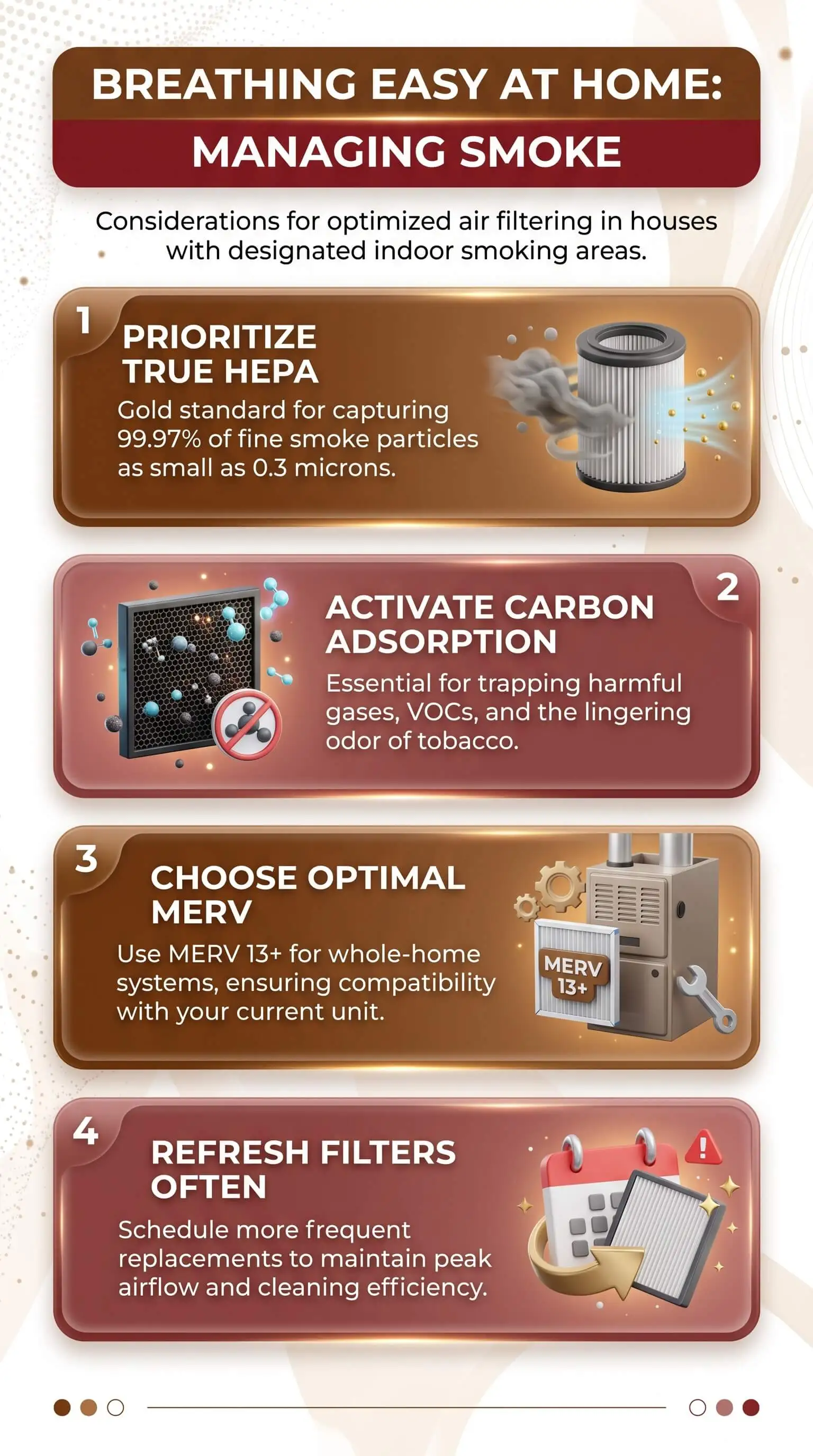
MERV 13 is the recommended minimum for homes with active indoor smoking rooms. It’s the lowest rating at which particle capture starts making a meaningful difference for tobacco smoke specifically.
Activated carbon is required alongside mechanical filtration. MERV-rated media captures particles. Carbon media captures the gas-phase VOCs that carry smoke odor. A filter that only does one of those jobs handles half the problem.
Upgrading to a higher MERV filter increases airflow resistance. Confirm your HVAC system’s maximum rated MERV before buying to avoid straining the blower or restricting airflow.
Replace filters every 30 to 45 days in active smoking rooms, roughly half the interval for a non-smoking household.
The most complete approach pairs a high-MERV HVAC filter for whole-home particle recirculation with a standalone activated carbon purifier in the smoking room for source-level VOC and odor control.
Why Standard Air Filters Fall Short in Smoking Rooms
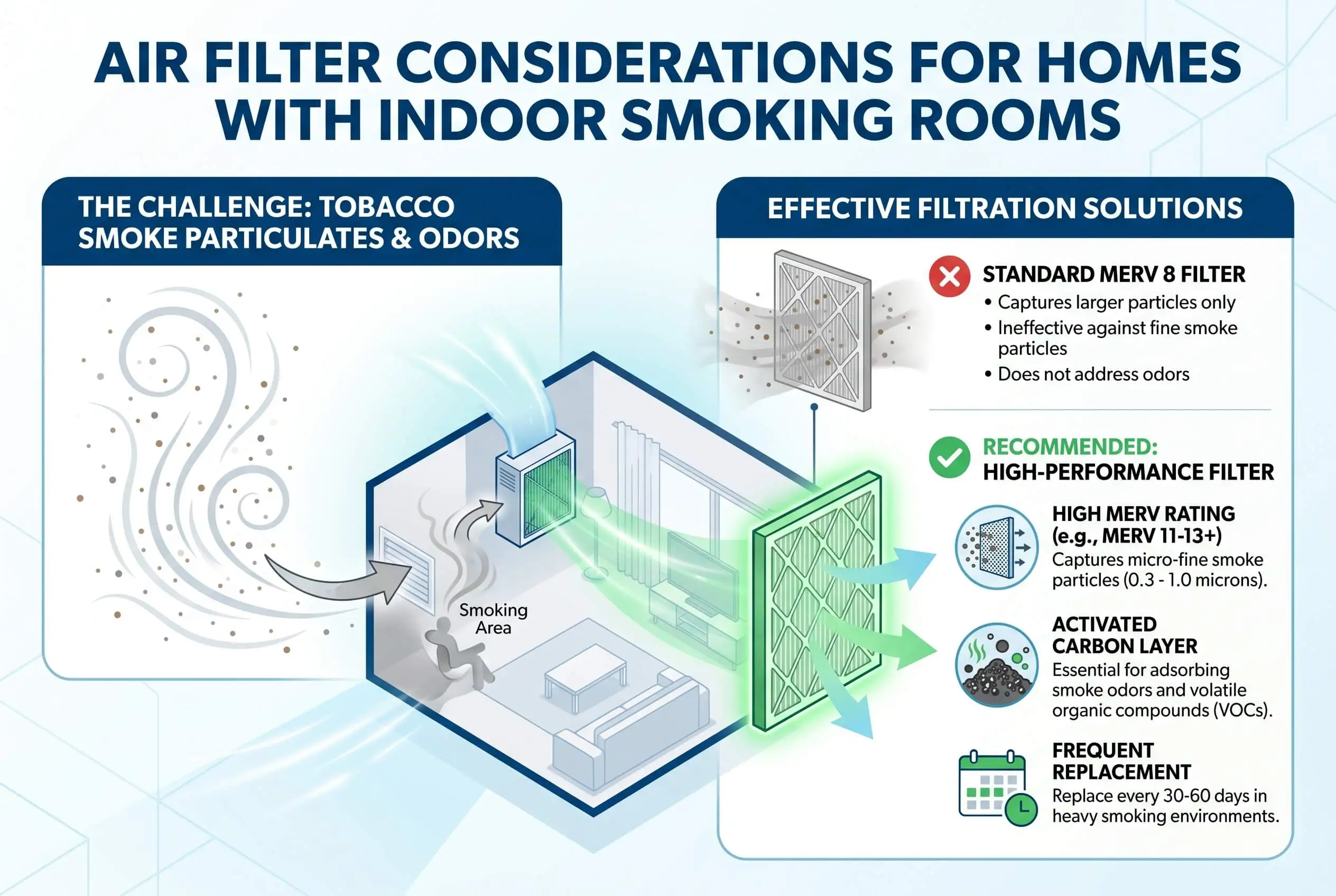
Standard residential HVAC filters protect equipment from debris. They were not designed to capture fine combustion particles, and the numbers make that clear: a MERV 1 through MERV 4 filter catches lint, dust, and carpet fibers at 10 microns or larger. Tobacco smoke generates particles between 0.1 and 1.0 microns. That’s a 10-to-1 size difference, and it means a basic filter lets the majority of smoke particles pass straight through the media and keep circulating through every room the system serves.
Particle capture is only half the problem. Tobacco combustion also releases benzene, formaldehyde, and acetaldehyde as gases — volatile organic compounds that no pleated filter captures, regardless of MERV rating. A high-MERV filter handles the particulate load. The carbon stage handles the gases. Homes with active smoking rooms need both.
MERV Ratings and Smoke: What the Numbers Actually Mean
MERV stands for Minimum Efficiency Reporting Value, a standardized scale that measures how efficiently a filter captures particles across specific size ranges. The higher the rating, the smaller the particles it stops. Against tobacco smoke, the ratings break down like this:
MERV 8: Captures particles 3 microns and larger effectively. Strong performance for dust, pollen, and mold spores. In the 1.0-to-3.0-micron smoke range, it catches fewer than 20 percent. Not the right choice for active smoking rooms.
MERV 11: Performance improves meaningfully on particles down to 1.0 micron. A practical choice for light or occasional indoor smoking, or for systems where MERV 13 would push past the rated airflow capacity.
MERV 13: Captures 50 to 75 percent of particles in the 0.3-to-1.0-micron range. This is the recommended minimum for homes with active smoking rooms, and the point at which particle capture starts making a meaningful difference for tobacco smoke specifically.
MERV 16: Hospital-grade capture efficiency at the fine particle end. It can introduce more airflow resistance than older or smaller residential systems handle well, so check your system’s specifications before going this route.
One compatibility issue worth knowing before you buy: a higher MERV rating means denser media, which increases airflow resistance. Check your HVAC equipment manual or ask a technician to confirm the system’s maximum rated MERV before upgrading. Running a filter above that specification reduces airflow, strains the blower, and shortens equipment life.
Filter Media Types That Target Smoke
HEPA Filtration
True HEPA filters capture 99.97 percent of particles at 0.3 microns, a performance standard developed for medical and industrial settings. For most residential HVAC systems, that density is a problem. The media is too thick for residential air handlers, and running air through it risks collapsing the filter or damaging the blower motor. HEPA is the right choice in a standalone portable purifier placed directly in the smoking room, where the unit’s fan is built for the higher resistance.
Activated Carbon Filtration
Activated carbon works through adsorption. Gas molecules bond to the enormous surface area packed into the carbon material, and it’s the only residential filtration media that directly targets VOCs and smoke odor. Carbon alone doesn’t capture fine particles, which is why combination filters are the most practical solution for smoking rooms: a pleated MERV-rated layer stops the particles, the bonded carbon layer stops the gases. When comparing options, check for products that specify the weight of the carbon layer. A heavier load adsorbs more VOCs before it saturates.
Electrostatic Filters
Washable electrostatic filters use a static charge generated by airflow to attract particles to the media, and the reusable design cuts ongoing replacement costs. Their real-world capture efficiency, though, is frequently overstated and depends heavily on how consistently the filter gets cleaned. In a smoking room, that cleaning needs to happen every two to four weeks. Most households don’t maintain that schedule. A well-maintained high-MERV pleated filter is the more reliable choice for heavy smoke loads.
How to Choose the Right Air Filter for a Smoking Room
These five steps, done in order, prevent the most common filter mistakes: the wrong MERV for your system, the wrong dimensions for the slot, or skipping the carbon stage your household needs.
Step 1: Locate your filter slot and record the dimensions. Measure length, width, and depth in inches. The size printed on your current filter’s frame is the nominal size, which may differ slightly from the actual opening.
Step 2: Confirm your HVAC system’s maximum rated MERV. Check the equipment manual or look up your unit’s model number. Most residential systems are rated between MERV 8 and MERV 13.
Step 3: Select the highest MERV your system supports. For homes with active smoking rooms, that means MERV 11 at minimum and MERV 13 wherever the system specification allows.
Step 4: Add a standalone activated carbon unit in the smoking room. The HVAC filter handles whole-home particle recirculation. The carbon unit handles source-level VOC and odor concentration where it’s highest.
Step 5: Set a 30-to-45-day replacement schedule. Smoke loads filters significantly faster than household dust. Mark the installation date on the filter frame and replace at 30 days for heavily used rooms, 45 days for moderate use.
Filter Change Frequency for Smoking Rooms
The visual difference between a filter pulled from a smoking home at 30 days and one pulled from a non-smoking home at 90 days tells you everything. Smoke loading shows up as dense brown-gray accumulation across the full media face. Standard dust shows up as light gray at the edges. The smoke-loaded filter is also restricting airflow, which forces the HVAC unit to work harder to move the same volume of air.
The standard replacement interval for most households is 60 to 90 days. For homes with active indoor smoking rooms, cut that to 30 to 45 days. Hold your hand near a supply vent as a quick secondary check. Noticeably reduced airflow before your scheduled change date means the filter needs replacing now.
“Most homeowners in smoking households reach for the highest MERV filter available, which is the right instinct. But media thickness matters as much as the rating. A 4-inch or 5-inch filter at MERV 11 often outperforms a thin 1-inch MERV 13 because the particles spend more time in contact with the filtration surface. Matching media depth to your specific system is the step most people miss, and it’s one of the most consistent patterns we see.”
7 Essential Resources
The resources below give you the scientific and regulatory foundation behind every recommendation on this page. Each source has been verified live.
1. How the EPA Explains Secondhand Smoke and Your HVAC System
Ventilation and filtration can reduce secondhand smoke exposure indoors, but neither eliminates it. That’s the EPA’s direct position, and it matters before you set expectations for any filter upgrade. This resource explains what indoor tobacco smoke contains, how it travels through a building, and what the agency considers effective in reducing exposure.
Source: https://www.epa.gov/indoor-air-quality-iaq/secondhand-tobacco-smoke-and-indoor-air-quality
2. The CDC’s Breakdown of Health Problems Caused by Secondhand Smoke
The CDC documents exactly what secondhand smoke does to nonsmokers’ cardiovascular and respiratory systems. For homeowners making filter decisions, this resource puts the health stakes in concrete terms: brief exposure produces measurable physiological changes, and that’s the case for fine-particle capture at the HVAC level.
Source: https://www.cdc.gov/tobacco/secondhand-smoke/health.html
3. The American Lung Association’s Guide to Air Cleaning and Filter Selection
The Lung Association covers the practical difference between portable air cleaners and HVAC-based filtration, what MERV ratings actually measure, and when a standalone unit makes sense alongside a central system. Their guidance on HEPA application and MERV performance expectations matches the approach we recommend for smoking households.
Source: https://www.lung.org/clean-air/indoor-air/protecting-from-air-pollution/air-cleaning
4. Source Control: The Lung Association’s First Recommendation for Indoor Pollution
The American Lung Association’s first recommendation before any filtration discussion is source control: reduce or eliminate the pollutant at its source. For smoking rooms, this resource grounds the principle that filtration supplements behavioral controls rather than replaces them. Knowing that helps homeowners set realistic expectations for what even a MERV 13 filter can accomplish.
Source: https://www.lung.org/clean-air/indoor-air/protecting-from-air-pollution/source-control
5. EPA: An Introduction to Indoor Air Quality and Pollutant Sources
This EPA overview explains how indoor pollution sources release gases and particles, why inadequate ventilation compounds the problem, and how activities like smoking can leave pollutant concentrations elevated long after the activity itself stops. The section on intermittent pollutant sources makes the clearest case for why carbon media is necessary alongside mechanical filtration in smoking households.
Source: https://www.epa.gov/indoor-air-quality-iaq/introduction-indoor-air-quality
6. EPA on Volatile Organic Compounds and Their Impact on Indoor Air Quality
The EPA’s resource on VOCs explains how gas-phase pollutants form indoors, why their concentrations consistently run higher than outdoors, and which household sources produce them in the greatest volume. Tobacco combustion is among the most significant residential VOC sources, releasing benzene and formaldehyde that mechanical filtration can’t touch. This is the scientific grounding for why activated carbon is a required second layer in any smoking-room filtration approach.
Source: https://www.epa.gov/indoor-air-quality-iaq/volatile-organic-compounds-impact-indoor-air-quality
7. ASHRAE Standard 62.2: The Residential Ventilation Benchmark
ASHRAE Standard 62.2 is the only U.S. standard focused exclusively on indoor air quality in residential buildings. It defines minimum ventilation rates, filtration requirements, and how HVAC systems should work together to minimize indoor pollutants. For anyone upgrading to a higher MERV filter, this is the technical framework HVAC engineers and equipment manufacturers use to rate system compatibility and airflow performance thresholds.
Source: https://www.ashrae.org/technical-resources/bookstore/standards-62-1-62-2
3 Statistics
Indoor Air Is Already Starting From Behind
The EPA reports that Americans spend about 90 percent of their time indoors, and that indoor concentrations of some pollutants run 2 to 5 times higher than outdoor levels. In a home with an active smoking room and an underperforming HVAC filter, those numbers stack. We hear this regularly from homeowners who are surprised to learn that their most significant daily pollution exposure isn’t coming from outside at all. Upgrading your filter is one of the most direct ways to change that.
Source: https://www.epa.gov/report-environment/indoor-air-quality
The Cardiovascular Toll of Secondhand Smoke Is Measurable
The CDC reports that secondhand smoke causes nearly 34,000 premature deaths from heart disease each year among adults who don’t smoke. That figure reflects chronic, repeated exposure — not one-time incidents. Every air change through an inadequate filter in a smoking household sends smoke-range particles through the breathing space of everyone who doesn’t smoke. Better filter selection reduces the particle load on every one of those cycles.
Source: https://www.cdc.gov/tobacco/secondhand-smoke/health.html
Secondhand Smoke Exposure Remains a Household Reality for Millions
CDC data from the National Health and Nutrition Examination Survey found that approximately 58 million nonsmoking Americans were exposed to secondhand smoke during 2013 through 2014. Among those living in the same home as a smoker, 73 percent showed measurable cotinine in their blood, the established marker for secondhand smoke absorption. For the nonsmoking occupants of any smoking household, that exposure is ongoing and daily. In that context, filter selection is a health decision.
Source: https://www.cdc.gov/mmwr/volumes/67/wr/mm6748a3.htm
Final Thoughts and Opinion
No single filter solves the indoor smoking room problem, and saying so is the most useful thing we can tell a homeowner trying to protect their family. A MERV 13 filter in the HVAC system addresses fine particle recirculation. The activated carbon unit in the smoking room handles the VOC load. A 30-to-45-day replacement schedule keeps both working as intended. Each part does a different job, and skipping any one of them leaves a gap the others can’t fill.
The larger mistake we see is treating filter selection as a one-time decision. A MERV 13 filter in a heavy smoking household that hasn’t been changed in 90 days isn’t doing its job by day 45. The filter that protects your family is the clean one: current, properly rated, and replaced before it loads past the point of effectiveness. You’ve already decided to take this seriously. The information above gives you what you need to do it right.
Frequently Asked Questions
Q: What MERV rating do I need for an indoor smoking room?
A: MERV 13 is the recommended minimum for homes with active indoor smoking rooms. Tobacco smoke produces particles primarily in the 0.1-to-1.0-micron range, and MERV 13 filters capture 50 to 75 percent of particles in that size band, which is a meaningful step up from MERV 8 or lower. Before installing one, confirm your HVAC system’s rated maximum MERV. If your system tops out at MERV 11, use the highest rating it allows and add a standalone air purifier in the smoking room.
Q: Will a HEPA filter work in my HVAC system for smoke?
A: True HEPA filtration is rarely compatible with residential HVAC systems. HEPA media is too dense for most residential air handlers, and running air through it in a standard duct system can collapse the filter or damage the blower. For whole-home smoke particle filtration, MERV 13 through MERV 16 is the appropriate residential range. HEPA is an excellent choice in a standalone portable purifier placed directly in the smoking room, where the unit’s fan is built for the higher resistance.
Q: How often should I change my air filter if someone smokes indoors?
A: Every 30 to 45 days for homes with active indoor smoking rooms. Tobacco smoke loads filter media significantly faster than standard household dust. Check the filter visually at 30 days and replace it when heavily loaded. If airflow from supply vents feels noticeably reduced before your scheduled change date, replace the filter immediately.
Q: Does an air filter remove the smell of cigarette smoke?
A: A mechanical HVAC filter captures smoke particles but leaves the odor-producing gases untouched. Smoke smell comes from volatile organic compounds — benzene, formaldehyde, acetaldehyde — that pass straight through pleated media. Activated carbon is required for smoke odor control. Look for combination filters that include both a pleated MERV-rated stage and a bonded activated carbon layer, or add a standalone carbon-based purifier in the smoking room alongside your upgraded HVAC filter.
Q: Can I use a standalone air purifier instead of upgrading my HVAC filter?
A: Both serve distinct functions and work best together. A standalone air purifier treats the air in a single room but doesn’t address smoke particles that have already entered the HVAC system and are recirculating through the rest of the home. Your HVAC filter processes every cubic foot of air your system moves, reaching every room. Upgrading the HVAC filter reduces whole-home smoke particle recirculation. The standalone purifier handles the concentrated source load in the smoking room. Using both provides the most complete coverage.
Q: What size air filter do I need for my HVAC system?
Find your filter size by measuring the slot: length, width, and depth in inches. The nominal size printed on your current filter’s frame is your starting point, though actual slot dimensions sometimes differ slightly from what’s labeled. If your system uses an uncommon size, Filterbuy carries MERV-rated filters across hundreds of standard and custom dimensions, including 1-inch through 5-inch media depths suited to smoking-room applications.
Ready to Find the Right Filter for Your Home?
The right filter for a smoking household exists. Finding it means knowing your system’s MERV limit, your slot dimensions, and which media type your situation actually calls for.
Browse MERV-rated air filters at Filterbuy, available in hundreds of standard and custom sizes across MERV 8, MERV 11, MERV 13, and higher ratings, including 1-inch through 5-inch media options suited to homes with smoking rooms.
Better Air For All.
