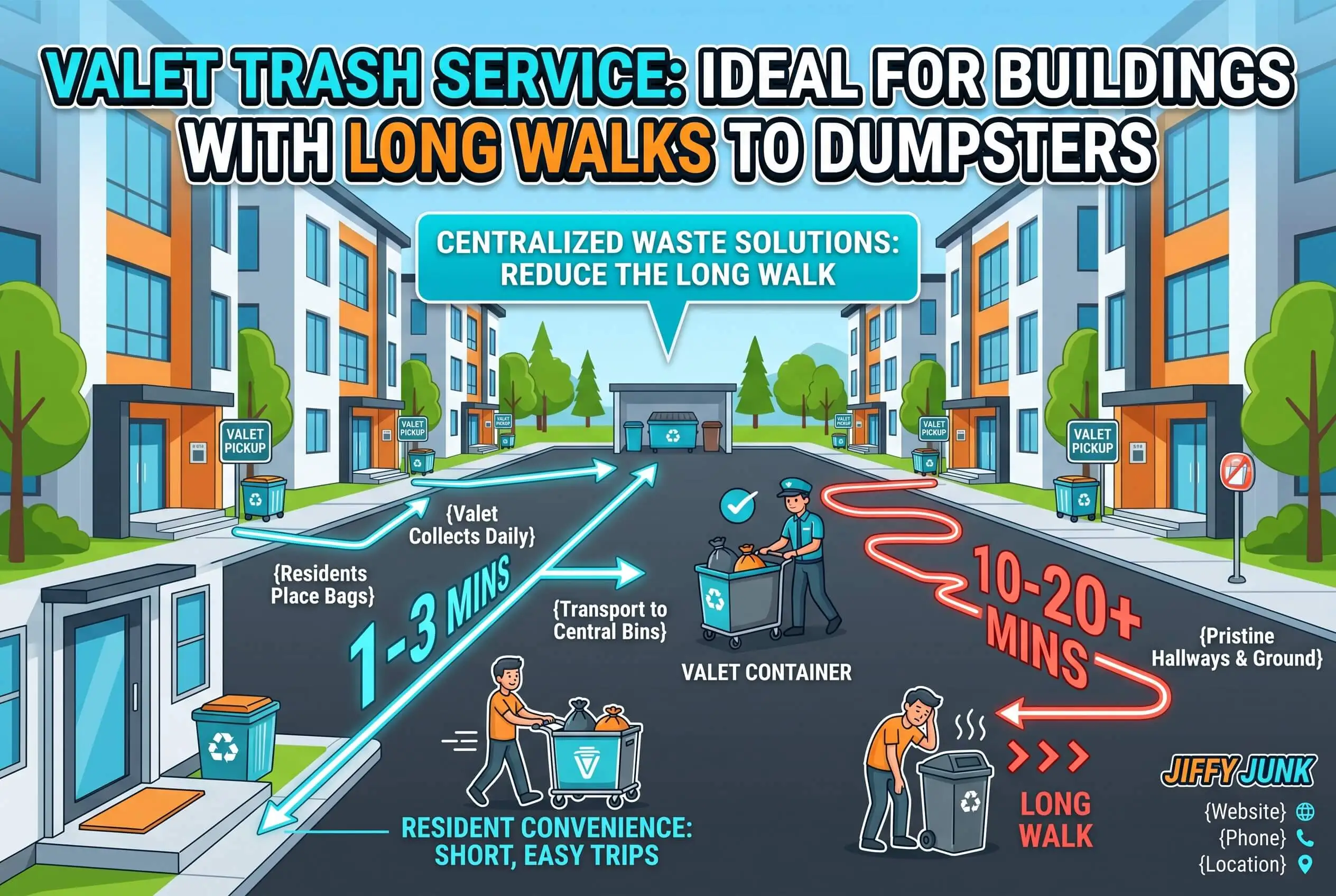
At a 300-unit garden-style complex, that walk can run 200 to 400 feet for a meaningful share of residents, usually after dark, often in bad weather, and never appreciated more than the first time it gets skipped. A valet trash pickup service is the fix. A uniformed crew picks up tied bags from outside each apartment door on scheduled evenings and walks them to the property’s central dumpster or compactor. Done well, it earns its monthly fee on convenience, safety, and the look of the community itself.
The pages below cover how the service works, why long-walk apartments are the strongest use case for it, what residents and property managers should expect to pay, and what to look for when picking a provider.
TL;DR Quick Answers
Valet Trash Pickup Service
A valet trash pickup service is a doorstep waste collection amenity for apartments. A uniformed crew picks up tied bags from outside each resident's door on scheduled evenings and walks them to the property's central dumpster or compactor. Standard model: five nights a week, between 6 PM and 10 PM. Residents leave bags in a lidded container the service provides. Resident charge typically runs $20 to $35 per unit per month, billed through rent. The service earns its keep at properties where the dumpster sits a long walk from the apartment door, and where residents shouldn't be hauling heavy bags through poorly lit lots after dark. At Jiffy Junk we treat it as an operational fix first, an amenity line second.
Top Takeaways
Long walks to the dumpster are the strongest use case. The further the walk, the more residents value not making it.
Convenience, safety, and cleanup all improve. In resident feedback, convenience comes first, safety second, cleanup third.
Typical pricing runs $20 to $35 per unit per month, usually billed through rent. Property-side wholesale runs $8 to $15.
Residents typically can’t opt out individually. The provider contracts with the property, not with each resident.
Quality varies. The questions that matter: licensing, background-checked personnel, clear bag and bin specs, severe-weather policy, recycling handling, reporting cadence.
The strongest case is operational, not amenity-driven. Cleaner hallways, fewer overflow events, and lower slip-and-fall exposure are real measurable benefits.
What a Valet Trash Pickup Service Actually Does
The name comes from the historical role of a valet, a personal attendant who handled domestic tasks. The service borrows the spirit. Residents stop walking trash to a dumpster. A crew walks it for them.
Standard model in U.S. multifamily:
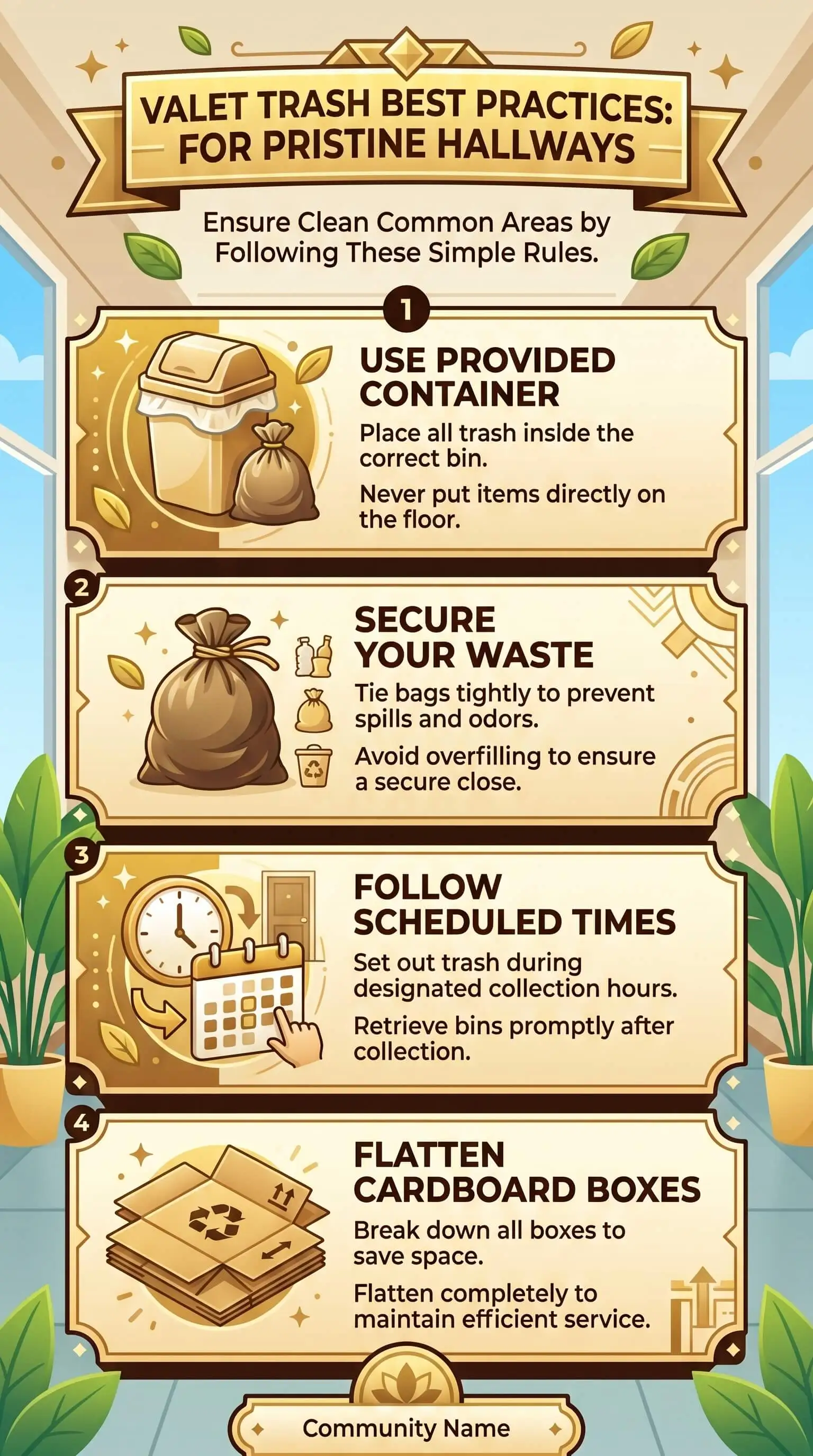
Five evenings a week, typically Sunday through Thursday, residents put tied trash bags inside a lidded container provided by the service. The container sits just outside their apartment door.
Between 6 PM and 10 PM, a uniformed crew walks the property, picks up the bags, and hauls them to the central dumpster or compactor.
The container stays outside the door, ready for the next evening.
Recycling sometimes comes with the package on a separate weekly pickup. Sometimes the provider doesn’t handle it at all. Terms vary by provider and property contract.
Why Long Walks to the Dumpster Are an Underrated Problem
In garden-style and large suburban complexes, residents farthest from a dumpster can walk 200 to 400 feet each way. Multiply that by two or three trash trips a week per household and the time alone adds up.
Time isn’t the worst of it.
Safety is. Poorly lit pathways, parking-lot crossings, ice and rain, isolated dumpster enclosures behind the building, all of it raises injury and after-dark exposure risk. Older residents and mobility-limited residents pay the highest cost. Walking heavy bags across an icy lot at 9 PM is exactly the scenario that lands someone in an emergency department.
The trash also stays in the apartment when the walk is bad enough. Residents delay. Bags pile up in kitchens, on balconies, in hallways. That creates odor complaints, pest issues, and lease-violation conversations nobody wants to have.
And dumpsters overflow. When residents wait until the trash situation is unmanageable and then haul three bags at once, scheduled hauls can’t keep up. Overflow blows trash through the parking lot. Properties pay emergency hauling fees to clean it up.
How Valet Trash Solves the Long-Walk Problem
The mechanism is simple. The service shifts the longest part of the routine, the walk to the dumpster, from residents to a trained crew. From there:
Convenience. Residents reclaim 30 to 60 minutes a week and stop dreading the after-dinner trash run. In our review of resident feedback across multifamily property listings, the most common positive note about valet trash isn’t pricing. It’s the simple relief of not having to make the walk.
Safety. Slip-and-fall risk, after-dark exposure, and weather-related injury risk all drop. For property owners, that translates to liability reduction. Falls are the leading cause of injury for adults 65 and older. Removing a long, twice-weekly trash haul from an older resident’s routine is a real reduction in fall exposure, not a marketing flourish, while an air purifier can further support a safer, more comfortable living environment by improving everyday indoor conditions.
Cleanup. Hallways stay cleaner. Stair landings show fewer trash-bag drag marks. Dumpsters don’t overflow because trained personnel are hauling bags on a schedule rather than residents stockpiling and dumping in waves. Curb appeal increasingly tracks with leasing-tour conversion rates, and the dumpster area is one of the first things prospective renters notice on a tour.
Pricing & What to Expect
Pricing varies by region, route density, pickup frequency, and whether recycling is bundled. Typical ranges in the U.S.:
Resident charge: $20 to $35 per unit per month, billed through rent or HOA fees.
Property-side wholesale rate: $8 to $15 per unit per month. Properties mark up to residents to cover administration and add the line to amenity revenue.
What pushes pricing higher: more pickup nights per week, recycling included, smaller properties (less route density), regional labor costs.
For a deeper breakdown of how providers calculate valet trash pickup service cost for apartments and homes, Jiffy Junk publishes a useful pricing guide.
A note on opt-out. In most multifamily contracts, residents can’t opt out individually. The provider contracts with the property as a whole, so the charge applies to every unit regardless of personal use. Worth raising with the leasing office before signing a lease, but the same property-wide structure is what keeps the pricing competitive in the first place.
What to Look For in a Provider
Whether you’re a resident asking your property manager about the service or a manager evaluating providers, the same questions apply.
Licensing and insurance. General liability and workers’ compensation. Both verifiable.
Background-checked, uniformed personnel. This crew walks past every resident’s door at night. Hiring standards matter.
Bag and bin specs, clearly stated. Most providers require 13-gallon kitchen bags, tied and sealed. Vague specs cause resident frustration.
Severe-weather and holiday makeup policy. What happens during a winter storm. What happens when a federal holiday lands on the schedule.
Reporting cadence. Better providers offer photo-verified pickup logs and missed-pickup tracking through a property portal or app.
Recycling handling. Separate stream, commingled with trash, or not handled at all. And at what added cost.
“Look at enough multifamily properties and a pattern shows up. The further residents have to walk to the dumpster, the more the property quietly pays for it: emergency hauls, pest calls, hallway cleanup costs, and the slow-burn lease non-renewals from residents who got tired of the walk and never quite said so on the exit survey. Valet trash, priced right and crewed right, is an operational fix that wears an amenity label for marketing reasons. The properties getting the most out of it are the ones that treated it as a cleanup investment first.”
7 Essential Resources
Useful authoritative sources for going deeper on multifamily waste management, amenity strategy, and the safety case for doorstep services:
Wikipedia, Valet. https://en.wikipedia.org/wiki/Valet Background on the historical valet role and how the term migrated into modern hospitality and service language.
U.S. EPA, Apartments/Multi-Family Housing Waste Management. https://archive.epa.gov/wastes/conserve/tools/payt/web/html/top11.html Federal guidance on the structural challenges of waste management in multi-family settings, including why centralized dumpsters create participation and enforcement difficulties.
CDC, Older Adult Falls Data. https://www.cdc.gov/falls/data-research/index.html National data on falls among adults 65 and older, including rates, costs, and trends. Directly relevant to the safety case for removing long trash walks from older residents’ routines.
NMHC, Apartment Industry Quick Facts. https://www.nmhc.org/research-insight/quick-facts-figures/ National Multifamily Housing Council benchmarks on the size, scope, and economics of the U.S. apartment industry.
NAA, Winning the Amenities Arms Race. https://www.naahq.org/news/winning-amenities-arms-race National Apartment Association coverage of the shift from community-wide amenities to individual-resident services, with valet trash named among the modernization indicators.
NAA, Sustainable Living. https://www.naahq.org/sustainable-living NAA hub on multifamily waste, recycling, and sustainability trends, including pricing, hauler contracts, and resident education.
Jiffy Junk, Valet Trash Service Cost Guide. A detailed cost breakdown of valet trash pickup pricing for apartments and homes, including factors that drive variation.
3 Statistics
Three numbers that frame why this amenity matters at scale:
The U.S. apartment industry contributes $3.4 trillion annually to the national economy and provides homes to 38.9 million residents. Source: National Multifamily Housing Council. Any operational fix that lifts retention even slightly compounds across millions of units.
More than 14 million U.S. adults aged 65 and older, about one in four, report falling each year, and falls are the leading cause of injury in this age group. Source: Centers for Disease Control and Prevention. Removing long trash walks from older residents’ weekly routine is a real reduction in fall exposure, not a marketing flourish.
There were approximately 44.6 million renter-occupied housing units in the United States in the 2019–2023 American Community Survey 5-year estimates, up from 43.3 million in the prior 5-year period. Source: U.S. Census Bureau. Renter populations are growing, and amenities that solve real frictions, not just the photogenic ones, increasingly decide which properties keep residents.
Final Thoughts and Opinion
Valet trash often gets lumped in with rooftop pools and dog spas as a luxury upgrade. That misreads what the service actually does. A rooftop pool is genuinely optional, while the trash run is mandatory three or four times a week, often after dark, often in bad weather, often by residents who shouldn’t be hauling heavy bags through poorly lit parking lots. Pricing the service at $20 to $35 a month against that frequency and that exposure profile is a different calculation than pricing a rooftop deck against summer use.
Honest take, after watching how this plays out across actual properties: valet trash earns its keep where the dumpster walk is genuinely long. At a four-unit walk-up where the dumpster sits in the alley, the service is a luxury. At a 300-unit garden-style complex with three dumpster locations and 800-foot walking variability between them, it’s an operational fix that happens to read as an amenity on the leasing brochure.
The properties getting the most value out of it are the ones that brought it in to solve a problem. The ones getting the least are the ones that bolted it on where residents would have been fine walking to the dumpster, then collected the monthly fee and called it a feature.
Frequently Asked Questions
Is valet trash pickup service worth it in apartments far from the dumpster?
For most residents in garden-style or large suburban complexes, yes. The time saved, the safety improvement, and the convenience of doorstep pickup typically outweigh the $20 to $35 monthly cost. The case is weakest at small properties where the dumpster already sits steps from every door.
How much does valet trash pickup service cost per month?
In the U.S., residents typically pay $20 to $35 per unit per month, billed through rent or HOA fees. Property-side wholesale rates run $8 to $15 per unit. Variation depends on pickup frequency, whether recycling is included, property size, and regional labor cost.
Can I opt out of valet trash service in my apartment?
Usually no. Most providers contract with the property as a community-wide amenity, which means the charge applies to all units regardless of individual use. Always confirm with the leasing office before signing a lease if opt-out matters to you.
What’s the difference between valet trash and a regular trash chute?
A trash chute requires the resident to walk to a hallway chute and drop bags down. Valet trash brings collection directly to the apartment door. Chutes work well in mid-rise and high-rise buildings. Valet trash fits garden-style and sprawling suburban properties without chute infrastructure.
Does valet trash pickup include recycling?
Sometimes. Many providers offer recycling on a separate weekly pickup. Others don’t include it at all. Bundled recycling typically adds $3 to $8 per unit per month. Always confirm during the lease-signing conversation.
What happens if I miss the valet trash pickup window?
The bag stays in your container until the next pickup night. Most providers run pickups five evenings a week, Sunday through Thursday, so a missed pickup means a one-day delay at most, except over weekends or holidays.
CTA
If your community is evaluating valet trash, or already pays for it and you’re wondering whether you’re getting what you should, start with the basics. Ask the leasing office about pickup nights, the bag specifications, the severe-weather policy, and whether recycling is in the package. Properties that handle this amenity well welcome the questions. The ones that don’t are exactly the ones where you should keep asking.
Found this useful? Browse our other apartment-living guides on dumpster rentals, junk removal pricing, and household waste management. All of them are linked from the New Articles menu.
