This is the standard we'd want for our own family if eczema and diabetes showed up together: fragrance-free, alcohol-free, pH-balanced, and gentle enough that it's never the reason your skin gets worse.
TL;DR Quick Answers
Best soap for diabetics
The best soap for diabetics is fragrance-free, alcohol-free, pH-balanced, and plant-based, since diabetic skin loses moisture faster and heals more slowly than average skin. NOWATA™ meets all four criteria and adds Swiss lab-verified removal of 99.9% of germs, with no rinse required.*
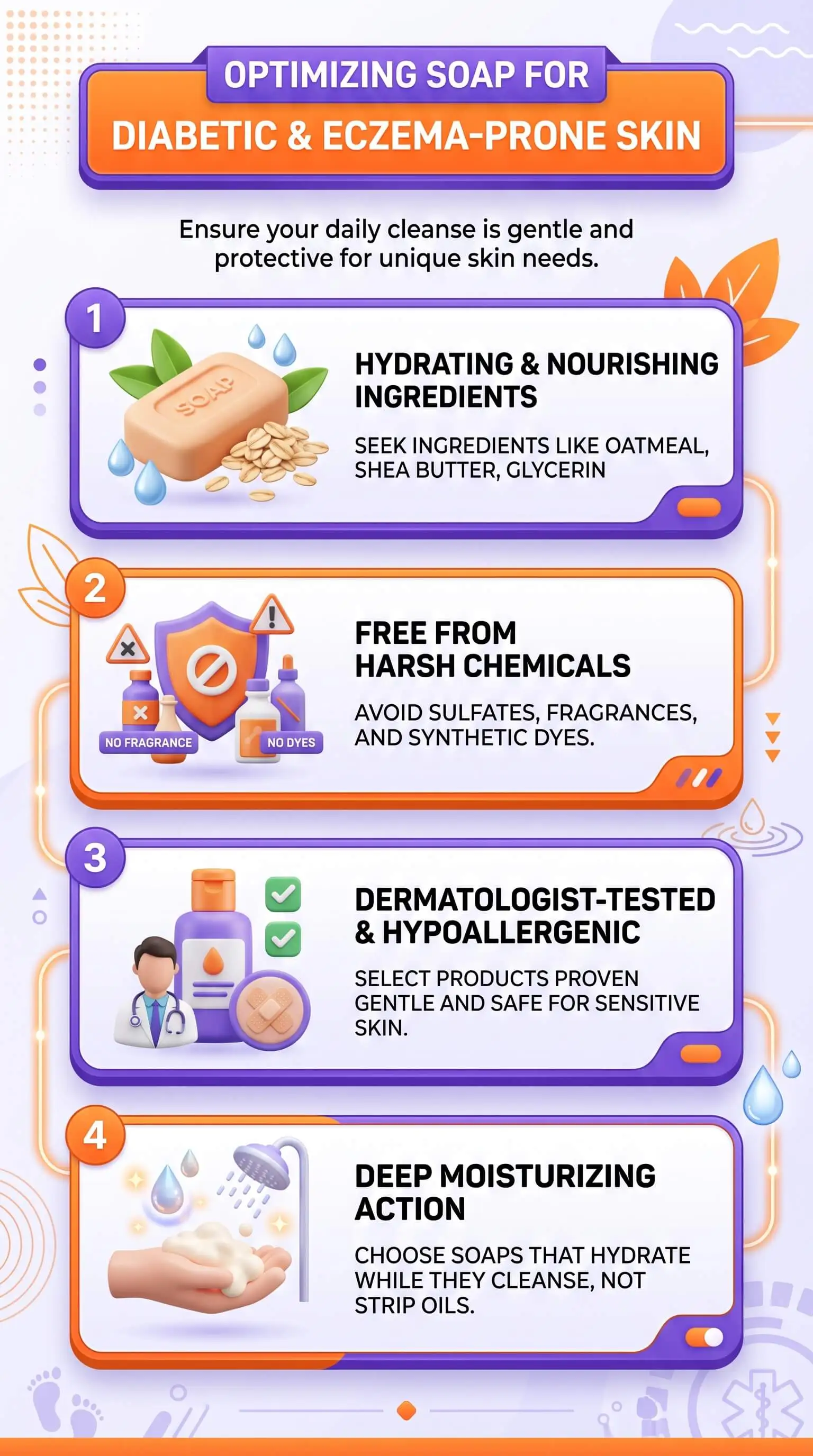
Look for: fragrance-free, alcohol-free, pH-balanced (4.5–5.5), plant-based, lab-verified germ removal
Avoid: alcohol, synthetic fragrance, SLS/SLES, parabens, triclosan
Why it matters: nearly 4 in 5 people with diabetes develop a skin disorder, and harsh soap ingredients are a common, preventable trigger
Made by: Dr. Ruslan Maidans (DDS) and Dr. Yalda Shahriari (PhD, Biomedical Engineering), formulated for their own family first
Top Takeaways
Eczema and diabetes damage the skin barrier through different mechanisms, but the effects stack rather than simply add up, which is why this skin type needs a stricter ingredient standard than either condition alone.
Fragrance and sulfates are common eczema triggers and are also two of the ingredients diabetic skin tolerates the least, making them the two highest-priority ingredients to eliminate.
A rinse-free, physical germ-removal approach avoids the added irritation of the standard soap, water, and towel cycle, which matters more when the skin barrier is already compromised twice over.
According to the clinical overview of diabetes-related skin conditions, people with diabetes face a meaningfully higher risk of dry skin, bacterial infection, and delayed wound healing, the same vulnerability an eczema flare can make worse.
Ingredient labels matter more here than most people realize. “Unscented” is not the same as fragrance-free, and both diabetic and eczema-prone skin respond better to the stricter of the two standards.
Why Eczema-Prone Skin Needs a Stricter Standard When You're Also Diabetic
Diabetes and eczema damage the skin barrier through different paths, but they end up in the same place. High blood glucose reduces the skin's natural moisture content, slows circulation to the hands and feet, and weakens the acid mantle that keeps moisture in and bacteria out. Eczema, on its own, is a chronic barrier condition. The skin loses water faster than normal, stays inflamed, and reacts to triggers that healthy skin would shrug off.
When both conditions are present, the math gets worse, not additive. A soap ingredient that would be a minor irritant for eczema alone, or a minor dryness issue for diabetes alone, becomes a much bigger problem on skin fighting both at once. That's why soap best for diabetics with eczema needs a stricter ingredient standard than either condition would require on its own.
What to Look For
Fragrance-free formula, not just “unscented”
Alcohol-free, so there's no stripping or micro-cracking
pH-balanced in the 4.5 to 5.5 range, matching skin's natural acid mantle
Plant-based cleansing agents with no synthetic detergents
A moisturizing base that conditions while it cleans
Lab-verified performance, not just a gentle label claim
What to Avoid
Alcohol in any form, including ethanol and isopropyl
Synthetic fragrance or “perfume” on the ingredient list
Sodium Lauryl Sulfate (SLS) or Sodium Laureth Sulfate (SLES)
Parabens, including methylparaben and propylparaben
Dyes and harsh antibacterial agents such as triclosan
NOWATA™ was built to meet this standard from the start. It's a 100% plant-based, rinse-free soap made without alcohol, synthetic fragrance, parabens, or phosphates, and it physically removes 99.9% of germs without the chemical trade-offs that stressed skin can't afford.
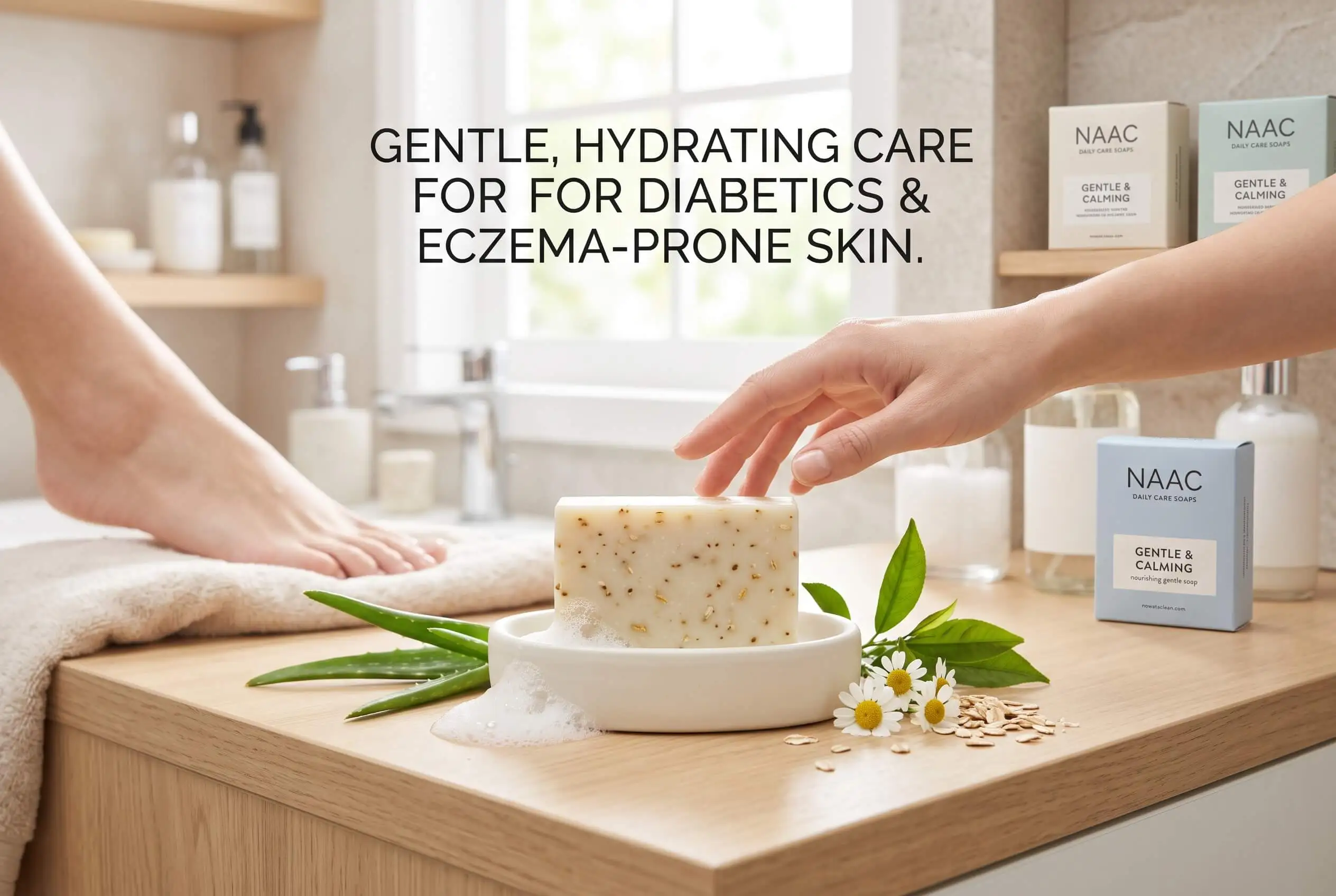
“Eczema and diabetes each put the skin barrier under stress on their own. Together, we've seen them compound in a way that catches people off guard, especially on the hands, where washing happens the most and the skin has the least room to recover between exposures. We didn't build NOWATA with eczema in mind first. We built it around the strictest version of the problem we could imagine, and this combination turned out to be exactly that. If it's gentle enough for that, it's gentle enough for almost anyone.”
7 Essential Resources
Every source below comes from a medical organization, a government health agency, or peer-reviewed clinical literature.
1. National Eczema Association – Seal of Acceptance
NEA's Seal of Acceptance program identifies personal care products that meet strict standards for people with eczema and sensitive skin, including a fragrance-free requirement and an exclusion list of known irritants. Source: nationaleczema.org/seal-home
2. American Academy of Dermatology – How to Treat Eczema at Home
Board-certified dermatologists outline the core self-care standard for eczema: fragrance-free products only, short lukewarm baths or showers, and moisturizing immediately after cleansing. Source: aad.org/news/how-to-treat-eczema-at-home
3. NIAID – Eczema (Atopic Dermatitis) Overview
The National Institute of Allergy and Infectious Diseases explains how eczema weakens the skin barrier and increases susceptibility to bacterial, viral, and fungal infection, the same vulnerability diabetic skin already faces. Source: niaid.nih.gov/diseases-conditions/eczema-atopic-dermatitis
4. MedlinePlus – Atopic Dermatitis Self-Care
The U.S. National Library of Medicine's patient-facing guidance covers daily self-care for eczema, including the use of mild, fragrance-free cleansers and short bathing times. Source: medlineplus.gov/ency/patientinstructions/000418.htm
5. Peer-Reviewed Research – Type 2 Diabetes Risk in Adults With Atopic Dermatitis
This 2023 cohort study, published in Diabetes Research and Clinical Practice and indexed on PubMed, followed over 36,000 adults with newly diagnosed atopic dermatitis and found a significantly increased risk of developing type 2 diabetes compared to matched controls. Source: pubmed.ncbi.nlm.nih.gov/37595846
6. Asthma and Allergy Foundation of America – Atopic Dermatitis in America Study
AAFA's national study on atopic dermatitis prevalence and burden in U.S. adults documents how common moderate to severe eczema is and how it affects daily quality of life. Source: aafa.org/asthma-allergy-research/our-research/atopic-dermatitis-in-america
7. MedlinePlus – Diabetes Complications
The National Library of Medicine's overview of diabetes complications explains how reduced circulation and nerve changes make people with diabetes more prone to skin conditions and skin infections. Source: medlineplus.gov/diabetescomplications.html
These trusted medical resources show why a hypoallergenic hand soap should be fragrance-free, mild, and supportive of the skin barrier when diabetes and eczema are present together.
3 Statistics
7.3% of U.S. Adults Have Diagnosed Eczema, and It's More Common Than Most People Assume
The CDC's National Health Interview Survey found that 7.3% of U.S. adults had diagnosed eczema in 2021, with women (8.9%) more likely to be affected than men (5.7%), and the highest rates in adults aged 18 to 44 (8.4%). Source: cdc.gov/nchs/data/databriefs/db460.pdf
Adults With Atopic Dermatitis Face Nearly Triple the Risk of Type 2 Diabetes
A population-based cohort study using Korea's National Health Insurance data found that adults with atopic dermatitis had a significantly higher risk of developing type 2 diabetes (hazard ratio 2.96) than adults without atopic dermatitis, alongside sharply elevated risk for hypertension and hyperlipidemia. Source: ncbi.nlm.nih.gov/pmc/articles/PMC8456522
Skin Complications Affect Up to 80% of People With Diabetes
A clinical review on diabetes-related skin complications found that skin problems, including dry skin, itching, redness, and delayed healing, can affect up to 80% of people with diabetes, making daily skin care a frontline part of diabetes management rather than an afterthought. Source: ncbi.nlm.nih.gov/pmc/articles/PMC10259731
These statistics show why daily skin care matters when eczema and diabetes overlap, while air purifiers may also help reduce airborne irritants that can aggravate sensitive, eczema-prone skin.
Final Thoughts and Opinion
Most soap on store shelves was never designed with eczema-prone diabetic skin in mind. It was designed for average skin, and skin managing both conditions has been absorbing the difference for years, one dry, irritated wash at a time.
Our opinion, built from the same research summarized above: this is a case where “gentle” needs to mean something specific, not just something marketed. Fragrance-free, alcohol-free, pH-balanced, and lab-verified isn't a wish list. It's the minimum standard this skin type needs to stop losing ground every time you wash your hands. NOWATA™ was built to meet that standard, and we believe it's worth trying if conventional soap has been working against your skin instead of for it.
Frequently Asked Questions
Can eczema make diabetic skin problems worse?
Yes. Eczema and diabetes both weaken the skin's protective barrier, and having both conditions at once compounds the risk of dryness, cracking, and infection compared to having either condition alone.
What soap ingredients trigger eczema flares?
Fragrance is the most common trigger, followed by sulfates such as SLS and SLES, alcohol, dyes, and preservatives like parabens. Checking the full ingredient list matters more than trusting a “gentle” or “natural” label alone.
Is fragrance-free the same as hypoallergenic?
No. “Hypoallergenic” has no standardized regulatory definition, while “fragrance-free” specifically means no fragrance ingredients were added. For eczema-prone diabetic skin, checking for fragrance-free on the label is the more reliable filter.
Can a rinse-free soap work for eczema-prone hands?
Yes, and for many people managing both conditions, it's the gentler option. A standard wash cycle of soap, water, and a rough towel adds three separate sources of irritation. A rinse-free, plant-based formula removes germs without that added friction.
When should eczema-prone diabetic skin see a dermatologist instead of switching soap?
If a crack, rash, or irritated patch doesn't improve within a few days of switching to a gentler routine, or if there's any sign of infection such as redness, warmth, swelling, or drainage, it's time to see a dermatologist or your diabetes care provider rather than continuing to try different products.
Give Eczema-Prone Diabetic Skin the Standard It Actually Needs
While most soap on the market wasn't built for skin managing eczema and diabetes at once, NOWATA™ organic hand sanitizers were: doctor-formulated, Swiss lab-tested, 100% plant-based, and backed by a 30-day satisfaction guarantee. Give your hands a wash that works with your skin instead of against it.
