Pull your air filter after a week of wildfire smoke and it will tell you something the calendar can't. So yes, in most homes that filter should come out once the heavy smoke clears, even if it only looks a little dingy. Until the air outside settles, check it every week. Swap it the moment it starts to smell like a campfire.
The first summer smoke sat over my neighborhood for days, I expected the usual fuzzy layer of dust. Instead I found a dull, sticky gray film, and the whole air filter smelled like an old ashtray. It was a clear sign that the air filter had been capturing airborne particles that would otherwise continue circulating through my home. Most people never see that film. It's also a helpful reminder of why checking your air filter during smoky weather matters more than simply following the replacement date printed on the box.
TL;DR Quick Answers
air filter
An air filter is a layer of fibers in your heating and cooling system that traps dust, pollen, and smoke particles before they circulate through your home. It protects your family’s lungs and your HVAC equipment. How well it works depends on its MERV rating and how often you change it.
What it catches: Many systems come with a MERV 8 filter, which handles dust and pollen. MERV 11 filter traps far more fine particles, including wildfire smoke.
When to replace it: Follow the box for everyday dust. During smoke events, check it weekly and swap it once the heavy smoke clears.
Why looks can fool you: In a 2025 lab study, charged MERV 13 filter media lost 72% of its smoke removal efficiency while airflow barely changed. Strong air at the vents doesn’t prove the filter is still working.
How it should fit: It should sit snug in its slot with no gaps or bending. An HVAC technician can confirm the highest rating your system handles.
Top Takeaways
Replace after heavy smoke: Swap the air filter once smoke clears, even if it looks fine.
Check weekly during smoke: Inspect it every 7 days and replace it at the first smoky smell or gray loading.
Strong airflow proves nothing: Lab testing found charged media can lose most of its smoke capture while airflow barely changes.
Aim for MERV 13: Use it if your system can handle it, make sure it fits snug, and keep spares on hand.
Finish the cleanup: Air out the house, clean ash with damp methods, and check your car's cabin filter.
Why Wildfire Smoke Wears Out an Air Filter So Fast
Your air filter is a web of fibers that grabs particles as air moves through your heating and cooling system. Everyday house dust is big and dry, so it mostly piles up on the surface.
Smoke plays by different rules. Most of it is PM2.5, meaning particles 2.5 microns or smaller, and a big share measures well under 1 micron. The EPA calls these fine particles the biggest health threat in smoke because they travel deep into your lungs.
They also carry oily, tar-like compounds that coat the fibers instead of stacking up like dust. That's how a filter rated for 90 days can wear out in a fraction of that time once smoke rolls in.
Signs Your Air Filter Needs Replacing After Smoke
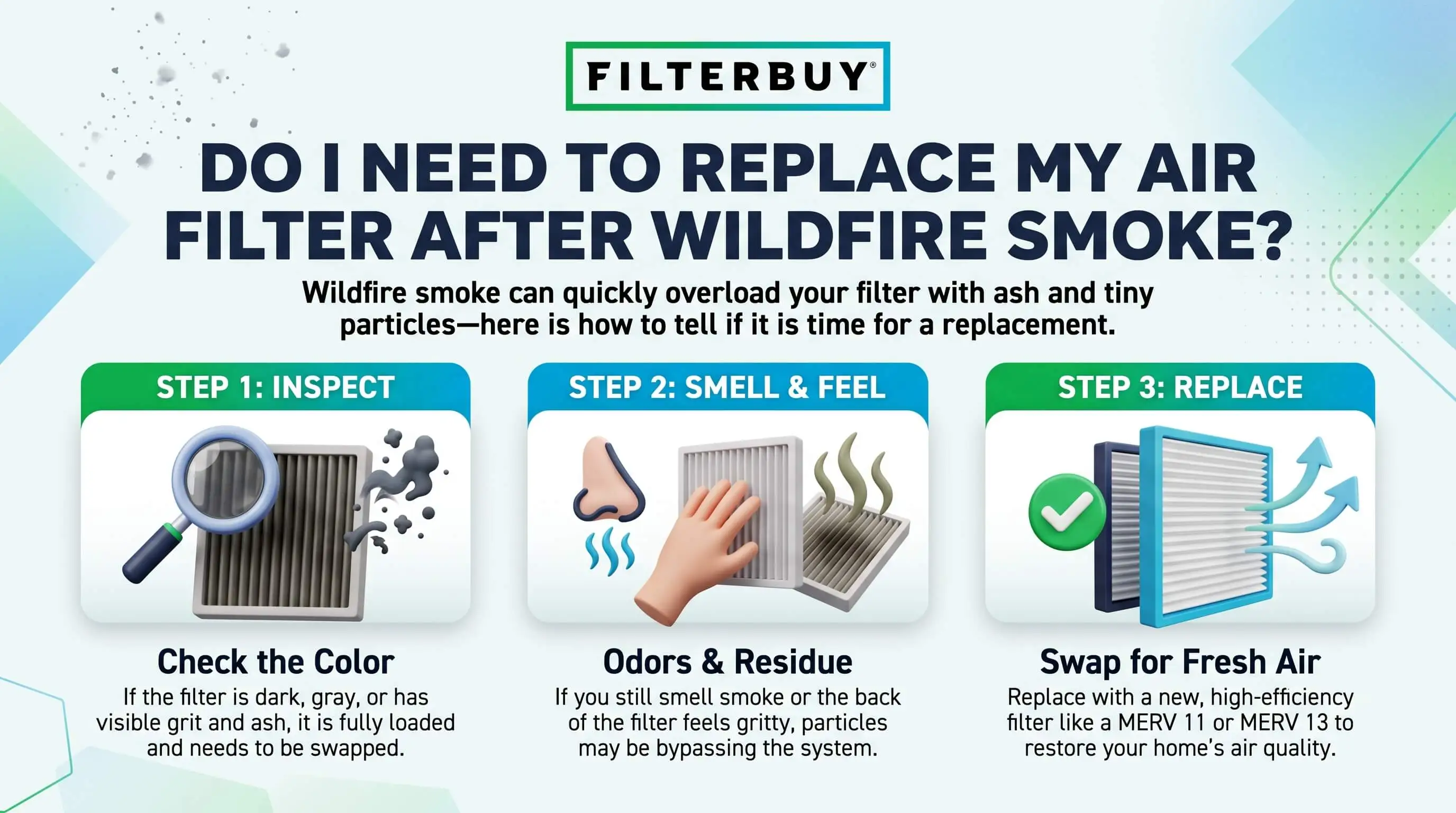
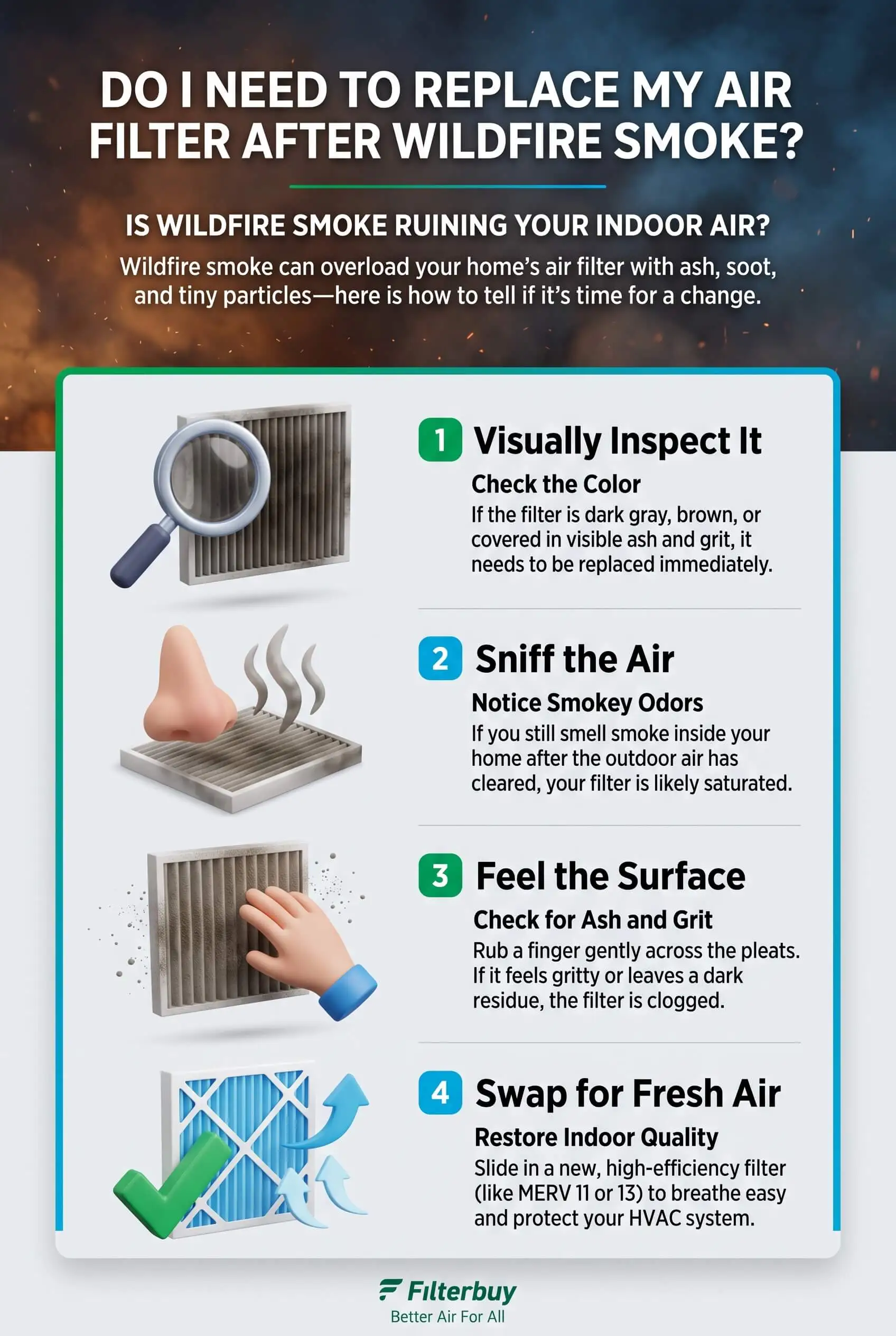
Don't take a smoky filter for granted. Slide it out, carry it to a bright window, and replace it if you spot any of these:
Gray or charcoal pleats: A dull tint across the whole face of the media, not just dust along the edges.
Little light coming through: Hold it up to the glass. If light barely passes through, airflow is already suffering.
Smoke odor at the vents: A campfire smell drifting from the supply registers after you've closed up the house.
A smell that hangs on: Your rooms still smell smoky after outdoor air quality returns to Good.
Bowing or gaps: A filter that has bowed or pulled away from its frame lets smoky air sneak around it.
Why a Filter Can Look Fine and Still Be Spent
Most homeowners judge a filter by airflow. Strong air at the vents feels like proof the filter is doing its job, but smoke breaks that rule.
Researchers at Metalmark Innovations put that assumption to the test in a 2025 lab study. They pushed pine needle smoke, a common stand-in for wildfire smoke, through 17 types of filter media. Charged synthetic media rated MERV 13 and MERV 15 lost 72% of their smoke removal efficiency within 80 minutes, yet their resistance to airflow barely moved. Mechanical media held on to more of its efficiency, though air had a harder time getting through it.
The researchers tested flat media samples, not pleated filters inside real homes, so read the results as a warning rather than a verdict on any product. The lesson for your house still stands. An air filter for home use can keep moving plenty of air while smoke slips right past it, so replace yours once a heavy smoke event ends.
How Often to Check and Replace During and After Smoke
The EPA keeps its advice simple. Keep spare filters for your HVAC system and air purifiers in the closet, plan on replacing them more often than the manufacturer recommends while heavy smoke lingers, and change any filter that looks dirty or smells like smoke.
A Simple Post-Smoke Air Filter Routine
Check weekly. Look at the filter every 7 days for as long as outdoor air quality stays poor.
Swap at the first sign. A smoky smell or gray loading means it's time, whatever the box says.
Run the fan on "On." Flip the thermostat fan from "Auto" to "On" so air keeps passing through the filter, and close any fresh air intake.
Reset when the air clears. Once AirNow shows good air for your area, put in a fresh filter, even if the old one looks passable.
Date the frame. Write the install date on the edge, and you'll never have to guess how long it's been working.
Choosing a Replacement Air Filter for the Next Smoke Event
MERV 13 is the rating I'd aim for. The EPA points to it for smoke, and it traps far more fine particles than the MERV 8 filters many systems come with. My MERV 13 guide covers what to check before you upgrade.
The rating only gets you halfway. Two more details decide whether that filter protects your family, your home, and your HVAC system:
Exact fit: The filter should sit snug in its slot with no gaps, and you should never bend it to force it in.
System capacity: Older or low-static blowers can struggle with denser media, so ask an HVAC technician for the highest rating your system handles.
Filters also sell out fast once smoke rolls in. I keep two spares in the exact size my return grille takes so a swap never stalls.
What Else to Do Indoors Once the Smoke Clears
A fresh filter does the heavy lifting. These steps finish the cleanup:
Open the windows and run the kitchen and bath exhaust fans once outdoor air improves, so lingering smoke has a way out.
Wipe ash with a damp cloth and a wet mop, since dry sweeping kicks it back into the air. Use a HEPA vacuum on carpets.
Skip duct cleaning unless the ducts are visibly clogged or the registers puff out particles. The EPA takes the same position.
Check your car, too. Its cabin filter loads up in smoke just like the one in your home, and changing it yourself usually takes a few minutes.
“In my experience, the filters I pull after a smoke week rarely look as bad as they perform. Smoke leaves a thin, oily film on the fibers that cancels out the static charge doing most of the capturing, so air keeps flowing while the fine particles slide right through.”
7 Essential Resources
1. Find out who smoke hits hardest
How smoke affects the body, and why children and people with heart or lung conditions need extra protection. Source: How Wildfire Smoke Affects Your Body, CDC.
2. Know when to keep everyone inside
Health guidance matched to air quality levels, with clear steps for cutting your exposure when smoke moves in. Source: Fires and Your Health, AirNow.
3. Choose a portable air cleaner that won't add ozone
The official list of certified air cleaners for setting up a clean room alongside a fresh HVAC filter. Source: CARB-Certified Air Cleaning Devices, California Air Resources Board.
4. Plan ahead for sensitive lungs
Practical planning advice for families managing asthma or other breathing conditions during smoke season. Source: Wildfire Smoke and Lung Health, American Lung Association.
5. Watch the fire weather forecast
Red flag warnings and fire weather outlooks give you a head start on stocking spare filters. Source: Wildfire Weather Safety, National Weather Service.
6. Harden your home against embers
Steps that keep flames and embers away from the house itself, the next layer beyond clean indoor air. Source: Preparing Homes for Wildfire, NFPA.
7. See how your community prepares
Federal guidance for neighborhoods where homes meet wildland. Source: Wildfire and the Wildland Urban Interface, U.S. Fire Administration.
3 Supporting Statistics
Running a high-efficiency HVAC filter with the fan on continuously may cut indoor PM2.5 by about 50%. Even a basic filter may cut it by about 24%. Source: EPA.
Charged MERV 13 and MERV 15 filter media lost 72% of their smoke removal efficiency after 80 minutes of smoke loading in the lab. Source: arXiv preprint, Shirman et al.
Wildfires burned about 5.13 million acres across 77,850 fires in the U.S. in 2025. Source: National Interagency Fire Center.
With millions of acres affected by wildfires and research showing that smoke can reduce filter efficiency, using a high-efficiency pleated furnace filter and replacing it after heavy smoke exposure can help reduce indoor fine particles and maintain cleaner air at home.
Final Thoughts and Opinion
Once wildfire smoke shows up, I stop trusting the calendar. The 90-day label on the box assumes ordinary house dust, and smoke loads a filter in a completely different way. What you can't see in the media matters more than what you can.
So every heavy smoke event becomes a reset in my house. I check weekly while it lasts. Once it clears, I replace the filter with one of the top air filters and put a spare back on the shelf. It takes little effort. The payoff is cleaner air for your family and less strain on your HVAC system.
Frequently Asked Questions
Can I clean and reuse an air filter after wildfire smoke?
Not if it's a disposable pleated filter. A vacuum lifts surface ash, but the oily residue stays bound to the fibers and keeps dragging down performance. Washable filters are different, so clean them exactly as the manufacturer directs and check for leftover odor.
Does a smoke smell from my vents mean the air filter is bad?
Often, yes. A smoky odor from the registers usually means the filter has loaded up and needs replacing. Standard particle filters don't capture smoke gases, though, so a faint smell can linger briefly after a fresh filter goes in.
Is a MERV 13 air filter too restrictive for my furnace?
That depends on your equipment. The EPA recommends MERV 13 filter or the highest rating your system fan and filter slot can accommodate. An HVAC technician can tell you what your blower handles without straining.
Should I run my HVAC fan on "On" or "Auto" during smoke?
Go with "On." The EPA advises running the system fan as often as possible during smoke so indoor air keeps passing through the filter. Set the system to recirculate, or close the fresh air intake, so it stops pulling in more smoky air.
Do I need duct cleaning after a wildfire?
Usually not. The EPA recommends duct cleaning only when ducts are visibly clogged with debris or particles are blowing out of the supply registers. For most homes, a fresh air filter and a thorough damp cleaning take care of it.
Clear the Air With a Fresh Air Filter After Wildfire Smoke
Slide your air filter out, hold it up to the light, and see exactly what the smoke left behind. That one look answers whether you need a replacement, and a fresh filter brings your home's air back to where it was before the smoke rolled in.
