So fifteen minutes isn't really the interesting half of the answer. What matters is whether you own one of the easy ones, because the filter is never the thing that makes this job hard. Access is. On most vehicles you drop the glove box and the housing is sitting right there in front of you, and on a small number, reaching that same part means taking a dashboard apart.
Five minutes with your glove box and your owner's manual tells you which kind of car you're driving and how to change cabin air filter correctly. Do that before you spend a dollar.
TL;DR Quick Answers
How to Change a Cabin Air Filter
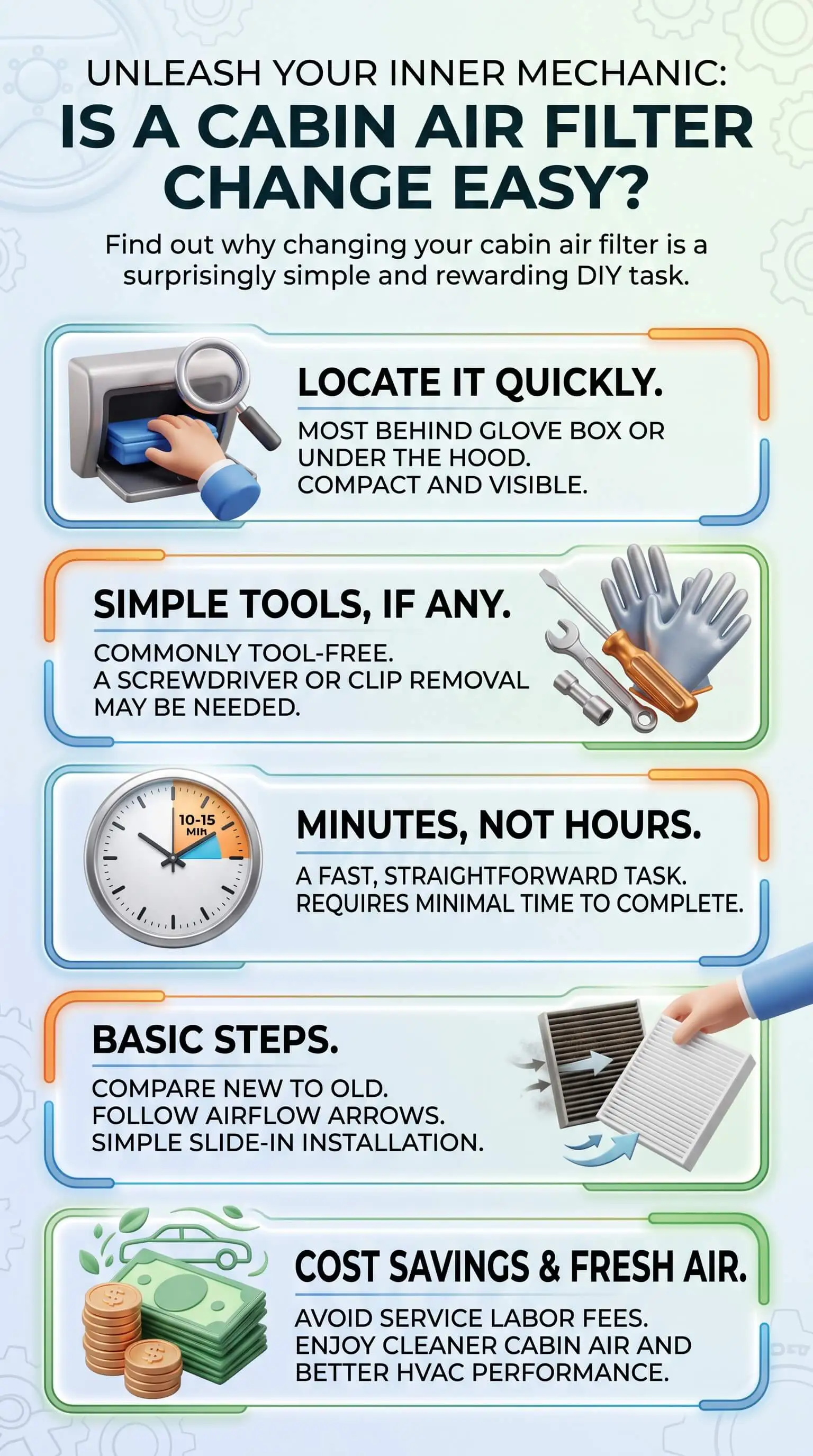
On most cars you change a cabin air filter by dropping the glove box, unclipping the cover behind it, and sliding a new filter in with the airflow arrow pointing the same direction the old one did. Ten to twenty minutes, no tools.
Check first: open the glove box and look for release tabs on both sides. If they're there, you're in tier one and these steps apply.
Park level, shut off the engine, empty the glove box.
Press the side tabs inward so the compartment swings down past its normal stops.
Unclip the rectangular cover behind it.
Photograph the old filter's airflow arrow, then slide it out slowly so debris doesn't drop into the blower.
Slide the new filter in with its arrow matching your photo. On most vehicles it points down.
Snap the cover back, lift the glove box until the tabs click, run the fan on high.
If there are no tabs in the glove box, check the cowl panel at the base of the windshield or your owner's manual index. A few vehicles need a dash pulled, and that one belongs at a shop.
Top Takeaways
On most vehicles this is a fifteen-minute job behind the glove box with no tools required.
Difficulty belongs to your specific dashboard, not to the task.
The five-minute check runs glove box tabs, then owner's manual index, then windshield cowl panel.
Photograph the old filter's airflow arrow before you pull it. Installing it backward is the most common mistake and the easiest one to dodge.
A filter that's close but not exact lets air slip around the media entirely.
Mold, standing water, or a smell that survives a new filter all mean stop and call someone.
The Three Difficulty Tiers
I sort this job by where the filter lives, not by the badge on the hood.
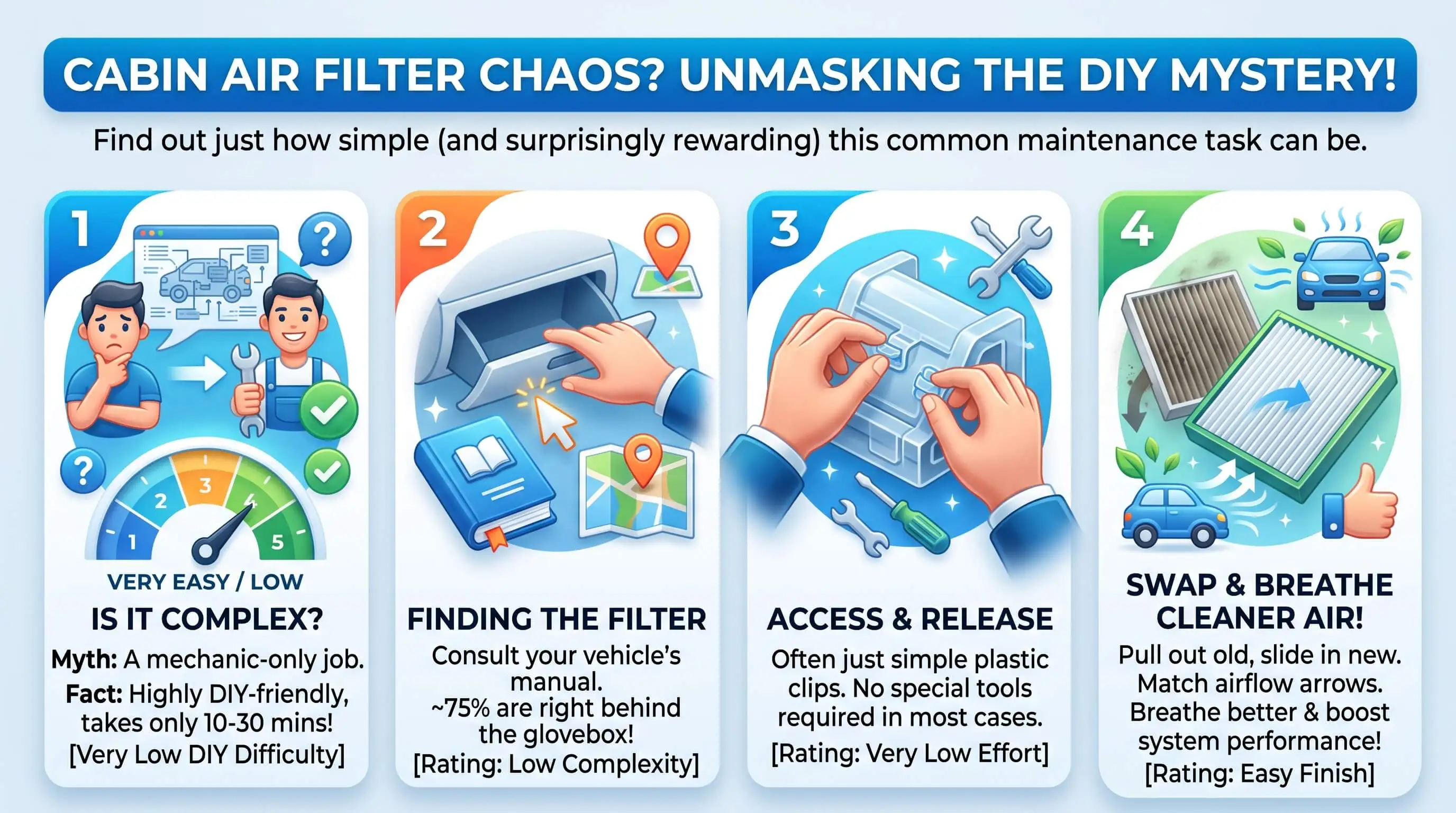
Tier one puts it behind the glove box, which covers the large majority of passenger vehicles built from the mid-2000s onward. Empty the compartment, release the tabs on each side so it swings down past its normal stops, and a rectangular plastic cover appears behind it. Unclip the cover, slide the old filter out, slide the new one in. Fifteen minutes is generous, and there's very little you can permanently break if you work slowly.
Tier two hides it under the cowl panel at the base of the windshield, or behind a lower dash panel held on by a screw or two. Add a Phillips screwdriver and twenty to forty minutes.
Tier three buries the housing deep enough that reaching it means pulling out a real section of dash or console, even if you plan to install high quality filters. A small number of older vehicles never got a cabin filter at all. Either way, this one isn't worth your Saturday.
The Five-Minute Check That Tells You Which Tier You're In
Open your glove box, take everything out, and run your eyes down both sides. If you spot flexible tabs or stops that look designed to be pushed past, you're almost certainly in tier one. That single look settles most cars on the road.
If the glove box gives you nothing useful, check the index of your owner's manual for the cabin filter, pollen filter, or interior ventilation filter. Manufacturers document this, and the manual will usually name the location outright. A filter that doesn't show up in the index at all is telling you something on its own.
If you're still coming up empty, pop the hood and look at the plastic cowl panel running along the base of the windshield. On cowl-mounted designs the housing sits under one end of it, usually over on the passenger side.
That's three checks and five minutes with nothing bought, which beats finding out about the two-hour version with your glove box already hanging open.
How to Change a Cabin Air Filter Without Guessing at the Steps
Once you know your tier, the sequence itself is short. The order of operations is easy enough to follow. Two details sitting inside it are where people actually go wrong.
The first is the airflow arrow. Every cabin filter has a direction marker printed on the frame, and putting it in backward fights the airflow direction the manufacturer built the filter around. The second is fitment. A filter that's close but not exact leaves gaps around the edges, and air takes the free path around the media instead of going through it, which quietly undoes the whole reason you replaced it.
Pro Tip: before you pull the old filter out, look at which way its arrow points and take a photo with your phone. That's your answer key for installing the new one, and it costs you two seconds.
Both details get handled properly in a step-by-step cabin filter replacement guide that runs from parking the car through testing the fan afterward. Read it once before you start, not halfway through with parts in your lap.
Why Allergy Sufferers Should Care More Than Most
A car cabin is a small sealed box drawing its air from a few feet above a roadway. Whatever is in the pollen count outside, or in the exhaust plume of the truck ahead of you, gets inside within seconds. The only thing standing between that air and your lungs is a rectangle of pleated media about the size of a paperback.
That media does its work the way any air filter does, by pushing air through a fibrous mat that catches particles too large to follow the airstream through the gaps. It loads up over time and it behaves differently as it loads. A filter you left in place through two pollen seasons isn't the filter you installed.
April is when I notice it. The purifier at home runs around the clock, the bedroom windows stay shut through the worst of the tree pollen, and then I spend forty minutes each way in a car whose filter hadn't been touched since the day I bought it. That was a real hole in an otherwise careful setup, and it turned out to be the cheapest one to close.
When I Stop and Call a Shop
Some of this isn't worth doing yourself, and I'd rather say so plainly than talk you into a bad afternoon.
If reaching the housing means pulling structural trim, the odds of snapped clips and a permanent new dashboard rattle outweigh whatever labor you'd have saved. If you open the housing and find mold or standing water, that usually points to a blocked evaporator drain, and a fresh filter just gets contaminated on the same schedule as the last one. And if the smell is still there with a new filter seated correctly, the source sits further into the system than any filter can reach. Book the appointment.
“Most of the people who call us about weak airflow have never opened the glove box. On the car they already own it's a fifteen-minute job, and when we pull the old filter it comes out grey and packed solid. What we actually get paid for is the small share of vehicles where the housing sits behind the dash, where access can feel closer to an HVAC system replacement than a simple filter change. Working out which group your car belongs to is worth more than any tip about the filter itself.”
7 Essential Resources
I checked every link below on August 20, 2026.
National Allergy Bureau pollen counts reports measured pollen and mold levels from certified counting stations instead of modeled forecasts, which is what you want when you're deciding whether today calls for the recirculate button.
AirNow gives you the current Air Quality Index by zip code, including particle pollution and wildfire smoke sitting along your route.
The Car Care Council do-it-yourself resources sort out which maintenance jobs are reasonable to take on at home and which ones aren't, from a nonprofit that has nothing to sell you.
California Air Resources Board vehicle exposure studies summarize measured pollutant levels inside cars during real commutes. It's the closest thing to hard data on what your cabin filter is up against.
ACAAI allergy facts and statistics covers prevalence figures and symptom background from the American College of Allergy, Asthma and Immunology.
The AAFA allergy facts and figures report pulls current national allergy data into one document and cites its own sources underneath.
The StatPearls clinical overview of allergic rhinitis walks through the mechanism behind seasonal symptoms if you'd rather have the physiology than the summary.
Supporting Statistics
More than 45 million people in the United States live within 300 feet of a major road or transportation facility, according to EPA near-roadway air pollution research. Living close to traffic isn't an edge case. For a lot of the country it's just where home is.
In 2024, 69.2 percent of American workers drove alone to work and 9.3 percent had a one-way commute of 60 minutes or longer, per Census Bureau American Community Survey estimates. That last group spends upward of two hours a day breathing whatever their cabin filter does or doesn't catch.
One quarter of U.S. adults, 25.2 percent, had a diagnosed seasonal allergy in 2024, based on National Center for Health Statistics survey data. Roughly one driver in four has a direct, personal reason to care what that filter is doing.
With millions of Americans living near major roads, spending significant time commuting, and managing seasonal allergies, a clean cabin air filter can make a meaningful difference in the air drivers breathe. MERV 11 pleated HVAC furnace air filters serve a similar filtration purpose in home HVAC systems by helping capture airborne particles.
Final Thoughts and Opinion
My honest read, after doing this on several vehicles and watching people put it off for years, is that the difficulty of this job has been oversold in both directions at once.
The articles telling you it's trivially easy are right about most cars and wrong about yours if you happen to own an awkward one. The shop quoting you sixty dollars in labor is overcharging on a tier one vehicle and charging you fairly on a tier three. Neither one is lying, because they're describing different cars.
What's missing from nearly everything written about this is the triage step. Five minutes with the glove box and the owner's manual tells you which conversation you're actually in, much like checking pleated furnace filters before deciding whether they need attention. I'd rather someone run that check and then decide to pay a shop than skip it and put the job off another two years, which is what usually happens.
And I want to be fair to the shops on cost. On a vehicle that genuinely needs dash work, that labor charge is buying labor. That's not markup.
Frequently Asked Questions
How long does it actually take to change a cabin air filter?
Ten to twenty minutes on most vehicles. The swap itself takes under a minute, and everything else is emptying the glove box and getting the cover off and back on.
Do I need any tools?
Usually none at all, since glove box designs are released by hand. A Phillips screwdriver covers most of what's left.
What happens if I install the filter backward?
It fights the airflow direction the manufacturer built the filter around, and you'll usually notice that as weaker output at the vents. Fixing it means pulling the filter and flipping it around.
How often should a cabin air filter be replaced?
Once a year suits most drivers. Heavy pollen, dusty roads, and long stretches in dense traffic all shorten that. Your owner's manual carries the manufacturer's number.
Is the cabin air filter the same as the engine air filter?
No. The cabin filter cleans the air coming into the passenger compartment while the engine air filter protects the engine intake. They sit in different places and follow different replacement schedules.
Go Look at Your Glove Box
Head out to the driveway, empty the glove box, and check both sides for those tabs. That one look tells you whether you're twenty minutes away from cleaner air on your commute with a simple air filter replacement or better off booking someone, and finding out costs you nothing. Little effort, real payoff.
Then come back and tell me what you found. I want to know how these tiers hold up against what people are actually driving.
