TL;DR Quick Answers
Air Quality Boston
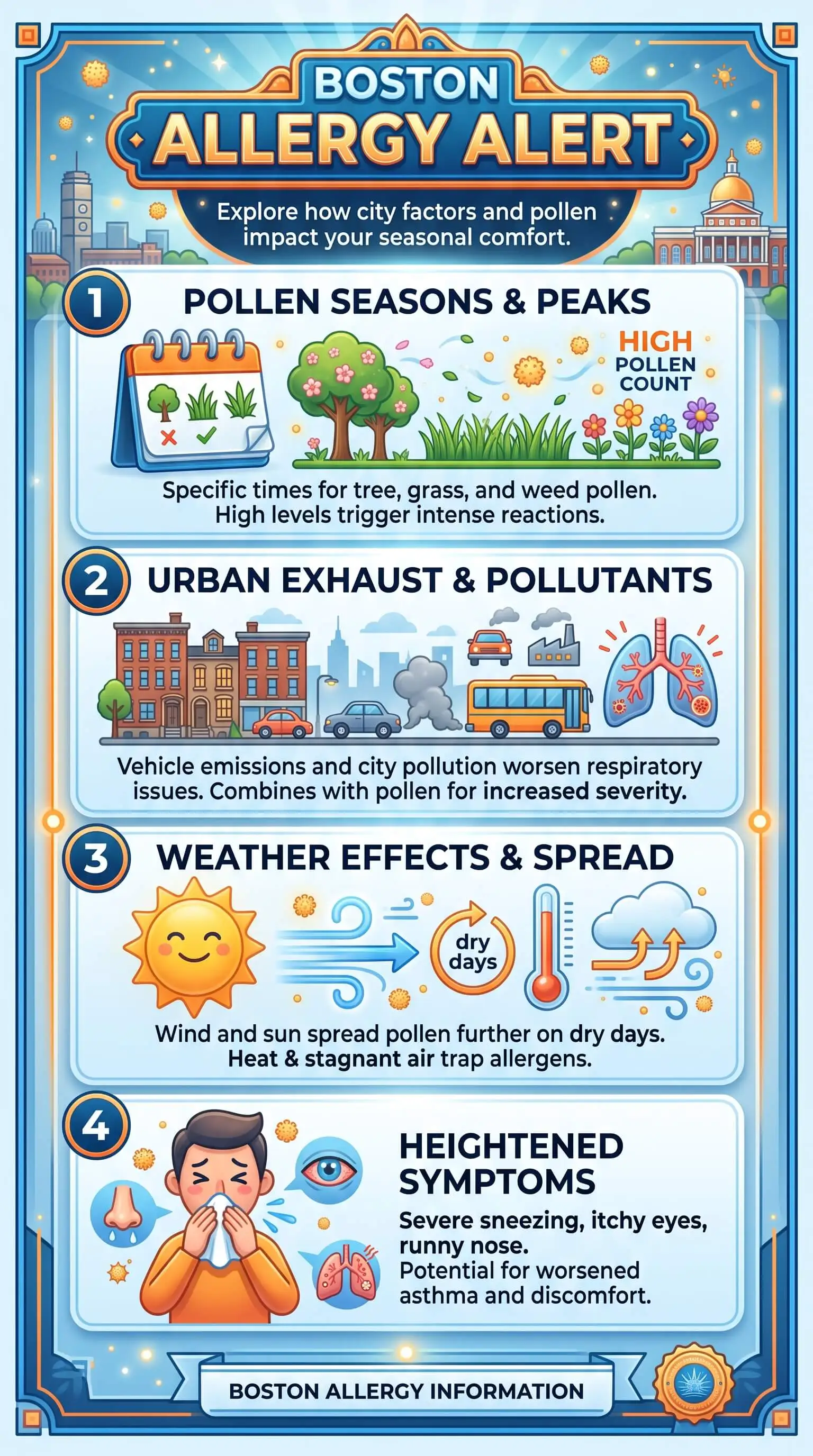
Boston air quality shifts hour to hour, driven by traffic on I-93 and I-90, summer ozone, seasonal pollen, and wildfire smoke arriving from Canada. Check MassDEP MassAir Online or EPA AirNow before you ventilate. The number matters most to allergy sufferers, because ozone amplifies whatever pollen is already in the air.
Where to check: MassDEP MassAir Online for state forecasts, EPA AirNow for regulatory-grade readings, Massachusetts Environmental Public Health Tracking for your own census tract.
What drives it: traffic emissions on I-93 and I-90, afternoon ozone in summer, oak pollen in spring, ragweed until the first hard frost, and smoke drifting in from Canadian wildfires.
Why it moves so fast: sea breeze can leave the coast more than 20 degrees cooler than points a few miles inland at midday, so ozone forms over some neighborhoods and not others.
Best time to open the windows: morning. Ozone builds all day and peaks in the late afternoon, so the instinct to air out the house once it warms up is backwards.
What it means indoors: switch the HVAC fan from Auto to On, so a clean MERV 11 or MERV 13 filter runs continuously instead of only when the system cycles.
Top Takeaways
Air quality and pollen are one problem wearing two names. Ozone inflames airway lining, and inflamed airways react harder to the same amount of pollen.
Oak drives Boston’s spring. The Boston Basin forest mix is oak and hickory with white pine, which is why April and May hit harder than a generic tree pollen forecast lets on.
Your season runs roughly 05 April to 09 November. That’s Boston’s average freeze window, and a later first frost stretches ragweed season rather than moving it.
Your neighborhood has its own weather. Sea breeze can leave the coast more than 20 degrees cooler than inland at midday, which changes where ozone forms and how pollen settles.
Ventilate in the morning, not the afternoon. Ozone builds through the day, so the instinct to open up once it warms is backwards in summer.
Switch the HVAC fan to On. Continuous circulation filters your indoor air all day instead of only when the system happens to be heating or cooling.
What Makes Boston Air Different for Allergy Sufferers
The Trees Boston Actually Has
Most Boston allergy advice stops at "tree pollen in spring." You can’t do anything with that. The city sits in the Boston Basin ecoregion, where the forest mix runs to transition hardwoods, meaning oak and hickory blended with white pine. Oak is the one to watch. It’s wind-pollinated, it produces heavily, and it ranks among the more allergenic trees in the Northeast. So when somebody tells me April and May flatten them while August barely registers, I already know what I’m looking at. The geography of the city shapes the rest, because Boston is coastal, low-lying, and built substantially on filled land, and every one of those facts changes how air moves through the neighborhoods where people live.
Traffic, Ozone, and Smoke That Travels
Then there’s the traffic. I-93 and I-90 pump a steady baseline of nitrogen oxides into the air, and on hot afternoons sunlight cooks those emissions into ground-level ozone. Add the wildfire smoke that now reaches New England from Canada and the western states with real regularity. Boston can post a high reading on a day with nothing you can see, smell, or point to. That’s the maddening part, and it’s exactly what I mean when I say the worst air is invisible. Bad air here often looks like a beautiful afternoon.
Why Boston Air Quality Changes What Pollen Does to You
Ozone Irritation and the Amplified Pollen Response
Here’s the mechanism. Ozone is an irritant gas, and it inflames the lining of your nose, throat, and airways the moment you breathe it. An inflamed airway is a reactive airway. So the same oak pollen you shrugged off last Tuesday now lands on tissue that’s already primed to overreact, and your body answers harder, faster, and longer than it did a week ago. The pollen count never changed. Your threshold did. That single fact explains why a moderate pollen day stacked on an ozone alert can wreck you worse than a high pollen day under clean skies, and why watching one number without the other leaves you guessing about your own body.
The Freeze Window That Brackets the Pollen Calendar
Boston’s average window for freezing temperatures runs from roughly 09 November to 05 April. Those two dates bookend your allergy year. Trees start producing once real warmth follows the early April thaw, and ragweed keeps going right up until the first hard frost of the fall. So when that first frost arrives later than it used to, ragweed season doesn’t slide forward. It stretches. Every extra frost-free week in October buys you another week of weed pollen you did not have twenty years ago. If your September has quietly gotten rougher and you’ve been blaming age or a run of bad luck, look at the frost date instead.
Sea Breeze, Inversions, and Why Your Neighborhood Matters
Boston isn’t one air quality zone. Late spring and early summer sea breezes can leave the immediate coast more than 20 degrees cooler than points a few miles inland by midday, and that temperature split changes where ozone forms and how pollen settles out. East Boston and South Boston can be sitting in cool marine air while West Roxbury and Hyde Park bake. Inversions pile on, trapping pollutants near the ground until the weather pattern finally breaks. Two people with identical sensitivity, ten miles apart, really are breathing different afternoons.
Your building matters too. A lot of inner Boston is nineteenth-century construction sitting on filled land, and those envelopes leak. A Back Bay or South End walk-up trades air with the outdoors at a rate newer construction never will. Same outdoor reading, completely different indoor day.
What Actually Reduces Your Exposure Indoors
Look before you ventilate. If you check Boston’s real-time AQI before you throw the windows open, you dodge the most common self-inflicted problem I run into, which is airing out the house at exactly the wrong hour on an ozone afternoon. In summer, morning is your better window, because ozone builds all day and peaks late.
Then put the system you already own to work. Most people leave the HVAC fan set to Auto, which means the blower only moves air when the thermostat calls for heating or cooling. Flip that switch to On. Now it runs continuously and pulls your indoor air through the filter all day instead of in short bursts, and for most households it’s the single highest-return change available. Cost? A modest bump on the electric bill and nothing else.
On the filter itself, MERV 11 is a sensible floor for a household fighting pollen, and MERV 13 catches finer particles including smoke. Airflow is the tradeoff. A higher-rated filter is denser, and a system with undersized ductwork can struggle to pull through it, so check what your equipment is rated for before you grab the biggest number on the shelf. A clogged MERV 13 will protect you less than a clean MERV 11.
Now the honest part, because you deserve it straight. Filtration lowers the concentration of particles in your indoor air. It does not seal your home, and standard particulate filters do nothing about ozone, which is a gas rather than a particle. Anyone selling a filter as the cure for outdoor air pollution is overselling it. What good filtration really does, especially when paired with proper HVAC system installation, is cut down what you breathe during the hours you spend inside, and for most of us that’s the bulk of the day. Worth doing. Just not a force field.
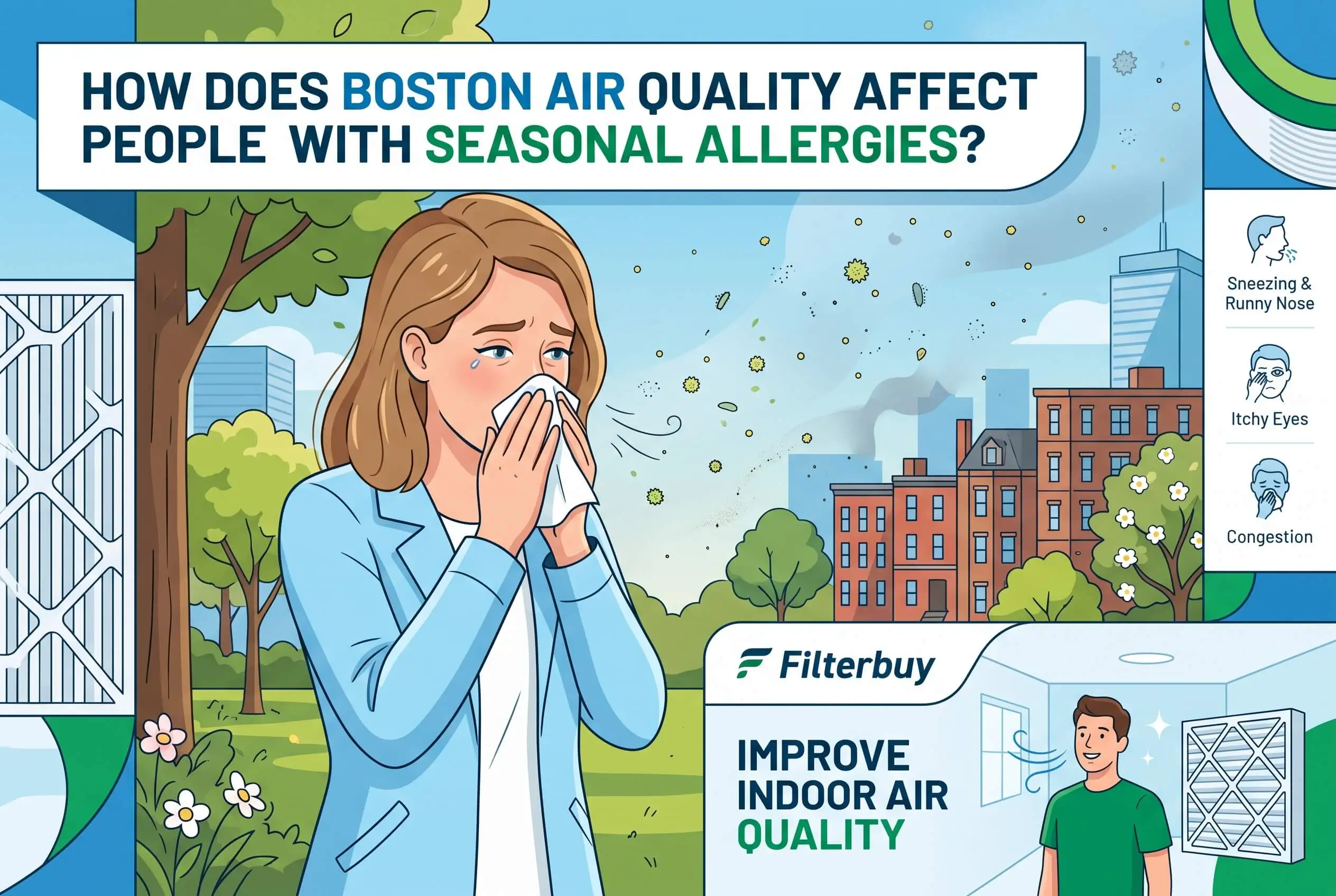
"Pull two filters from the same Boston house, one at the end of May and one at the end of September, and they don’t look anything alike. The May filter loads with a fine, even yellow-green dust straight across the pleat, which is oak and pine doing their work. The September filter loads unevenly and much darker, weed pollen mixed with road grit and whatever drifted in on the wind. Your home isn’t filtering some abstraction called outdoor air. It’s filtering whatever Boston threw at it that month, and those two months need different attention from you."
7 Essential Resources
Check Tomorrow’s Air Before You Plan Your Morning
MassDEP’s MassAir Online posts current conditions, forecasts, and site-level readings for Massachusetts. That’s what you want the night before you decide whether to run outside or sleep with the window cracked. Resource: mass.gov/service-details/environmental-look-ups-and-online-services
See PM2.5 and Ozone for Your Actual Neighborhood
Massachusetts Environmental Public Health Tracking maps particle pollution and ozone right down to the census tract. This is the detail that finally explains why your block behaves differently from a friend’s place across the river. Resource: mass.gov/info-details/ma-epht-outdoor-air-quality
Find Out Whether This Year Is Worse or Just Feels That Way
MassDEP compiles monitoring data across the state year over year in its annual air quality reports. Use them to separate a genuinely rough spring from your own memory. Resource: mass.gov/lists/massachusetts-annual-air-quality-reports
Understand Where Boston Ranks Against 99 Other Metros
The Asthma and Allergy Foundation of America scores the 100 largest U.S. metros on tree, grass, and weed pollen, then layers in medication use and specialist access. Good context when you’re deciding how seriously to take your own symptoms. Resource: aafa.org/asthma-allergy-research/allergy-capitals
Learn What the Research Says About Environmental Triggers
The National Institute of Environmental Health Sciences lays out what researchers have actually established about how indoor and outdoor exposures drive respiratory symptoms, including traffic pollution and indoor air findings. Resource: niehs.nih.gov/health/topics/conditions/asthma
Get Free Help Fixing Triggers Inside a Boston Home
The Boston Public Health Commission runs Breathe Easy at Home and the Boston Asthma Home Visiting Program, both aimed at the housing conditions that set off flare-ups. If you feel worse indoors than out, start here. Resource: boston.gov/news/may-asthma-awareness-month
Identify Which Plants Are Actually Triggering You
MedlinePlus breaks down which plant families produce the pollen behind hay fever, and how a hot dry day versus a cool wet one changes what’s floating around. Resource: medlineplus.gov/ency/patientinstructions/000489.htm
3 Statistics
Boston Carries a Heavy Respiratory Load
In 2021, 13.1% of Boston adults reported having asthma. Among Boston public high school students, the figure hit 30.1%. The citywide asthma emergency department visit rate was 43.6 per 10,000 residents.
Source: Health of Boston 2023 Asthma Report, Boston Public Health Commission. boston.gov Health of Boston 2023 Asthma Report
Pollen Allergy Is Not a Minor Complaint
Allergic rhinitis affects up to 60 million people in the United States every year. Pollen-related medical expenses top $3 billion annually. Almost half of that goes to prescription medication.
Source: Centers for Disease Control and Prevention, Allergens and Pollen. cdc.gov Allergens and Pollen
The Fall Season Keeps Getting Longer
Since 1995, ragweed pollen season has grown longer at 10 of the 11 monitored North American locations studied. The increase gets more pronounced the further north you go, tracking closely with later first frosts. An estimated 15.5% of Americans are sensitive to ragweed.
Source: U.S. Environmental Protection Agency, Climate Change Indicators: Ragweed Pollen Season. epa.gov Ragweed Pollen Season indicator
With asthma and pollen concerns affecting many people, HVAC ionizer installation can support efforts to improve indoor air quality and create a more comfortable home environment during challenging allergy seasons.
Final Thoughts and Opinion
Boston allergy advice has a framing problem, and I’ll say so plainly. It treats the pollen count and the air quality index as two unrelated numbers, published by different agencies, checked by different kinds of people. That split is exactly why so many Bostonians misread their own bodies. They see a moderate pollen forecast, feel terrible anyway, and decide they’re coming down with something or that their medication quit working. Usually neither is true. They just breathed irritated air on a pollen day, and nobody ever told them the two were connected.
I’d also push back on the instinct to solve this by buying something. The changes that pay off most here are free. Ventilating in the morning rather than the afternoon costs nothing. Moving the HVAC fan from Auto to On runs you a few dollars a month. Knowing that your first frost keeps drifting later, and that your ragweed exposure is stretching along with it, costs nothing at all and changes how you plan your entire fall. Equipment matters, and a properly rated filter earns its place in the lineup, but it belongs at the end of that list rather than the front of it.
The people I know who get through a Boston spring in decent shape aren’t the ones with the most gear in the house. They’re the ones who stopped treating their symptoms as weather they had no way to read. You can be one of them by Thursday.