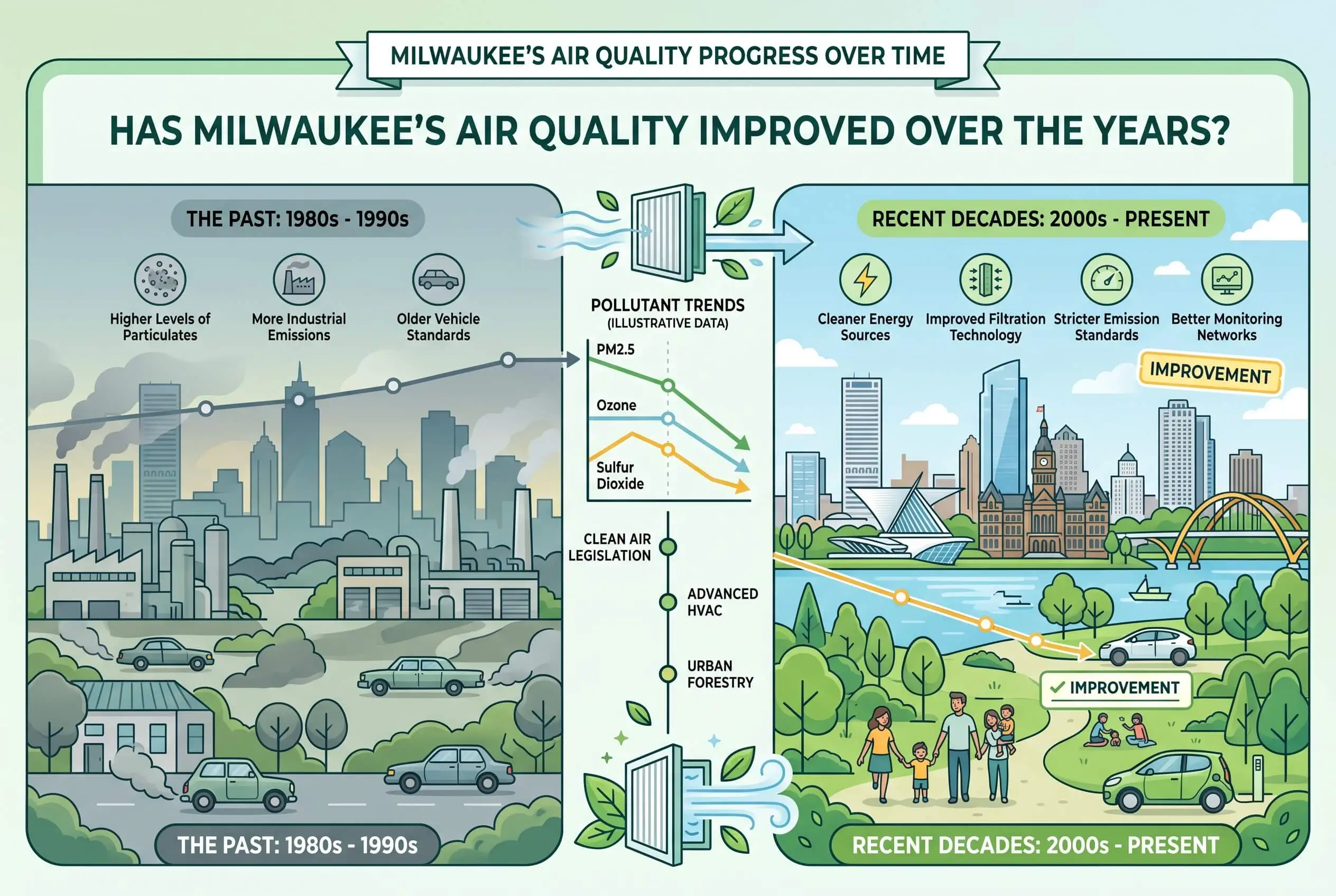
After going through two decades of the state's own monitoring data, my answer isn't simple, and it shouldn't be. Air quality Milwaukee has improved significantly compared to fifty years ago, thanks to decades of cleaner air initiatives and stricter pollution controls. While progress has slowed in recent years and occasional setbacks still occur, the overall trend remains much better than it once was. Here's what the data shows, and what I think it means for anyone breathing this air today.
TL;DR Quick Answers
Air Quality in Milwaukee
Milwaukee's air is cleaner than it was decades ago, but it still sits in serious nonattainment for ozone, with a 2027 federal deadline. Lake breezes off Lake Michigan concentrate ozone right on the shoreline every summer. I check the live number before planning anything outdoors on hot days.
Long-term trend: decades of sharp improvement in ozone, PM2.5, and sulfur dioxide levels.
Current status: serious ozone nonattainment, with an August 2027 attainment deadline.
Why it happens: lake breezes concentrate ozone along the shoreline on hot afternoons.
Top Takeaways
Milwaukee's air is far cleaner than it was in the 1970s and 1980s, thanks to the Clean Air Act and the shift away from coal.
Statewide, sulfur dioxide is down roughly 88 percent, fine particle pollution roughly 26 percent, and ozone roughly 21 percent over the last two decades.
That long-term progress has plateaued in the last several years, with ozone and PM2.5 concentrations flat or rising in parts of the state.
Milwaukee remains in serious nonattainment for ozone, with an August 2027 federal attainment deadline.
A lake breeze can carry ozone-rich air from over Lake Michigan onto the shoreline, often on the hottest summer afternoons.
Wisconsin's own emissions account for no more than an estimated 10 percent of the ozone measured in its nonattainment areas.
Milwaukee's story starts with the federal Clean Air Act of 1970. Milwaukee built its economy on manufacturing and Great Lakes shipping, and its skyline once carried the visible evidence of coal-fired industry. The Clean Air Act, followed by the 1990 amendments, forced a shift away from pulverized coal toward cleaner coal, oil, and gas. The results showed up in the monitoring data within a decade.
Over the following decades, Wisconsin's air pollution numbers moved almost entirely in one direction. Sulfur dioxide, fine particle pollution, and ground-level ozone all declined sharply on a statewide basis, and Milwaukee's readings followed the same downward path. That's the real, well-documented success story.
But the state's own 2024 Wisconsin Air Quality Trends Report tells the second half of it. Ozone and PM2.5 concentrations, after decades of steady improvement, have plateaued in recent years. In some cases, they have crept back up. Milwaukee sits at the center of that plateau.
The city's ozone problem is specific, and it's well understood. Milwaukee is currently classified in serious nonattainment of the federal ozone standard, with a controlling monitor design value of 0.074 parts per million and an attainment deadline of August 2027. Fine particle pollution tells a different story. It has improved enough that the three-county Milwaukee area now sits in maintenance status rather than nonattainment, meaning it once failed the PM2.5 standard and has since met it.
Geography explains a lot of this. Ozone precursor pollutants from vehicles and industry in Milwaukee and Chicago drift out over Lake Michigan, react with sunlight, and concentrate in a shallow layer just above the water. When a lake breeze forms on a hot afternoon, it carries that ozone-rich air back onto the shoreline, right where people live. The region's own planning commission calculates that Wisconsin's emissions account for no more than 10 percent of the ozone measured in its own nonattainment areas. The rest arrives on the wind from upwind states.
The American Lung Association's most recent grading reflects that same mixed picture. The metro area's ozone ranking among U.S. metro areas worsened this year, while its ranking for the stricter, year-round particle pollution measure improved. Milwaukee isn't moving cleanly in one direction, and that two-track story, two pollutants moving two different ways at once, rarely survives a headline. Using a quality air filter at home can also help reduce indoor exposure to fine airborne particles when outdoor pollution levels are elevated.
“After tracking Milwaukee's monitors through enough hazy Julys and clear Octobers, here's my read: Lake Michigan is the city's biggest advantage and its biggest liability for air quality, in that order, depending on the month.”
7 Essential Resources
These are the primary sources behind the numbers in this piece, plus a couple of tools worth bookmarking if you want to track conditions yourself.
Check Milwaukee's Air Quality Right Now
EPA's AirNow tool pulls a live, current-conditions AQI reading for Milwaukee, along with a short-term forecast.
Understand What the Ozone Standard Actually Means
For a plain-language breakdown of how ground-level ozone forms and why it's regulated, EPA's ozone pollution explainer is the clearest primary source I've found.
See How Air Pollution Affects Your Health
The CDC's air quality overview covers ozone and particle pollution health effects, plus how to use the Air Quality Index to plan your day.
Get Milwaukee's Official Report Card
The American Lung Association publishes county-level ozone and particle pollution grades for the Milwaukee metro area every year.
Read Wisconsin's Own Trends Data
The Wisconsin DNR maintains two decades of monitoring data by pollutant and by county, and it's the source behind most of the historical figures in this piece.
See the Nonattainment Status for Southeastern Wisconsin
The regional planning commission breaks down Milwaukee's ozone and PM2.5 classification and attainment deadlines in more detail than most residents will ever need, but it's worth a look if you want the full picture.
Learn How the Lake Shapes Local Ozone
The Lake Michigan Air Directors Consortium studies lake breeze circulation and cross-border ozone transport, which is where the shoreline effect described above comes from.
These resources explain Milwaukee’s current air quality, long-term pollution trends, health risks, ozone standards, and the role Lake Michigan plays in local conditions, while also showing why standalone air purifiers can be useful for reducing indoor particle exposure when outdoor air quality worsens.
3 Statistics
Research from the 2017 Lake Michigan Ozone Study found that the cold air riding in on a lake breeze stays confined to roughly the lowest 200 meters of the atmosphere. That means the ozone-rich air it carries onshore sits almost entirely at ground level, right where people breathe. (Source: NOAA Institutional Repository)
Wisconsin's Department of Health Services points to the Lake Michigan shoreline counties, stretching from Kenosha up to Door County, as the counties most often hit by unhealthy ozone levels, an area that on average exceeds the federal ozone standard. (Source: Wisconsin Department of Health Services)
The city of Milwaukee is home to roughly 567,000 residents. The wider Milwaukee metro area holds close to 1.57 million people, and all of them share the same shoreline air described throughout this piece. (Source: U.S. Census Bureau QuickFacts)
These findings show how Lake Michigan's shoreline conditions, ozone patterns, and population density influence Milwaukee's air quality, highlighting why air quality testing is an important tool for understanding local pollution levels and making informed decisions to protect your health.
Final Thoughts and Opinion
My honest opinion, after going through two decades of monitoring data: Milwaukee earned its long-term improvement, and it shouldn't lose sight of that just because the last few years have been flatter. The 88 percent statewide drop in sulfur dioxide and the double-digit declines in fine particles and ozone since the 1990s are real, hard-won results from regulation that worked. At the household level, regular HVAC maintenance can also help support cleaner indoor air by keeping your heating and cooling system operating efficiently during periods of poor outdoor air quality.
I also don't think Milwaukee residents should treat the plateau as a footnote. Ozone nonattainment with a 2027 deadline isn't a distant abstraction. A lake breeze on a 90-degree July afternoon can push the local AQI into unhealthy territory faster than most people expect, and the fact that a large share of that ozone originates outside Wisconsin doesn't make it any easier to breathe.
The real lesson here is that outdoor progress and indoor control are two separate jobs. The outdoor trend depends on regional emissions and policy timelines well outside any one household's control. What happens inside your own walls on a bad-ozone afternoon is a different matter entirely, and using MERV 13 filters can help reduce fine airborne particles that enter your home during periods of poor outdoor air quality, making both worth paying attention to.

Frequently Asked Questions
What is Milwaukee's current air quality category?
Milwaukee sits in serious nonattainment of the federal ozone standard and in maintenance status for fine particle pollution. Ozone is the pollutant still out of compliance, while PM2.5 has met the standard after previously failing it.
Why is Milwaukee in ozone nonattainment?
Ozone precursor pollutants from vehicles and industry react with sunlight over Lake Michigan, and onshore lake breezes carry that ozone-rich air back onto the Milwaukee shoreline. That often pushes local readings above the federal standard.
Has Milwaukee's particle pollution gotten better or worse recently?
It depends on the measure. The metro area's short-term particle pollution ranking worsened slightly in the most recent national report, while its ranking on the year-round particle pollution measure actually improved.
Does wildfire smoke affect Milwaukee's air quality?
Yes. Smoke drifting in from Canadian and Upper Midwest wildfires has driven Milwaukee's AQI into hazardous territory on individual days in recent years, on top of the area's existing ozone challenges.
How can I check today's air quality in Milwaukee?
The fastest way is a live AQI reading, which updates throughout the day and reflects current ozone and particle pollution levels for the area. Using pleated furnace filters can also help reduce airborne particles inside your home when outdoor air quality declines.
CTA
Milwaukee's air tells two true stories at once: a decades-long cleanup, and a recent plateau that's still being worked out. Keep an eye on the current conditions where you live, and revisit the trend data each season to see which story is winning. Pairing that awareness with the best home air filters can also help improve the air you breathe indoors when outdoor pollution levels rise.
