We're both doctors, and it still took us too long to see the chemistry behind it. Healthy skin is acidic, with a surface pH of around 4.7, and most soap is alkaline. Each wash leaves your skin to rebuild that acidity on its own, and compromised skin is already short on what it needs to do the job.
Fragrance-free is where we start when someone asks us what to look for. pH comes right after, and it's the first thing we check in any gentle hand soap for eczema, our own included. A formula that works with your skin's natural acidity asks far less of a barrier that's already struggling.
TL;DR Quick Answers
Hand soap for eczema
The best hand soap for eczema is truly fragrance-free, close to skin's natural pH of about 4.7, and made without sulfates or alcohol. As doctors and parents, we'd add one thing most labels skip: how often you wash matters as much as what you wash with, because every wet-dry cycle wears down an already compromised skin barrier.
Look for: "fragrance-free," which is stricter than "unscented," plus a stated pH between about 4.5 and 5.5, no SLS or SLES and no alcohol
Skip: true soap ingredients like sodium tallowate and sodium cocoate, which are alkaline
Count your washes: washing 8 to 10 or more times a day raises hand eczema risk by 51%
Cut the water when you can: a rinse-free, plant-based soap cleans hands between sink washes without adding another wet-dry cycle
Top Takeaways
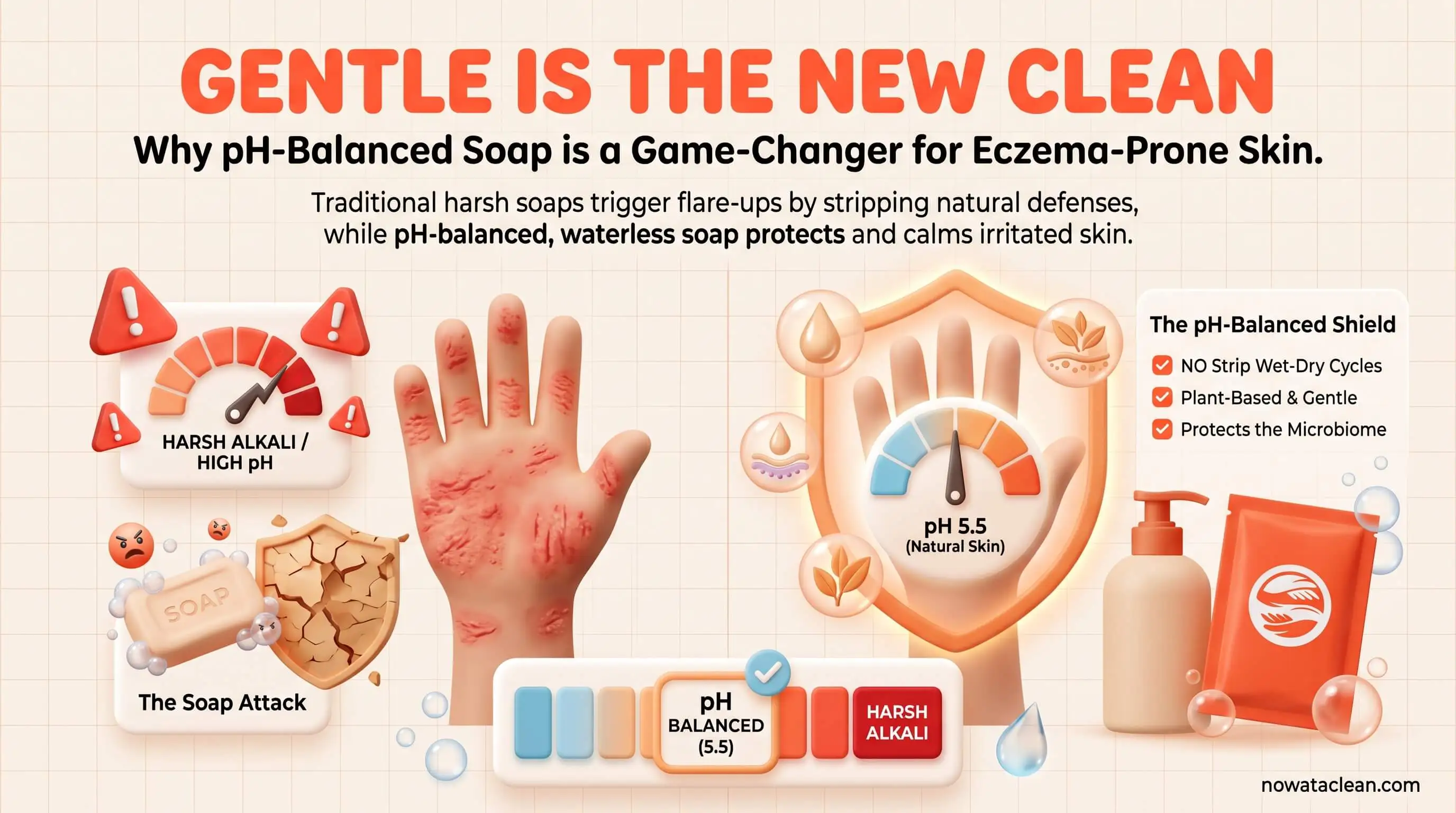
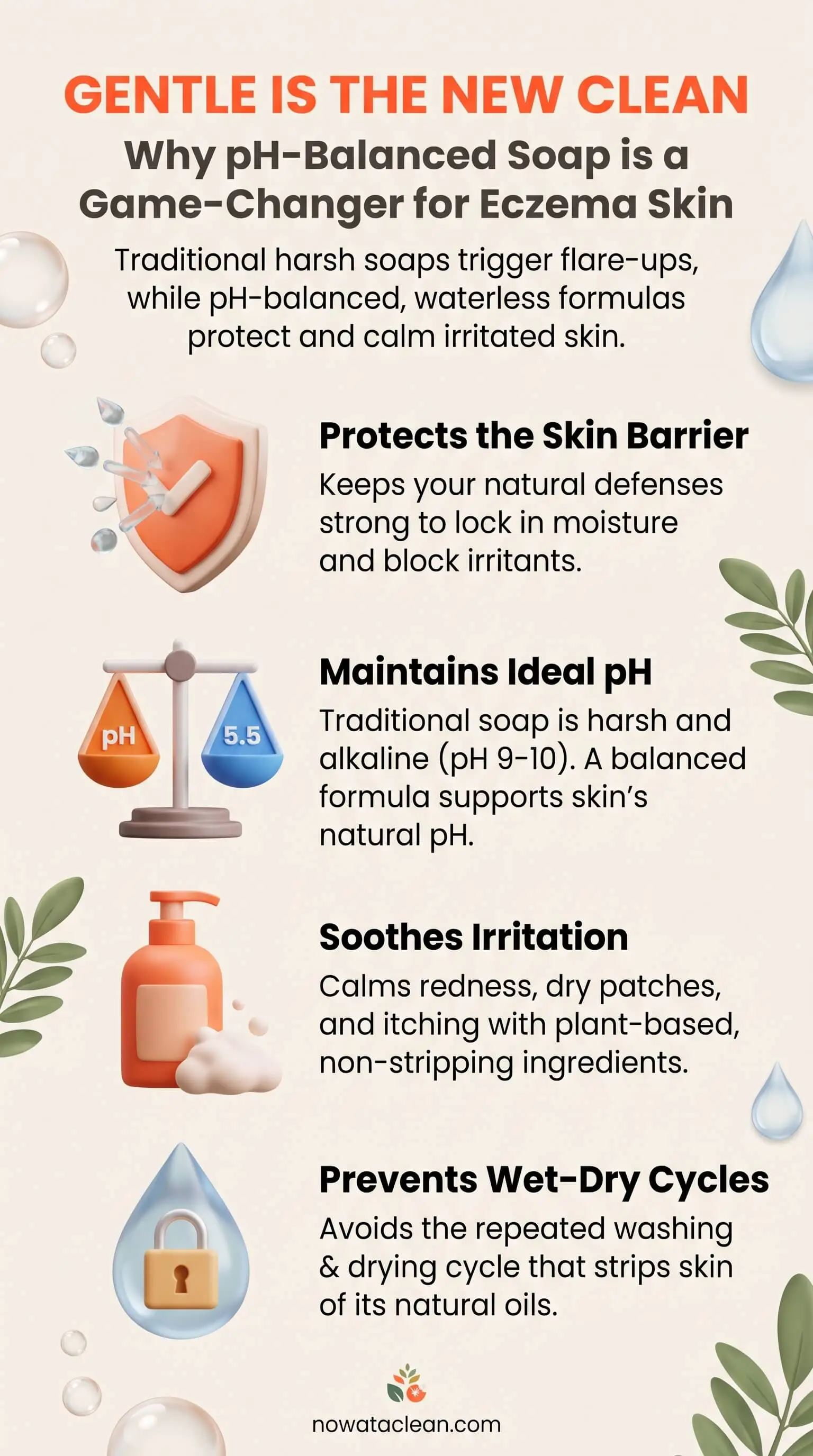
Healthy skin is acidic, at around pH 4.7, and most traditional soap sits near 9 to 10 .
Eczema-prone skin already leans less acidic, so alkaline washing knocks its barrier further off balance and slows repair.
The best hand soap for eczema is pH-balanced and truly fragrance-free, with no sulfates or alcohol.
Because only about 1 in 8 cleansers list their pH, ingredient names like sodium tallowate are your most reliable clue.
Washing 8 to 10 or more times a day raises hand eczema risk by about half, so cutting the washes you don't need counts as much as the soap.
What Eczema Does to Your Skin's Protective Barrier
Eczema is a form of dermatitis, and on the hands it usually shows up as dryness, redness, scaling and splits along the knuckles and fingertips. Underneath those symptoms sits a weakened skin barrier.
Your skin's outer layer, the stratum corneum, works a lot like a brick wall. Skin cells are the bricks, and fats called ceramides hold them together. Over that wall sits the acid mantle, a thin, slightly acidic film that keeps everything stable and gives your skin's friendly bacteria an edge over harmful ones.
Eczema-prone skin runs low on both. It holds less natural moisturizing factor, its lipid mortar is thinner, and water escapes through it faster. Dermatologists call that transepidermal water loss. You'd probably call it the reason your hands feel dry an hour after lotion.
Allergies are part of this story. Eczema, hay fever and asthma often turn up in the same person, a pattern known as the atopic triad, and indoor allergens like dust mites and pet dander can set off flares. That's why cleaner indoor air with air purifiers for allergies helps some people. Whatever touches your hands a dozen times a day matters just as much.
Why pH Matters for Eczema-Prone Hands
Healthy skin surface pH averages about 4.7. Most traditional soaps land between 9 and 10 , and that gap explains why a soap labeled "gentle" can still leave eczema-prone hands worse off.
The pH scale is logarithmic, so each whole number is a tenfold jump. A bar soap at pH 9.7 is roughly 100,000 times more alkaline than skin at 4.7.
When an alkaline wash pushes skin pH up, the enzymes that break down barrier lipids speed up and the ones that rebuild them slow down. Repair after each wash takes longer. The shift also favors Staphylococcus aureus, a bacterium closely tied to eczema flares. Because eczema skin tends to sit less acidic than healthy skin to begin with, every alkaline wash moves it further in the wrong direction.
Tap water adds to the problem. In a 330-person study, researchers found that plain tap water could keep skin pH elevated for up to six hours after washing. Wash 10 times a day and your skin may barely get back to its natural acidity before the next round.
What to Look for in a Hand Soap for Eczema
We'd put pH-balanced and truly fragrance-free at the top of any list for eczema-prone hands. After that, you want a formula without sulfates or alcohol that you can use all day without paying for it later.
Look for:
pH-balanced, or better yet, a stated pH between about 4.5 and 5.5
"Fragrance-free" on the label, since "unscented" products can still contain masking fragrance
No sodium lauryl sulfate (SLS) or sodium laureth sulfate (SLES)
No alcohol
Plant-based cleansers or mild synthetic detergents, called syndets, in place of traditional soap
An ingredient list short enough to read at a glance
Avoid:
True soap ingredients near the top of the label, such as sodium tallowate, sodium cocoate or sodium palmate
Fragrance, parfum or essential-oil blends
Ethanol, isopropyl alcohol and other drying alcohols
Dyes, colorants and triclosan
How common cleanser types compare:
True soap (bar or liquid): Usually alkaline at pH 9 to 10 , it needs a full wash and rinse and often carries added scent. We don't recommend it for eczema-prone hands.
Syndet (synthetic detergent): These often fall between pH 5 and 7 . They still need water, so check the label for fragrance, but they're a solid choice for sink washing.
Rinse-free plant-based cleanser: This type skips water entirely, and fragrance-free versions add no scent. It suits frequent washing at work, at school or on the road.
How to Check a Soap's pH Before You Buy
Only about 1 in 8 cleansers list their pH, and "pH-balanced" isn't a regulated term, so the label won't always help you. When we size up a product, we run through five checks.
Read the first five ingredients. Sodium tallowate, sodium cocoate or "saponified oils" almost always mean true soap, and true soap is almost always alkaline.
Look for a number. A brand that publishes a pH range is giving you something you can verify.
Ask the brand. Customer service or an ingredient FAQ often answers what the label skips.
Test it yourself. Inexpensive pH strips give you a reading on any liquid soap in seconds.
Patch test first. Use a small amount on your inner forearm once or twice a day for several days before switching over.
Managing eczema and diabetes together raises the bar further. This guide to soap for eczema-prone diabetic skin covers that combination in detail.
Washing Habits That Protect Eczema-Prone Skin
A good soap does half the job. The way you wash does the rest, since every wet-dry cycle takes a little more out of a barrier that's already thin.
Use lukewarm water, never hot
Wash for about 20 seconds and stop, because longer scrubbing adds friction without getting hands any cleaner
Pat your hands dry instead of rubbing
Apply a fragrance-free moisturizer within a few minutes, while skin is still slightly damp
Wear gloves for dishes and household cleaning
Skip the washes you don't need
That last habit is the one we spent two years working on. Our kids' hands would start the day looking fine and end it raw, and swapping soaps never broke the pattern because the washing itself was doing the damage. So we built NOWATA, a plant-based soap made without fragrance or alcohol that cleans without water. You rub it onto dry hands until it forms small clumps, then brush them away, and your skin skips another round of tap water and towel friction.
NOWATA won't replace your sink, and it isn't meant to. We keep it for school pickup, the office, road trips and anywhere else a full wash isn't practical.
"We were taught in training that skin's acidity is part of its immune defense. We didn't feel the weight of that until our own kids' hands started cracking. They'd wake up fine, and by dinner their knuckles were raw. The worst days lined up with how often they'd washed, not with what they'd touched. We'd already tried every 'gentle' soap on the shelf, so we stopped asking which one was mildest and started asking why every wash had to work against the skin's chemistry at all. NOWATA came out of that question, and our family used it long before we offered it to yours."
7 Essential Resources
These are the sources we kept open while researching skin pH and eczema. Some come from patient groups and government health agencies, and a few are peer-reviewed studies that reward the extra reading time.
1. National Eczema Association: Hand Eczema
The NEA's hand eczema page walks through how the condition shows up on the hands and wrists, from itching and dryness to blisters and painful cracks. Start here if you're still figuring out what you're dealing with. Source: nationaleczema.org/types-of-eczema/hand-eczema
2. NIAMS: Atopic Dermatitis
The National Institute of Arthritis and Musculoskeletal and Skin Diseases covers what researchers have learned about atopic dermatitis, including the gene changes that weaken the skin barrier. You won't find a product pitch anywhere on it. [VERIFY: link blocked automated checks] Source: niams.nih.gov/health-topics/atopic-dermatitis
3. MedlinePlus: Atopic Dermatitis Self-Care
The National Library of Medicine recommends gentle skin cleansers over traditional soaps, short contact with water and moisturizing while skin is still damp. Its list of infection warning signs is worth bookmarking. Source: medlineplus.gov/ency/patientinstructions/000418.htm
4. Significance of Skin Barrier Dysfunction in Atopic Dermatitis
This peer-reviewed review lays out why barrier breakdown comes first in eczema and how filaggrin, antimicrobial peptides and the skin microbiome each contribute. If you want the science behind gentle cleansing, read this one. Source: pmc.ncbi.nlm.nih.gov/articles/PMC5911439
5. Clinical Insights About the Role of pH in Atopic Dermatitis
A panel of Canadian dermatologists wrote this 2019 consensus paper for the Journal of Drugs in Dermatology. It explains how raised skin pH feeds eczema flares and how cleanser choice can help keep skin at its natural acidity. Source: jddonline.com: Clinical Insights About the Role of pH in Atopic Dermatitis
6. pH of Handwash Products Study
Researchers tested 33 liquid soaps, soap bars and syndets, and the liquids and syndets generally came closer to skin's natural pH than the bars did. It's a useful reality check on how alkaline everyday products can be. Source: pmc.ncbi.nlm.nih.gov/articles/PMC10931849
7. Skin Barrier Integrity After Alkaline Exposure in Atopic Dermatitis
In this Acta Dermato-Venereologica study, repeated contact with alkaline agents damaged the barrier more severely in people with atopic dermatitis than in healthy volunteers. Both groups also lost a significant share of their skin's natural moisturizing factor. Source: medicaljournalssweden.se/actadv/article/view/6448
Read side by side, these sources land where our own experience did, with skin pH as the place to start when you're protecting eczema-prone hands.
3 Statistics
Of everything we read while building NOWATA, these numbers did the most to change how we think about hand hygiene for eczema-prone skin.
Healthy Skin Surface pH Averages About 4.7
Researchers measured forearm skin pH in 330 people before and after a 24-hour break from showering and cosmetics, and estimated that natural skin surface pH averages 4.7. Skin below pH 5 had a stronger barrier, held more moisture and showed less scaling than skin above it. The same team found that plain tap water can raise skin pH for up to six hours after washing. Source: Lambers et al., International Journal of Cosmetic Science, 2006
Only 12.8% of Cleansers Disclose Their pH
In a study presented at the 2024 American Academy of Allergy, Asthma and Immunology Annual Meeting, just 12.8% of marketed cleansers listed their pH. Every true soap the researchers tested came back alkaline, while about 85% of liquid synthetic detergents were acidic. So for most shoppers with eczema, the label simply leaves the most useful number out. Source: The Dermatology Digest
Washing Hands 8 to 10 Times a Day Raises Hand Eczema Risk by 51%
A 2022 meta-analysis of 45 studies in Contact Dermatitis found that washing hands at least 8 to 10 times daily raised hand eczema risk by 51%, and 15 to 20 washes a day pushed it to 66%. Alcohol-based sanitizer showed no significant link to higher risk. That result points straight at the washing routine, which is exactly where we focused when we designed a soap that skips water. Source: Contact Dermatitis, 2022
Final Thoughts
"Use a gentle soap and moisturize afterward" is usually the first advice people with eczema hear, and it has never come with a definition of gentle.
We'd define it this way. Fragrance-free is the minimum. Beyond that, pH matters more than almost anything else on the label, and cutting back on wet-dry cycles matters about as much as the soap you pick. A product that gets those right gives skin a chance to recover between washes instead of starting over every time.
That's the standard we held NOWATA to when we made it for our kids. Skin varies and so do triggers, and we won't pretend one product suits everyone. Still, if you've worked through four or five "gentle" soaps and your hands haven't improved, your skin may simply be reacting to a pH it was never built to handle that often.
Frequently Asked Questions
What pH should hand soap be for eczema?
Aim for a hand soap with a pH between about 4.5 and 5.5, close to the natural acidity of healthy skin. Healthy skin averages around 4.7, so a slightly acidic formula disturbs the barrier far less than traditional soap at 9 to 10 . If the label doesn't give a number, check the ingredients or ask the brand.
Is bar soap bad for eczema-prone hands?
Traditional bar soap is usually alkaline, and it can strip barrier lipids and leave eczema-prone skin drier and more reactive. Syndet bars are a different product, made with synthetic detergents, and they often sit closer to neutral. Sodium tallowate, sodium cocoate or saponified oils near the top of the label tell you it's true soap.
Is pH-balanced the same as fragrance-free or hypoallergenic?
No. pH-balanced describes how acidic a formula is, and fragrance-free means no fragrance was added. Hypoallergenic has no standard regulatory definition at all. For eczema-prone hands, we'd look for a soap that's both pH-balanced and truly fragrance-free.
Can hand sanitizer replace hand soap for eczema?
Sometimes, though not completely. A 2022 meta-analysis found alcohol-based sanitizer wasn't significantly linked to higher hand eczema risk, but alcohol stings cracked skin and won't lift visible dirt. Between sink washes, a rinse-free soap without alcohol or a plant-based organic hand sanitizer can fill the gap.
Does tap water affect eczema-prone skin?
Yes. Tap water usually runs neutral to slightly alkaline, and one study found it can keep skin pH raised for up to six hours after washing. Repeated wet-dry cycles also pull moisture out. Use lukewarm water, keep washes short, pat dry and moisturize right away.
When should eczema-prone hands see a dermatologist instead of trying a new soap?
Book a dermatologist visit if your hands crack, bleed or blister, or if they haven't improved after a couple of weeks on a gentler routine. Warmth, swelling, pus or fever can signal infection and need a doctor sooner. A better soap supports good skin care, but it won't treat eczema.
Choose a Hand Soap That Works With Your Skin's Natural pH
Pick up the soap by your sink tonight and turn the bottle around. Check whether it says fragrance-free and whether it lists a pH anywhere, then look for sodium tallowate or sodium cocoate near the top of the ingredients. If it falls short, your hands have been paying for it one wash at a time.
We made NOWATA for our own children as a plant-based, pH-balanced soap with no fragrance or alcohol, and it cleans without any water at all. It comes with a 30-day satisfaction guarantee, so you can try it on your own hands and see whether clean hands and calm skin can finally coexist.
